Wind in Japanese: 風 (kaze) — writing, readings and words
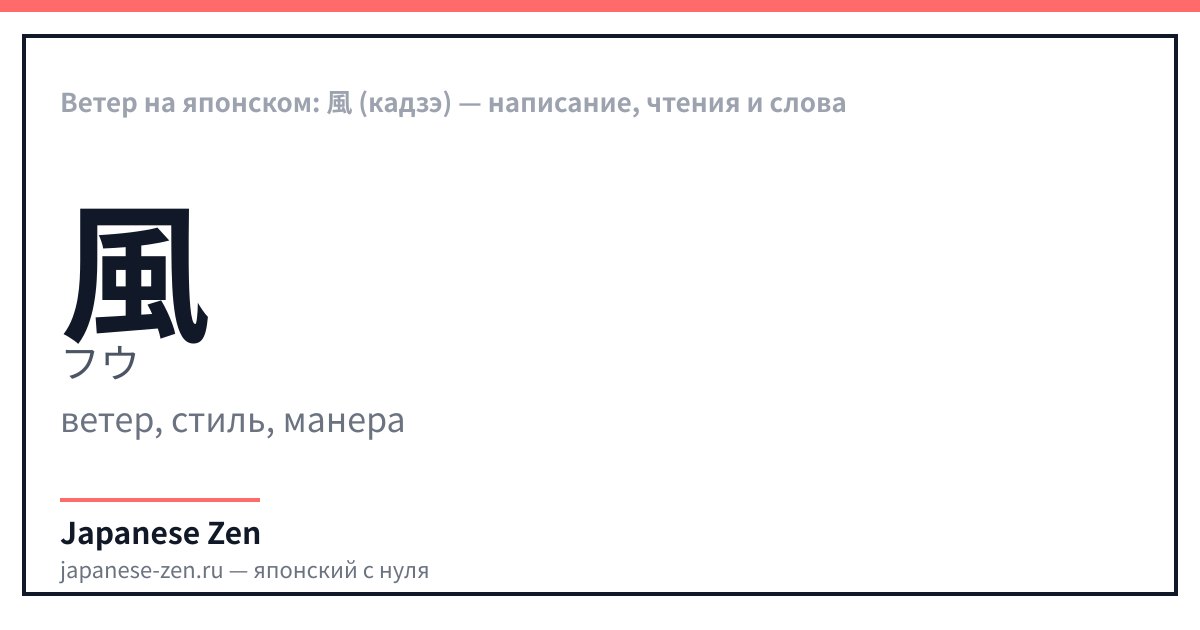
Wind in Japanese is 風 (kaze). The same character and the same reading hide in 台風 "taifū" (typhoon) and 神風 "kamikaze", literally "divine wind". A separate trap for those who learn the word by ear: 風邪 "kaze" means "a cold". The first character is the same, 風, but next to it stands 邪 "evil, wicked", and the whole combination is read as one — the reading "kaze" cannot be derived from the readings of the individual characters.
The same word names both the element and the illness — and there is no typo in that. Far Eastern medicine believed for centuries that a cold enters the body together with a bad flow of air, and the language still preserves this idea in its writing.
The character 風: the readings "kaze" and "fū", and whether there is a rule between them
風 — значение: wind, style, manner — онъёми: フウ、フ — кунъёми: かぜ、かざ- — 9 штрих(ов).
The kun reading as a standalone word, the on reading in compounds
Inside the character hides the element 虫 "insect" — in ancient China wind was associated with winged spirits and dragons, hence this neighborhood. The kun reading "kaze" works as a standalone word: "today there is a strong kaze". The on reading "fū" (sometimes "fu") is heard in Sino-Japanese compounds: 台風 "taifū" — typhoon, 和風 "wafū" — in Japanese style. At the same time 神風 "kamikaze" is assembled from two kun readings — "kami" and "kaze" — although from a pair of kanji one usually expects on readings: "shinpū" also exists and sounds more bookish.
台風, 神風 and the trap 風邪 — three words with the same sound
| Japanese | Reading | Translation |
|---|---|---|
| 風 | kaze · kaze | Wind |
| 台風 | taifū · taifū | Typhoon |
| 神風 | kamikaze · kamikaze | Divine wind (historically — typhoons that drove off the Mongol fleet in the 13th century) |
| 風邪 | kaze · kaze | A cold (sounds like "wind", but is written with different characters) |
| 和風 | wafū · wafū | In Japanese style |
| 風鈴 | fūrin · fūrin | Wind chime |
| 扇風機 | senpūki · senpūki | Electric fan |
Why 風邪 is read "kaze", although there are two characters
風邪 is read as a whole, as one word — "kaze". Such a reading is called jukujikun: it is assigned to the combination, not assembled from the readings of the characters, so neither "fū" nor "ja" is heard in it. The first character here is the same 風 as in "wind", the second is 邪 "evil, wicked". Behind this stands old Eastern medicine: it was believed that illness enters the body together with a cold or bad flow of air. 神風 "kamikaze" got its name from the typhoons of the 13th century that twice thwarted the Mongol invasion; in the 20th century the word was taken for suicide pilot units — that is already another, historical topic, not a linguistic one.
Write 風 yourself
Trace the character 風 along the guides — the system will evaluate each stroke.
FAQ
- How do you say "wind" in Japanese?
- 風 (kaze). The same character and reading appear in 台風 "taifū" (typhoon) and, as a whole kun reading, in 神風 "kamikaze".
- Why does "a cold" 風邪 sound the same as "wind", although it is written differently?
- The word 風邪 is read as a whole as "kaze" — this historically developed from the idea that illness enters the body with a bad flow of air. The second character, 邪, means "evil, wicked".
- What does 神風 literally mean and how did the word become "kamikaze"?
- Literally "神" is "god", "風" is "wind": "divine wind". This was the name for the typhoons that twice thwarted the Mongol invasion in the 13th century; in the 20th century the word passed to suicide pilot units.
- How does 台風 differ from an ordinary strong wind?
- 台風 is a specific weather term, a tropical cyclone of a certain strength over the western part of the Pacific Ocean. A simply strong wind without a cyclone is not called that.
- When do you say 和風, and when 洋風?
- 和風 "wafū" — "in Japanese style" (cuisine, interior, music), 洋風 "yōfū" — "in Western style". Both characters 風 here mean not weather, but manner, style.
Sources
Updated: 2026-09-09