Sky in Japanese: 空 (sora) — Writing, Readings, and Words
Sky in Japanese is 空 (sora). The same character has two more readings with different meanings: "kara" — empty, as in 空手 karate, literally "empty hand," and "kū" — the Buddhist term for emptiness in texts such as the Heart Sutra. One written form holds three layers of meaning, and that is the main story of this character.
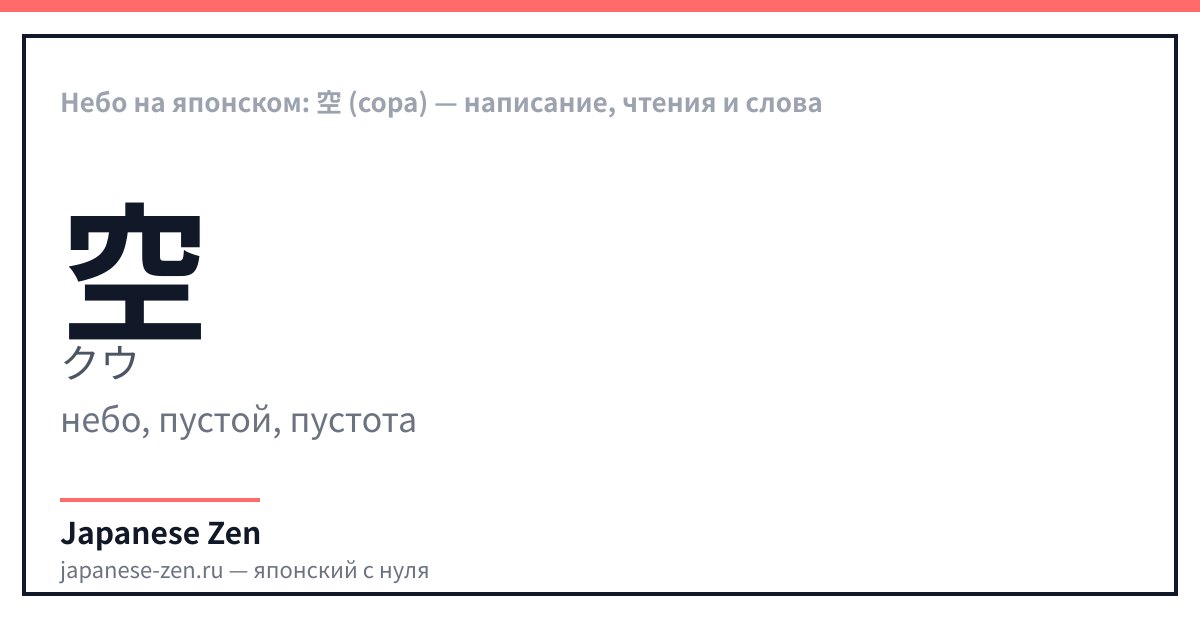
The open space overhead, an empty box, and the emptiness of Buddhist thought — English needs different words for these: sky, empty, emptiness. Japanese manages with a single character, changing only the reading.
One character 空 — three readings and three meanings
空 — значение: sky, empty, emptiness — онъёми: クウ — кунъёми: そら、あ.く、あ.き、あ.ける、から、す.く、す.かす、むな.しい — 8 штрих(ов).
"Sora" — sky, "kara" — empty
"Sora" names the physical sky as space: 空を見る "to look at the sky," 青空 "blue sky." "Kara" is the second kun reading of the same character, but as an adjective or prefix meaning "empty, vacant": 空っぽ "completely empty," 空手 "karate," literally "empty hand" — a martial art without weapons. The link between "sky" and "emptiness" is no accident: in the logic of the language, the sky is the most obvious empty space a person sees.
"Kū" — the third reading and emptiness in the Buddhist sense
| Japanese | Reading | Translation |
|---|---|---|
| 空 | sora · sora | Sky |
| 空手 | karate · karate | Karate (literally "empty hand" — the same "kara" reading as in "empty") |
| 空っぽ | karappo · karappo | Completely empty |
| 空気 | kūki · kūki | Air (the reading "kū," not "sora" and not "kara") |
| 青空 | aozora · aozora | Blue sky (voicing of "sora→zora" in compounds) |
| 空腹 | kūfuku · kūfuku | Hunger (literally "empty stomach") |
| 天気 | tenki · tenki | Weather (here 天, the second word for "sky," is at work) |
空 in the Heart Sutra and why it is not the same as "empty" in kara
The on reading "kū" appears in Buddhist philosophical terms, for example 空 "kū" — the Sanskrit concept of śūnyatā, emptiness as the absence of any permanent, separate essence in any phenomenon. The most famous line of the Heart Sutra, 般若心経, reads 色即是空 "form is emptiness" — there the reading used is precisely "kū," not the everyday "kara" of 空っぽ. The sky also has a second word, 天 — it is more often connected with weather (天気) and with the idea of heaven as a dwelling place, not as visible space.
Write 空 yourself
Trace the character 空 along the guides — the system will score each stroke.
FAQ
- How do you say "sky" in Japanese?
- 空 (sora). The same character has two more readings — "kara" (empty) and "kū" (Buddhist emptiness).
- Is it true that 空 is read "kara" in the word "karate"?
- Yes. 空手 literally means "empty hand" — a martial art that originally uses no weapons. The reading "kara" here is the same as in the word "empty."
- What does the third reading "kū" of the character 空 mean?
- "Kū" is the Buddhist term for emptiness, śūnyatā: the absence in phenomena of a permanent, separate essence. It is this reading that sounds in the line of the Heart Sutra 色即是空.
- How does 空 differ from 天 if both are translated as "sky"?
- 空 is the visible space overhead, the physical sky. 天 is more often connected with weather (天気) and with the idea of heaven as a dwelling place, not as space to look at.
- Why are 空気 (air) and 空腹 (hunger) read with "kū," not "sora"?
- These are Sino-Japanese compounds, and in them the character 空 usually takes the on reading "kū." The kun readings "sora" and "kara" do not appear in such literary words.
Sources
Updated: 2026-09-09