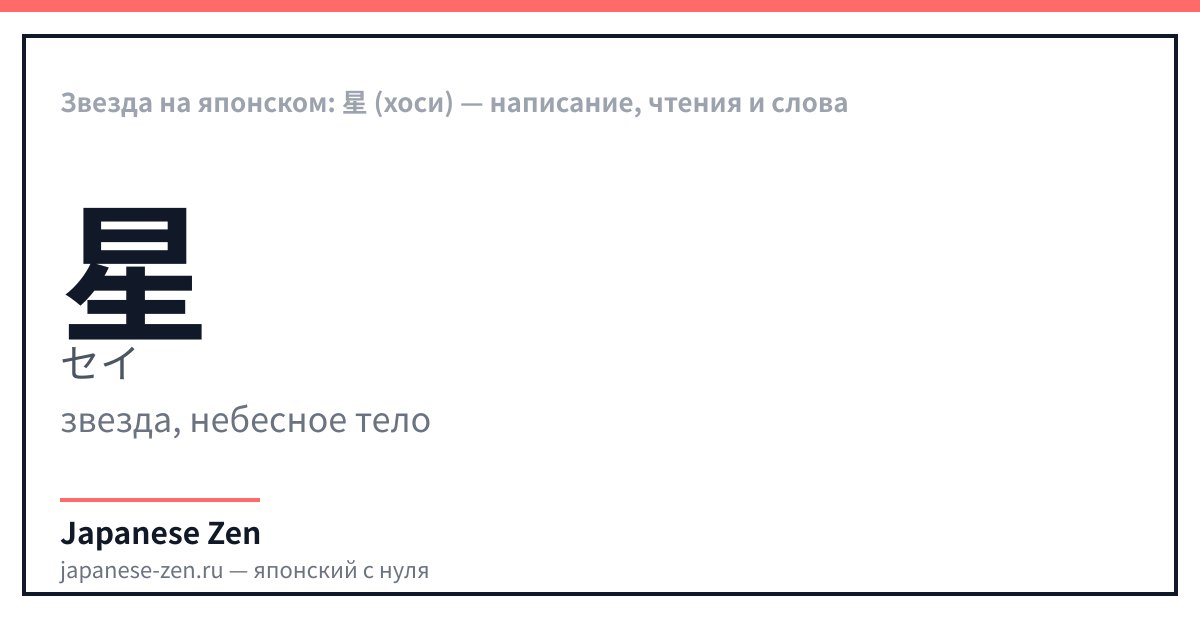
Star in Japanese: 星 (hoshi) — writing, readings, and words
Star in Japanese is 星 (hoshi), a character made of "sun" and "life." The celestial body and the celebrity star are called by different words in Japanese: 星 stays only for the sky, while for celebrities the loanword スター "sutā" is used. A shooting star also has two names: the colloquial 流れ星 and the literary 流星 — same meaning, the difference is only in register.
In English, "star" works equally for a constellation and a singer on a poster. Japanese didn't inherit that metaphor: the sky and fame are called by two different words here, and you can't mix them up.
One character 星, two readings: "hoshi" and "sei"
星 — значение: star, celestial body — онъёми: セイ、ショウ — кунъёми: ほし、-ぼし — 9 штрих(ов).
日+生 — what you can see in the character's composition
The character is composed of 日 "sun, luminary" and 生 "to be born, to live" — in ancient times stars were imagined as living fires in the sky. The kun reading "hoshi" is a standalone word and part of native compounds: 星空 "starry sky," 星占い "astrology." The on reading "sei" appears in Sino-Japanese terms: 星座 "seiza" — constellation or zodiac sign, 衛星 "eisei" — satellite. The two readings are not interchangeable: saying "sei" instead of "hoshi" for a star in the sky is a mistake.
星 and スター: why "star" has two different words
| Japanese | Reading | Translation |
|---|---|---|
| 星 | hoshi · hoshi | Star |
| 星座 | seiza · seiza | Constellation, zodiac sign |
| 流れ星 | nagareboshi · nagareboshi | Shooting star (colloquial variant, literally "flowing star") |
| 流星 | ryūsei · ryūsei | Shooting star, meteor (same phenomenon, but with a literary, scientific reading) |
| 火星 | kasei · kasei | Mars (literally "fire star") |
| 星空 | hoshizora · hoshizora | Starry sky |
| スター | sutā · sutā | Celebrity star (loanword from English; the word 星 is not used in this sense) |
流れ星 and 流星 — the same thing with different readings
For a meteor in the sky, a Japanese speaker might say 流れ星 "nagareboshi" in everyday conversation and 流星 "ryūsei" in the news or a scientific article: same meaning, different register. But for an artist, only スター is used, never 星 — unlike English, where "star" covers both the sky and fame, Japanese has completely separated them. As for Tanabata — the festival where two star lovers meet — here it's enough to know that both are called 星.
Write 星 yourself
Trace the character 星 along the guides — the system will evaluate each stroke.
FAQ
- How do you say "star" in Japanese?
- 星 (hoshi) — for a celestial body. For a celebrity, this word is not used; there is a separate word スター.
- Why is a celebrity star called スター and not 星?
- These are different words, not different meanings of one. 星 is reserved only for celestial bodies; for celebrities, the loanword from English スター "sutā" was adopted.
- How does 流れ星 differ from 流星 if both mean "shooting star"?
- Same meaning, different register. 流れ星 "nagareboshi" is the everyday colloquial variant, 流星 "ryūsei" is the literary, scientific name for the same phenomenon.
- What does 火星 mean and what do stars have to do with it?
- 火星 is Mars, literally "fire star": an old Sino-Japanese name for the planet based on its color, given long before telescopes.
- How are stars connected to the Tanabata festival?
- Tanabata is a festival about the once-a-year meeting of two star lovers. A detailed story about the festival itself is on a separate page; here we stay with the words.
Sources
Updated: 2026-09-09