Mountain in Japanese: 山 (yama) — writing, readings and words
Mountain in Japanese is 山 (yama), 3 strokes. The character is a pictogram of three peaks and has barely changed since ancient forms of writing. The kun reading "yama" appears in everyday words and surnames, while the on reading "san" appears in mountain names. That is also where Fuji-san comes from: here "san" is the reading of the character for "mountain", not a polite suffix. Almost everyone who has learned the address "Tanaka-san" falls into this trap.
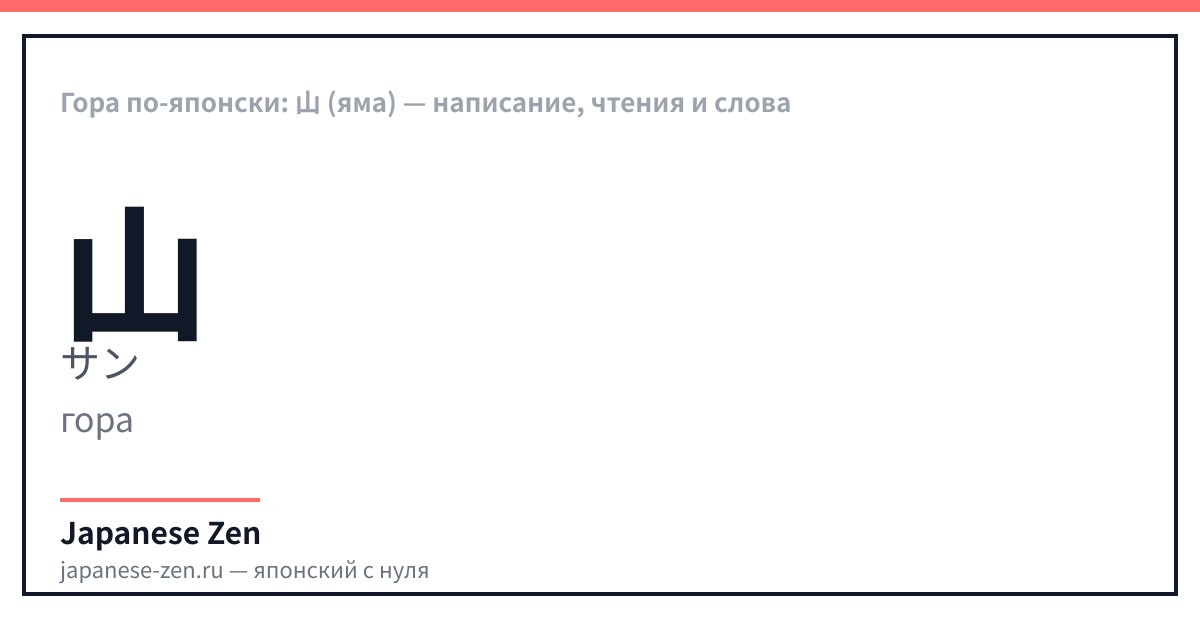
Fuji-san is not "honorable Fuji". The coincidence with the polite address is accidental: in the mountain's name, "san" is the on reading of the same kanji 山 that also writes the ordinary word "yama".
How the character 山 is built
山 — значение: mountain — онъёми: サン、セン — кунъёми: やま — 3 штрих(ов).
Three peaks and two readings
山 draws three peaks: the middle stroke is higher than the side ones, like the central summit of a mountain range. This is one of the oldest kanji — in ancient forms of writing on bones and shells it looked almost the same. The character has two main readings: the kun reading "yama" — in the standalone word and in surnames, and the on reading "san" — when 山 stands after the name of a specific mountain, as part of a proper name.
Fuji-san and other words with 山
| Japanese | Reading | Translation |
|---|---|---|
| 山 | yama · yama | Mountain (kun reading, standalone word) |
| 富士山 | Fujisan · Fujisan | Mount Fuji ("san" is the on reading of the character for "mountain", not a politeness suffix) |
| 山田 | Yamada · Yamada | Surname meaning "mountain field" |
| 山本 | Yamamoto · Yamamoto | Surname meaning "base of the mountain" |
| 登山 | tozan · tozan | Mountain climbing (on reading of 山 in a compound) |
| 火山 | kazan · kazan | Volcano (literally "fire mountain") |
Where the confusion with the polite "san" comes from
The coincidence in sound trips up almost everyone who started learning Japanese with forms of address like "Tanaka-san". The polite suffix -さん is written in hiragana and has nothing to do with the character 山. In mountain names, the reading of the kanji 山 itself is used: 富士山 — "Fujisan", 阿蘇山 — "Asosan". There is no uniform rule here: for some mountains the same character is read "zan" (比叡山 — "Hieizan"), for others it remains the kun reading "yama" (立山 — "Tateyama"). The one thing they share is that this is a reading of the kanji, and it is always written with kanji, not with the hiragana of the suffix.
Write 山 yourself
3 strokes: the middle vertical first, then the side peaks from left to right.
FAQ
- How do you say "mountain" in Japanese?
- 山 (yama), only 3 strokes. It is a pictogram of three peaks — one of the oldest kanji, almost unchanged since the times of ancient writing.
- Why is Fuji called "Fuji-san" if "san" is a polite suffix?
- The coincidence is accidental. In the mountain's name, "san" is the on reading — that is, of Chinese origin — of the kanji 山 "mountain", not the politeness suffix -さん used to address people. They are written differently: with the kanji in one case and with hiragana in the other.
- What other readings does the character 山 have besides "yama"?
- The on readings are "san" (in mountain names: Fujisan) and "zan"/"zen" in some words like 登山 "tozan", climbing. The kun reading "yama" is used when naming a mountain on its own or forming surnames — Yamada, Yamamoto.
- Are all Japanese mountains called with "-san"?
- No. Even among the on readings there are two: 富士山 — "Fujisan", while 比叡山 — "Hieizan". And for some mountains 山 remains the kun reading "yama": 立山 is read "Tateyama". The choice is historically fixed to a specific name; there is no single rule — it is memorized together with the mountain's name.
- Why is a volcano "fire mountain" in Japanese?
- 火山 (kazan) is literally made up of "fire" and "mountain": the word describes the phenomenon directly, without a separate borrowed term, as often happens in a language with an early layer of words of Chinese origin.
Sources
Updated: 2026-09-09