Mount Fuji: Height, History, and Why It's Not "Fujiyama"
Mount Fuji is an active volcano on the border of Shizuoka and Yamanashi prefectures and the highest point in Japan: 3,776 meters. It last erupted in 1707, and in 2013 UNESCO inscribed it as a World Heritage cultural site — "Fujisan, sacred place and source of artistic inspiration" — not a natural one. In English the mountain is sometimes called "Fujiyama," but the Japanese themselves say "Fujisan."
Much of what people know about Fuji is secondhand: some think it's extinct, others are sure it's visible from Tokyo every day. Let's go over the exact height and date of the last eruption, the origin of the word "Fuji," which remains unsolved, the mountain's role in Shinto rites, and how it ended up in Hokusai's prints and on the old 1,000-yen banknote.
Fuji in Numbers: Volcano, Height, UNESCO
Fuji's height is 3,776 meters: it is the highest point in Japan and the country's tallest volcano. The mountain stands on the border of Shizuoka and Yamanashi prefectures and is considered an active stratovolcano, though it last erupted in 1707 — the Hōei eruption, one of the three largest in its history. In 2013 UNESCO inscribed Fuji as a World Heritage cultural site under the name "Fujisan, sacred place and source of artistic inspiration." The mountain does not have natural-site status: what was registered is specifically a cultural landscape, including the five lakes at its base — the Fujigoko.
Can You Climb Mount Fuji?
The official climbing season is summer, when mountain huts are open and trails are marked; the rest of the year the slope is closed for organized climbing and is dangerous because of snow and wind. Most routes start not from the base but from the "fifth station" — a platform roughly halfway up the mountain, reachable by bus or car.
How "Fuji" Is Written: Ateji Without a Solution
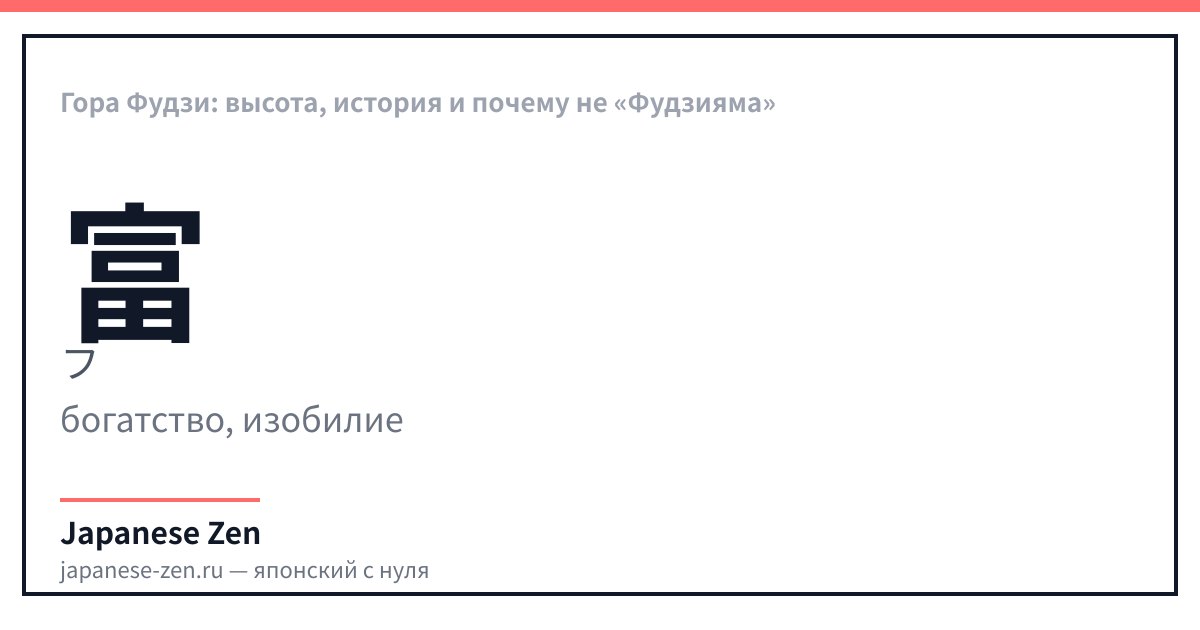
富 — значение: wealth, abundance — онъёми: フ、フウ — кунъёми: と.む、とみ — 12 штрих(ов). 富 — "wealth": the first of the two characters in 富士山. The kanji for Mount Fuji were chosen for their sound, not their meaning, so "wealth" has nothing to do with the mountain itself — except perhaps to emphasize its grandeur in the eyes of those who chose the spelling.
富士山 is ateji: the characters 富 "wealth" and 士 "warrior, man" were chosen to match the sound of the word "Fuji," not its meaning. The word itself existed before this spelling: in old sources the mountain was also called 福慈岳, 不二山 ("mountain without a pair"), and 不尽山 ("inexhaustible mountain"). Where the word "Fuji" itself came from is not known for certain: in the 19th century an Ainu version was proposed — from a word meaning "mountain breathing fire" — but modern linguists dispute this hypothesis and attribute it to a translation mix-up. There are other, less known versions of the word's origin, and none of them has been proven.
| Japanese | Reading | Translation |
|---|---|---|
| 富士山 | Fujisan · Fujisan | Mount Fuji |
| 富士 | Fuji · Fuji | Fuji without the word "mountain" |
| 山頂 | sanchō · sanchō | Mountain summit |
| 登山 | tozan · tozan | Mountain climbing |
| 初日の出 | hatsuhinode · hatsuhinode | First sunrise of the year |
| 一富士二鷹三茄子 | ichi-Fuji ni-taka san-nasubi · ichi-Fuji ni-taka san-nasubi | A proverb about good luck in the first dream of the year (literally "first Fuji, then a hawk, then an eggplant") |
Fuji or Fujiyama: Which Is Correct
"Fuji-san" is not presumptuous and not addressing the mountain as a person: "san" here is not a politeness suffix but the reading of the kanji for "mountain" itself. "Fujiyama" is not a mistake but a form that took hold outside Japan in translations and on 19th-century maps; the Japanese themselves, when naming the mountain, more often say "Fujisan" or simply "Fuji."
Write 富 along the guides — the first character in the spelling of Mount Fuji, "wealth."
Fuji as a Sacred Site: Gods, Pilgrims, Prints
Fuji has long been considered a Shinto sacred site: the mountain's deity is identified with the goddess Konohanasakuya-hime, patroness of blossoming and childbirth. Shrines called Sengen are dedicated to her — there are about 1,300 of them across Japan, and the main one, Fujisan Hongū Sengen Taisha, stands at the southern foot of the mountain, in the city of Fujinomiya.
From the Edo period, organized Fuji-kō pilgrimage groups climbed the mountain — laypeople who revered Fuji as a sacred site and made the ascent together, forming their own brotherhoods with shared rites.
In art, Fuji was made famous by Katsushika Hokusai in his series "Thirty-six Views of Mount Fuji." The mountain is still considered a lucky sign today: seeing it in a dream on New Year's night means good fortune, hence the proverb "ichi-Fuji ni-taka san-nasubi" — "first Fuji, then a hawk, then an eggplant." And on the 2004-series 1,000-yen banknote, which was in circulation until the new series was issued in 2024, Fuji is depicted on the reverse along with blooming cherry blossoms.
Fuji and Sakura: Symbols or Postcards?
On the old banknote the mountain and the cherry blossoms appear side by side in a single frame, which encourages people to see them as interchangeable postcard symbols of Japan. In fact they speak of different things: sakura is an image of transience — its bloom lasts a week and falls at its peak — while Fuji, by contrast, is a symbol of permanence: the same mountain that stood a thousand years ago.
Myths About Fuji: An Extinct Volcano and a Mountain Without Doubles
- "The correct way to say it is 'Fujiyama,' and 'Fujisan' is a polite substitute." It's the opposite: the Japanese themselves call the mountain "Fujisan" or simply "Fuji," while "Fujiyama" is a form that spread outside Japan and is almost never heard in spoken Japanese.
- "Fuji is an extinct volcano." No, geologists consider it an active volcano with a long period of dormancy: its last eruption was in 1707, not in the distant past.
- "Fuji is visible from Tokyo every day." Only in clear weather without haze or smog — most often in winter, when the air is drier; in summer the mountain is hidden in clouds for weeks.
- "Fuji is a unique name; there is no second mountain like it." All over Japan, conical mountains resembling it are called "such-and-such Fuji" — at least 340 such names are counted, and this is a separate tradition, not confusion in guidebooks.
FAQ
- What is the height of Mount Fuji?
- 3,776 meters — that is the official height of the summit, the highest point in Japan. The geodetic marker on the Kengamine peak shows slightly less, 3,775.56 meters, while the mountain's highest point, a rock outcrop next to it, is 3,776.12 meters; rounded, this is the familiar "3,776." The mountain stands on the border of Shizuoka and Yamanashi and on a clear day is visible for tens of kilometers.
- Is Fuji an active volcano?
- Yes, geologists classify it as an active stratovolcano, although it has not erupted for a long time — the last eruption was in 1707. A long dormancy is not the same as an extinct volcano: for volcanologists these are different categories, and Fuji's status has not been revised since.
- Which is correct: Fuji or Fujiyama?
- The Japanese themselves say "Fujisan" or "Fuji": "san" here is the reading of the kanji for "mountain," not a politeness suffix. "Fujiyama" is a form that took hold outside Japan and is almost never heard in spoken Japanese.
- When did Fuji last erupt?
- In 1707, during the Hōei eruption — one of the three largest in its entire history. At that time volcanic ash reached Edo, present-day Tokyo — about 100 kilometers from the mountain. No new eruptions have been recorded since, but geologists continue to consider the volcano active.
- Why is Fuji a sacred mountain?
- In Shinto belief, the mountain is associated with the goddess Konohanasakuya-hime, and hundreds of Sengen shrines across the country are dedicated to her. From the Edo period, organized Fuji-kō pilgrimage groups climbed to the summit.
- How is "Fuji" written in kanji?
- 富士山, or shorter 富士: both the full and the short spelling use the same two characters, "wealth" and "warrior, man." This is ateji — kanji chosen for their sound rather than their meaning, so "wealth" is not directly connected to the mountain itself.
Sources
Updated: 2026-09-14