Aokigahara — a forest on frozen lava at the foot of Fuji
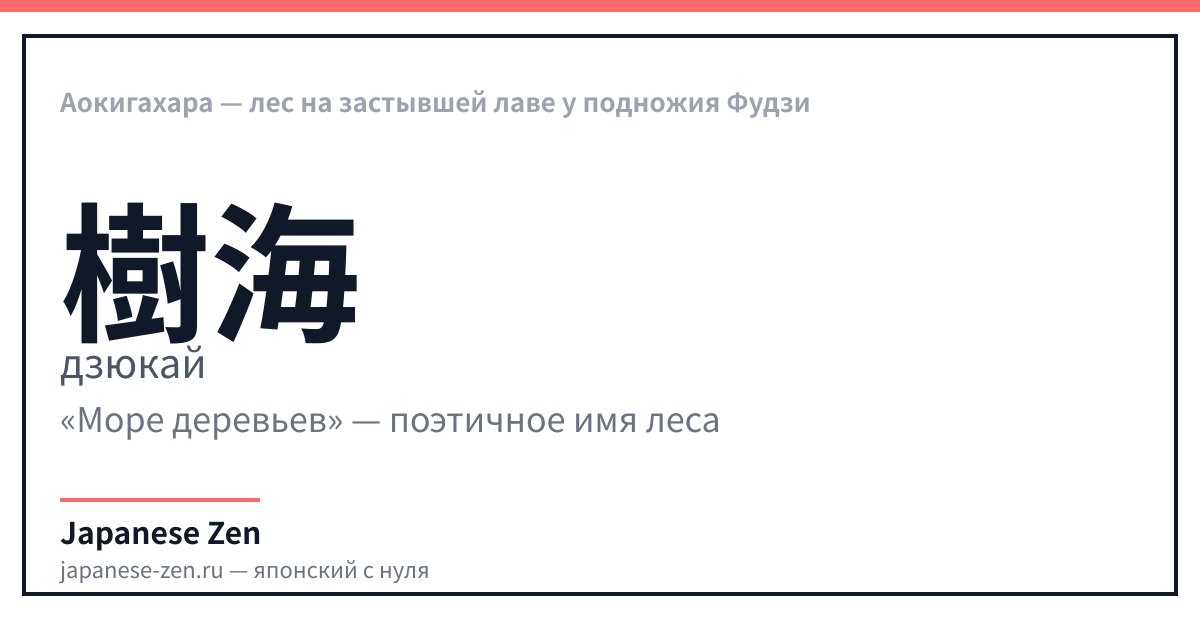
Aokigahara is a forest in Japan around which a dense legend has grown, overshadowing simple facts: it is a lava plateau at the foot of Fuji, where a thick forest rose over centuries on the bare stone of the 864 eruption. The place's second name is 樹海, 'sea of trees': from the mountain, the canopy merges into a solid green surface. A compass near the frozen lava can indeed deviate slightly due to iron in the rock, but the talk of complete loss of orientation greatly exaggerates the effect.
More myths are told about Aokigahara than about the volcano at its foot. Below is what is actually there: stone, trees, and a bit of iron in the soil.
Aokigahara: a lava plateau, not just a forest
Aokigahara (青木ヶ原) is a forest on the northwestern slope of Fuji, grown on a bare basalt plateau: lava flowed during the 864 eruption and spread over almost 30 square kilometers, and the forest rose on it later, over the centuries. The forest also has a poetic second name — 樹海, jukai, 'sea of trees': from the mountain, the canopy truly merges into a solid green surface without a single gap.
| Japanese | Reading | Translation |
|---|---|---|
| 樹海 | jukai · jukai | 'Sea of trees' — the poetic name of the forest |
| 溶岩 | yōgan · yōgan | Lava |
| 森 | mori · mori | Forest, grove |
| 洞窟 | dōkutsu · dōkutsu | Cave |
| 磁石 | jishaku · jishaku | Compass, magnet |
How to translate this without losing the meaning
'Aokigahara' is a toponymic name of the place, and 樹海 is not so much a translation as a nickname from above: the forest was named this way for the view from above, when the canopy closes into an even green carpet. Both names appear in guidebooks and texts, and they mean the same place.
樹海: the kanji that make up 'sea of trees'
樹海 is composed of two characters: 樹 'tree' and 海 'sea'. The combination works as a metaphor: the forest is so even and dense that from above it truly resembles the sea surface, only green. The kanji 樹 is less frequent than the simpler 木 'tree' — it is more literary and usually denotes a living, growing tree, not a forest or material.
What parts make up the character 樹
On the left of 樹 is the 'tree' radical 木, on the right is a phonetic element responsible for the reading. The same radical 木 is recognized in dozens of other characters about plants and materials — from 林 'grove' to 材木 'timber, building material'.
樹 — значение: tree, growing tree — онъёми: ジュ — кунъёми: き — 16 штрих(ов). 樹 — 'tree': on the left is the radical 木, on the right is the phonetic part. A more literary synonym of the simple 木, usually about a whole living tree, not about timber.
Write 樹 along the guides and study the stroke order.
What is most often misunderstood
- 'The compass doesn't work there at all.' An exaggeration: the frozen lava contains a lot of iron, and the needle can indeed deviate slightly near the rock, but there is no talk of complete loss of orientation.
- 'Aokigahara is the slope of Fuji itself.' Not quite: the forest grows at the foot of the mountain, on a flat lava plateau, not on its slopes or summit.
- 'It's an untouched thicket without a single path.' The forest has marked hiking trails and natural attractions — for example, the Narusawa Ice Cave and the Fugaku Wind Cave, both lava tunnels from the same 864 eruption.
- 'The whole point of visiting there is its dark fame.' The forest does have a heavy reputation, and Japanese authorities have repeatedly asked not to turn it into a tourist attraction; from a geological and natural standpoint, the place is interesting primarily for its lava terrain and caves.
FAQ
- What does 'Aokigahara forest' actually mean?
- Aokigahara is a forest on frozen lava at the foot of Fuji: it grew on the plateau left after the 864 eruption. The forest's second, more poetic name is 樹海 (jukai), 'sea of trees'.
- How is the word 樹海 translated?
- 樹海 is composed of 樹 'tree' and 海 'sea' — together it gives 'sea of trees'. The name describes the view of the forest from above: the canopy merges into an even green surface.
- Where did the forest on bare lava come from?
- In 864, a major eruption occurred on the northwestern slope of Fuji, lava spread over almost 30 square kilometers and froze into a bare plateau. The forest rose on this stone later, over the centuries.
- Is it true that the compass acts up there?
- The effect is real but modest: the lava contains a lot of iron, and the compass needle near the rock can deviate slightly. There is no talk of complete loss of orientation, as is sometimes told.
- Are there caves and routes for tourists in Aokigahara?
- Yes: the forest has marked hiking trails and lava caves — for example, the Narusawa Ice Cave and the Fugaku Wind Cave, both formed by the same 864 eruption.
- Why does the forest have such a dark reputation?
- The forest does have a heavy reputation in popular culture, and Japanese authorities have repeatedly asked not to turn it into a tourist attraction. From a geological standpoint, the place is interesting primarily for its lava terrain and caves.
Sources
Updated: 2026-09-09