Hanako-san — the legend of the spirit in the school toilet
Hanako-san (トイレの花子さん) is a school legend about the spirit of a girl who waits in the third stall on the third floor: knock three times, ask "Hanako-san, are you there?" — and, according to the legend, you will hear a quiet "yes." The story took shape in postwar Japan, peaked in the 1980s–1990s, and the name Hanako is simply one of the most common Japanese female names of the last century.
Of all the spirits in school folklore, Hanako-san has the clearest address: a specific floor, a specific stall. Beyond that, the variants begin — but the opening is almost always the same.
The spirit who waits in the third stall
Hanako-san is the spirit of a girl who, according to legend, inhabits the third stall of the school toilet on the third floor. The classic ritual: knock on the door three times and ask "Hanako-san, are you there?" (花子さん、いますか). If a quiet "yes" comes from behind the door and the door opens a crack — according to the legend, it's best not to go further.
- Where to look: the third stall, the third floor — in most versions, that's it.
- The ritual: three knocks and a question about whether she is inside.
- The answer: a quiet child's voice says "yes."
- Age of the figure: a girl of elementary school age, almost always unnamed in descriptions of her appearance.
Is this a scary story or actually dangerous?
Functionally, this is closer to a game of courage than to a legend about attacks: children "harmed by Hanako-san" are not found in the sources. The ritual is set up as a test of oneself — knock, ask, don't run away too soon — and in this it resembles other "spirit summonings," only set in a Japanese school.
トイレの花子さん: a name that literally gives the address
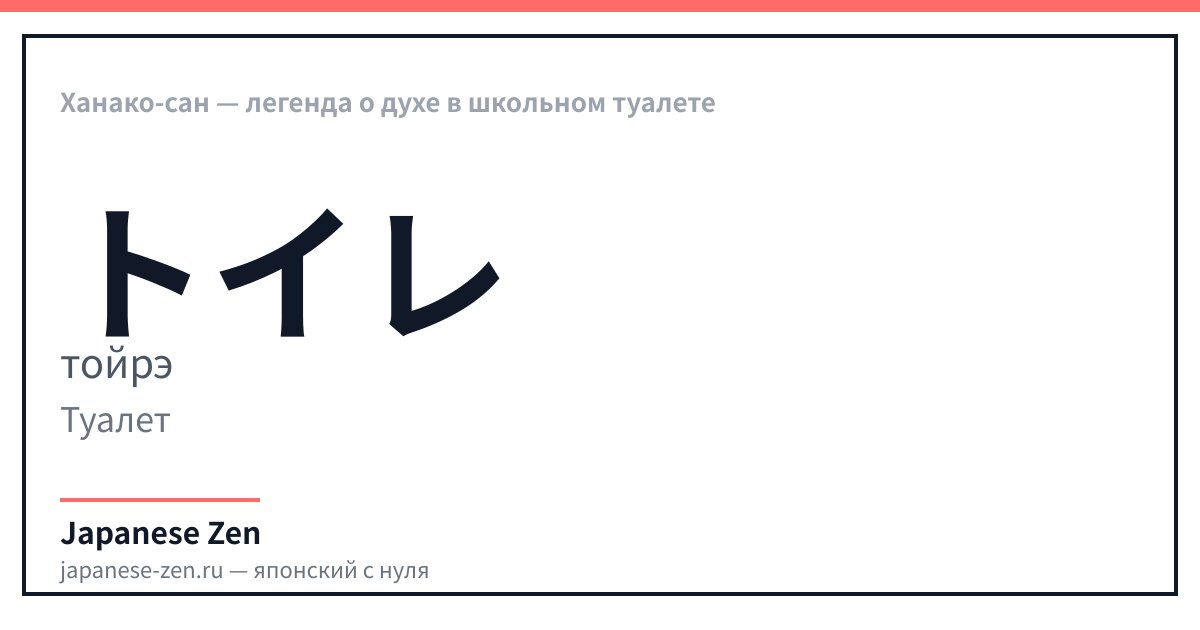
The name is extremely simple: トイレ "toilet" (a borrowing from English), の — the possessive particle, 花子さん — "Hanako-san," an ordinary Japanese female name with the polite suffix さん. Literally — "Hanako of the toilet": here the language works not as a riddle but as a place marker.
| Japanese | Reading | Translation |
|---|---|---|
| トイレ | toire · toire | Toilet |
| 花子 | Hanako · Hanako | Hanako — a female name, literally "flower child" |
| 花 | hana · hana | Flower |
| 子 | ko · ko | Child |
| 階 | kai · kai | Floor, story |
Why Hanako and not some other name
Hanako is one of the most common Japanese female names of the 20th century, something like an unnamed heroine in a counting rhyme. Such a name does not point to a specific person — it works as "any girl," and it is precisely this anonymity that makes the legend easy to carry from school to school.
花 — значение: flower, blossom — онъёми: カ、ケ — кунъёми: はな — 7 штрих(ов). 花 — "flower": the radical "grass" 艹 on top, a phonetic element below. The same character appears in 花見 "flower viewing" and 花火 "fireworks."
Write 花 along the guides and work through the stroke order.
Hanako-san history: from postwar schools to the 1980s peak
Researchers find the first traces of the legend in the 1950s — when Japanese schools were being built en masse after the war, and stories about spirits in new buildings spread quickly. The real peak came in the 1980s–1990s: that is also when the most local versions with different floors and stalls appeared. The legend has no single source — it is classic folklore without an author, and the versions of Hanako's origin (died during the war, was the victim of an accident, committed suicide) are unconfirmed and essentially contradict each other.
From a school scare to "Toilet-Bound Hanako-kun"
- "Hell Teacher Nube" — the second episode is entirely devoted to Hanako-san appearing in the school where the hero works.
- "Toilet-Bound Hanako-kun" (地縛少年花子くん) — the manga has been running since 2014, the anime since 2020, where the toilet spirit is not a girl but a boy; the story is no longer horror but a comedic drama about spirits.
How a scary story turned into a romantic tale
"Toilet-Bound Hanako-kun" keeps only the outer frame — the toilet, the spirit, the summoning ritual — while inside it tells a story of friendship and growing up. This is the usual path of a long-lived urban legend: first it scares, then it becomes material for a completely different genre.
FAQ
- What spirit is hidden behind the name Hanako-san?
- The spirit of a girl from Japanese school folklore who, according to legend, inhabits the third stall of the toilet on the third floor. The classic ritual is to knock three times and ask if she is there.
- What does "Hanako-san" mean?
- 花子さん is an ordinary Japanese female name (花子, literally "flower child") with the polite suffix さん. In the legend's name, トイレの "of the toilet" is added to it — a reference to the place, not part of the name itself.
- How is the name Hanako-san written in Japanese?
- In full — トイレの花子さん, "Hanako of the toilet." トイレ is the borrowed word "toilet," 花子 is the name itself, さん is the polite address.
- Where did the legend of Hanako-san come from?
- The first traces date to the 1950s, and the legend gained mass fame in the 1980s–1990s. The story has no single author and no confirmed origin — the versions of Hanako's death (war, accident, suicide) contradict each other.
- How does "Toilet-Bound Hanako-kun" differ from the original legend?
- In the 2020 anime based on the manga that has been running since 2014, the toilet spirit is not a girl but a boy, and the genre is not horror but a comedic drama about spirits and friendship. Only the outer frame remains from the legend: the toilet, the summoning ritual, the name.
- In which stall should you look for Hanako-san?
- In most versions — the third stall on the third floor of the school building, but local retellings have also named other floors: the legend has no single canon.
Sources
Updated: 2026-09-09