Yūrei — the kinds of ghosts in Japanese mythology
Yūrei is the general Japanese word for the spirit of a dead person, and Japanese mythology divides such spirits into subtypes: the vengeful onryō, the drowned funayūrei, the woman who died in childbirth ubume, and the jibakurei bound to a place. Each has its own reason to stay and its own way of making itself known. They are easier to tell apart by the circumstances of death than by appearance.
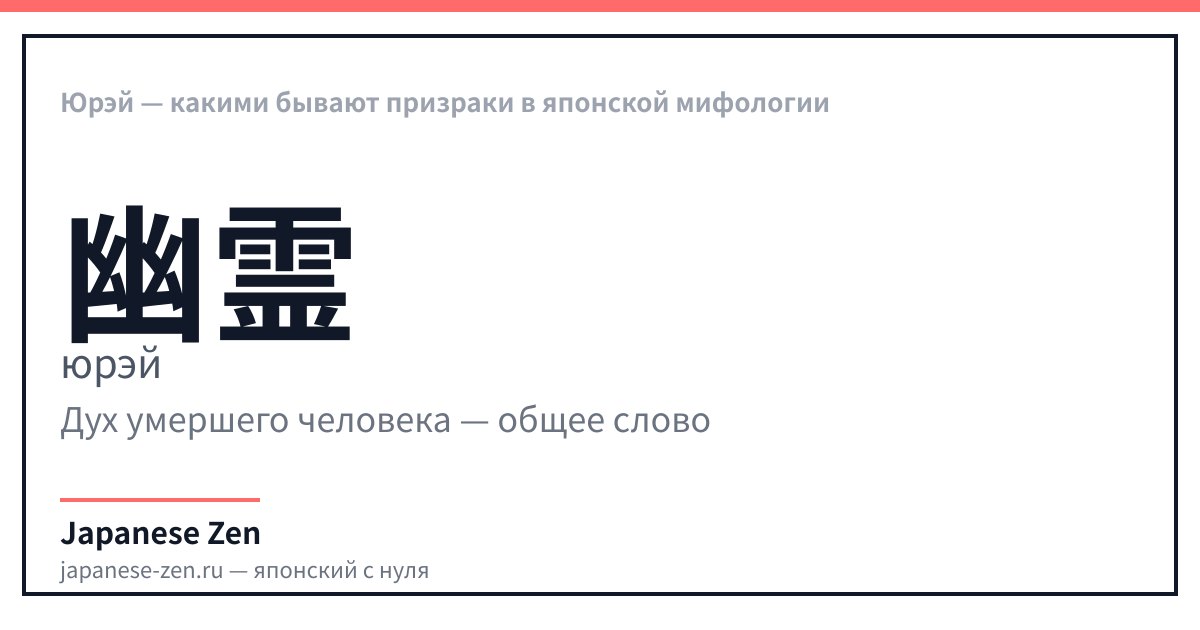
Asking "what does a yūrei look like" is like asking "what does a relative look like": it depends which one. Each subtype of spirit has its own biography, not one and the same white burial kimono for all.
A ghost is not one species but a family tree
Yūrei is the soul of a dead person that could not rest and remained among the living. It is not a diagnosis but an umbrella: it covers spirits with completely different motives and habits. People began distinguishing them long ago, already in the theater and painting of the Edo period, and the division has survived to this day.
| Type | Who it is | Why it does not leave |
|---|---|---|
| Onryō | a vengeful spirit with a specific offender | died from injustice and will not rest until it takes revenge |
| Funayūrei | the spirit of a drowned sailor | asks the living for a ladle, and once given one, sinks the boat with water |
| Ubume | the spirit of a woman who died in childbirth | asks passersby to hold her swaddled baby |
| Jibakurei | a spirit bound to the place of death | cannot or will not leave the house, crossroads, or field |
What all four have in common, for all their differences
The mechanism is the same: the death was wrong — sudden, unjust, or not lived through to the end — and the passage to the world of the dead was not completed. Hence the common recipe of Japanese folklore: not exorcism but the completion of an interrupted matter — revenge, recognition, a proper funeral, forgiveness.
- Onryō most often serves as the basis for revenge plots: for example, in the anime "Hell Girl" the action itself is built on a ritual for summoning such a spirit.
- Ubume and jibakurei are less often the heroes of big titles — you are far more likely to meet them in local legends and in the kaidan genre than on a poster.
幽霊 among its dictionary neighbors
| Japanese | Reading | Translation |
|---|---|---|
| 幽霊 | yūrei · yūrei | The spirit of a dead person — the general word |
| お化け | obake · obake | A shapeshifter, a colloquial word broader than yūrei: it covers both spirits and reanimated animals |
| 妖怪 | yōkai · yōkai | A supernatural being in general — many yokai were never human |
| 霊 | rei · rei | Spirit, soul — the root of the word, also used separately when speaking of the living |
| 地縛霊 | jibakurei · jibakurei | A spirit bound to a place — a modern term, not strict classical lore |
Why the card shows 幽 and not just 霊
霊 by itself means "spirit, soul" and refers not only to the dead — it also appears in words about intuition and about nature spirits. But 幽 adds precisely the trait that makes a yūrei a yūrei: dimness, half-hiddenness, a step away from the world of the living but not yet a full departure from it.
幽 — значение: dim, hidden, otherworldly — онъёми: ユウ — кунъёми: ふか.い、かす.か、くら.い、しろ.い — 9 штрих(ов). 幽 — "dim, barely visible, otherworldly": the same character appears in 幽玄 (yūgen, the aesthetic of the unspoken) and 幽体離脱 (out-of-body experience).
Trace 幽 along the guides and work through the stroke order.
Obon and summer — the season when spirits are closest
Yūrei also have a calendar: ancestral spirits are said to return home during Obon, the summer festival of remembrance. Families light a fire to show the way home, and at the end of the festival to see them back, and in some regions they float paper lanterns on the water. These very weeks are also the peak season for tales of encounters with spirits.
Why such stories are a summer habit
The logic is simple and practical: the chill down the spine from a good story took the place of a fan in the heat, back when air conditioning was out of the question. The genre of supernatural tales itself — kaidan — has its own rules, its own classics, and the same summer season.
The canon of appearance: recognized at a glance
A white burial kimono, disheveled black hair, and no legs — a recognizable silhouette that took shape in Japanese painting not at once and not by chance, but largely thanks to one eighteenth-century artist. But which yūrei is before you and why it stayed matters far more than how it looks on the outside.
- The classic revenge plot — Oiwa from the play "Yotsuya Kaidan," one of the most famous onryō figures in Japanese culture.
- The modern game canon of onryō also continues the anime genre of curses: the very premise of "Hell Girl" is a direct development of the idea of purposeful revenge from beyond the grave.
FAQ
- Who exactly is a yūrei?
- A yūrei is the soul of a dead person that could not rest and remained among the living. It is a general word: it covers spirits with different reasons to stay and different habits.
- What types are yūrei divided into?
- The main ones are onryō (vengeful), funayūrei (drowned sailor), ubume (died in childbirth), and jibakurei (bound to the place of death). Each has its own motive for staying among the living.
- Are all yūrei dangerous to people?
- No. Onryō and funayūrei pose a concrete threat, while ubume is usually sorrowful rather than evil: she needs to finish her business, not to harm. The danger depends on the type of spirit, not on yūrei as a class.
- How does a yūrei differ from an obake and a yōkai?
- Obake is a colloquial word broader than yūrei: it covers spirits, reanimated animals, and objects. Yōkai is about beings of a different nature altogether, among which former humans are not counted in the strict sense.
- When are yūrei said to appear most often?
- The main season is Obon, the summer festival of ancestral remembrance, when spirits are said to return home. The same summer time is linked to the tradition of telling ghost stories.
- How is yūrei written in Japanese?
- 幽霊, read ゆうれい: 幽 "dim, otherworldly" plus 霊 "spirit, soul." The vengeful variety is written with a separate word — 怨霊 (onryō).
Sources
Updated: 2026-09-09