Kuchisake-onna: how the name is written and why it is known outside Japan
Kuchisake-onna (口裂け女) — the "slit-mouthed woman": the three characters literally mean "mouth", "to tear" and "woman", and the legend itself from 1979 is examined in detail on the neighboring page. The name outlived its urban rumor: in 2007 a film titled "Kuchisake-onna" was made about it, and in the 2000s the same story spread through Korea and China under its own names.
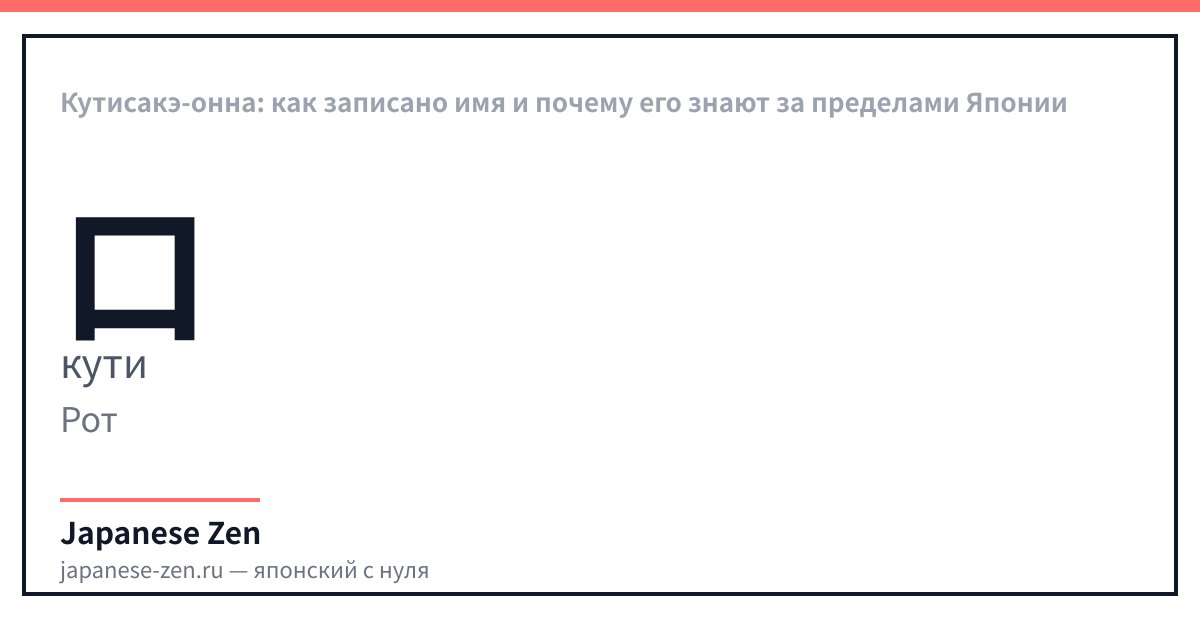
To the ear it is just four syllables, but on paper it is three kanji with a direct, almost surgical meaning. The legend's plot itself — the 1979 panic, the question about beauty, the scissors — is examined in detail on the neighboring page.
口裂け女 in parts: mouth, tear, woman
The name is assembled from three characters with no poeticism at all: 口 "mouth", 裂け — the form of the verb 裂ける "to tear, to rip", 女 "woman". The name is read くちさけおんな (kuchisake-onna), and this is a rare case where a yokai's name translates into English almost literally — "slit-mouthed woman" is not an approximate retelling but a direct translation.
| Japanese | Reading | Translation |
|---|---|---|
| 口 | kuchi · kuchi | Mouth |
| 裂ける | sakeru · sakeru | To tear, to rip |
| 女 | onna · onna | Woman |
| 口裂け女 | kuchisake-onna · kuchisake-onna | Slit-mouthed woman — the full name |
| 傷 | kizu · kizu | Wound, scar |
Why the name uses 女 and not a more polite word
女 is the simplest and most common character meaning "woman", without any evaluation or politeness. In the names of female yokai it appears constantly: yuki-onna, yamamba and others are built on the same model. This is more a grammatical detail of the construction than part of the image itself.
口 — значение: mouth, opening, hole — онъёми: コウ、ク — кунъёми: くち — 3 штрих(ов). 口 — "mouth": one of the first characters taught in Japanese, and at the same time the first syllable in the whole construction 口裂け女. The same root is in 人口 "population" (literally "people's mouths") and 入口 "entrance".
Write 口 along the guides and work through the stroke order.
What the legend is about, in a nutshell
The legend behind the name is an urban rumor from the spring of 1979: a woman in a surgical mask stops a child with the question "Am I pretty?", and after the answer she removes the mask and shows her slit mouth. Within a few months the rumor spread from Gifu Prefecture to schools all over Japan, and by summer it died down on its own. The full breakdown — with publication dates, school panics and ways to "save yourself" — is on a separate page about the slit-mouthed woman.
The 2007 film and neighboring versions of the rumor
In 2007 director Koji Shiraishi made the horror film "Kuchisake-onna" (released in English as "Carved: The Slit-Mouthed Woman") — not a retelling of the rumor but a standalone plot about her return decades later. Even earlier, the story itself had crossed Japan's borders.
- The 2007 film: directed by Koji Shiraishi, a reimagining of the legend as a standalone horror plot.
- Korea, 2004: the same story under the name "woman in the red mask" — with its own version, where the disfigurement was explained by a failed plastic surgery.
- Chinese-language internet, 2000s: the legend spread through forums, though without such a vivid local version as in Korea.
Why the story crossed borders so easily
The plot is built as a minimalist game with a clear rule — question, answer, consequence — and such a structure can be retold in any language without loss. That is why the legend found its own, non-translated versions in neighboring countries, rather than just a retelling of the Japanese one.
Kuchisake-onna in anime and other stories about yokai
- "Hell Teacher Nube" — in one episode the image is reimagined as three beautiful sisters rather than one woman.
- In collections of yokai stories and in horror games, kuchisake-onna is a recognizable archetypal character: a mask plus a question without warning.
What makes the image recognizable without a single word
Just two details are enough — a surgical mask and a question without context — for the viewer to read the reference to kuchisake-onna, even if the creators never name her. That economy is what keeps the image alive more than forty years after the first rumor.
FAQ
- How is the name kuchisake-onna translated and written?
- 口裂け女 — literally "mouth" (口) + "to tear" (裂ける) + "woman" (女), read くちさけおんな (kuchisake-onna). The English "slit-mouthed woman" is a direct translation, not a paraphrase.
- Are kuchisake-onna and the "slit-mouthed woman" the same thing?
- Yes, they are the same figure under two names: "slit-mouthed woman" is the translation of the meaning, "kuchisake-onna" is the Japanese name in transliteration. A detailed breakdown of the 1979 story itself is on the neighboring page.
- What film was made about kuchisake-onna?
- In 2007 director Koji Shiraishi made the horror film "Kuchisake-onna" — a standalone plot about her return, not an adaptation of the rumor as such.
- How did this story take hold in Korea and China?
- In the 2000s, already via the internet, the story reached Korea, where it got its own name "woman in the red mask" and a version with failed plastic surgery, and the Chinese-language internet — there without such a vivid local version.
- In which anime does kuchisake-onna appear?
- For example, in "Hell Teacher Nube", where the image is reimagined as three beautiful sisters. Overall, kuchisake-onna is a recognizable archetype of Japanese horror: a mask and a sudden question.
- What is the legend itself about, in short?
- A woman in a surgical mask in the spring of 1979 asked Japanese schoolchildren "Am I pretty?" and removed her mask after the answer. The full story of the panic is on the page about the slit-mouthed woman.
Sources
Updated: 2026-09-09