The Woman with the Slit Mouth — The Legend of the 1979 Panic
The Woman with the Slit Mouth is an urban legend about a ghost in a surgical mask: in the spring of 1979, the rumor spread from Gifu Prefecture to schools all over Japan within a few months. She stops a passerby with the question "Am I pretty?" and only removes her mask after the answer, and then the scissors come out. The legend was kept alive by word of mouth and newspaper articles — no phone or internet was needed for it.
At the dawn of this panic there were no social networks or messengers — only whispers during recess and a note in a local newspaper, and that was enough for parents to start escorting children from school in crowds within a few months. For the name and appearance of the woman herself, see the neighboring page about Kuchisake-onna.
The rumor that was born in Gifu and spread across the whole country
It all began at the end of 1978 in the town of Yaoitsu in Gifu Prefecture: according to the rumor, an elderly woman saw a stranger with a slit mouth in her yard. By January 1979, the local Gifu Nichinichi Shimbun had printed the story, in March Shukan Asahi retold it, and in April Shukan Shincho did the same. After that the rumor began to spread on its own: in a single spring it reached schools all over Japan, picking up local details at every stop.
- Starting point: end of 1978, the town of Yaoitsu, Gifu Prefecture.
- First publication: Gifu Nichinichi Shimbun newspaper, January 26, 1979.
- Peak of the panic: spring 1979, with dozens of publications.
- Fading: by the start of summer vacation in 1979, the rumor had died down on its own.
What schools did while the rumor grew
Teachers and parents reacted seriously: children were picked up from school in groups, patrols were organized, and in some cities — for example, Kushiro in Hokkaido and Niza in Saitama — classes were temporarily stopped entirely. Yet not a single confirmed attack stands behind the rumor: the press printed retellings of retellings, and the panic was sustained by them, not by real victims.
Identifying features: the mask, the question, the scissors
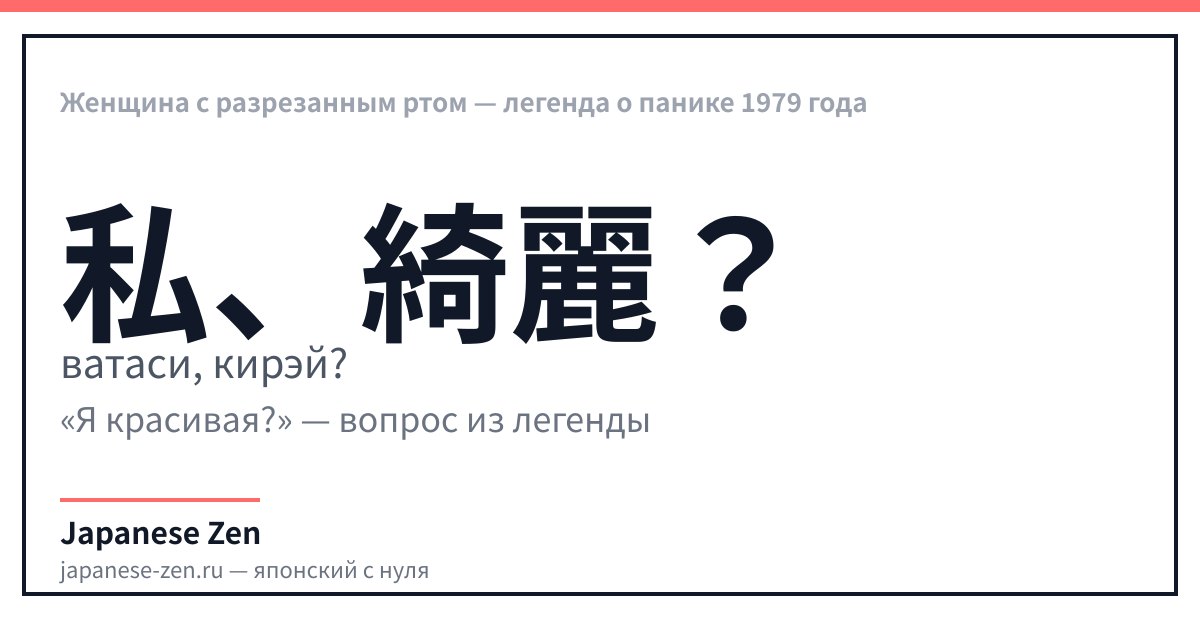
The rumor had a stable scenario that was retold almost identically across the country. A woman in a white surgical mask stops a child with the question "Am I pretty?" (私、綺麗?). If you answer "yes", the mask comes off — underneath is a mouth slit to the ears — and the question is asked again, now about the disfigured face. As for the wound itself, storytellers disagreed: some blamed a botched operation, others a jealous husband with a knife.
| Japanese | Reading | Translation |
|---|---|---|
| 私、綺麗? | Watashi, kirei? · Watashi, kirei? | "Am I pretty?" — the question from the legend |
| マスク | masuku · masuku | Mask |
| はさみ | hasami · hasami | Scissors |
| 噂 | uwasa · uwasa | Rumor, gossip |
| 口 | kuchi · kuchi | Mouth |
The Woman with the Slit Mouth story: how her appearance was explained
The story has no stable "canon" and never had one — this is a typical feature of an urban legend, not a retelling of a real case. Besides the version about a botched operation by a surgeon, there was a version about an attack or an accident in childhood. It is impossible to verify any of them: the real person behind the rumor was never found.
口 — значение: mouth, opening, hole — онъёми: コウ、ク — кунъёми: くち — 3 штрих(ов). 口 — "mouth": the very character at the base of the name 口裂け女. In the legend itself it is not a textbook kanji, but part of the image — the mouth hidden under a mask.
Four ways people saved themselves from her in 1979
- Answer vaguely — "so-so": according to the rumor, this confused the woman and gave time to run away.
- Offer a coin or a candy: she would supposedly get distracted picking up the treat.
- Say you're late: then she would politely apologize and let you go.
- Say the word "pomade" three times: according to one version, it was with a hairdresser's pomade that her mouth was cut, and the word threw her off.
Did these tips actually work
It is impossible to verify: the methods of escape are part of the same folklore as the woman herself. What is telling is something else: within a few months, children learned and spread across schools four independent "recipes for salvation" at once — a normal pace for a rumor without a single printed source.
Is this the same yokai as Kuchisake-onna?
Yes, it is the same figure under two names. "The Woman with the Slit Mouth" is a translation of the meaning, while "Kuchisake-onna" is the Japanese name as it is, 口裂け女. What differs is not the creature, but what trails behind each name: behind the English one — the rumor and panic themselves, behind the Japanese one — the written name, films, and later retellings.
| Name | What form it is | Where it appears more often |
|---|---|---|
| The Woman with the Slit Mouth | translation of the name's meaning | retellings of the legend, discussions of urban rumors |
| Kuchisake-onna | the Japanese name 口裂け女 in Latin script | film credits, anime, Japanese sources |
| 口裂け女 | the original kanji spelling | Japanese press of 1979 and everything written after |
FAQ
- Who is the Woman with the Slit Mouth?
- The figure of a Japanese urban legend from 1979: a woman in a surgical mask who asks "Am I pretty?" and after the answer shows a mouth slit to the ears. The same figure is known by the Japanese name Kuchisake-onna (口裂け女) — for details about the name and culture, see the neighboring page.
- Where did the story of the Woman with the Slit Mouth come from?
- The rumor was recorded at the end of 1978 in the town of Yaoitsu in Gifu Prefecture, and by the spring of 1979 several major publications had written about it. The story does not boil down to a real person — it is a classic urban legend with no confirmed author.
- What does she ask and why the mask?
- According to the rumor, the woman in a white surgical mask asks the question "Am I pretty?" (私、綺麗?). If you answer "yes", the mask comes off and reveals a mouth slit to the ears, and the question is repeated, now about the disfigured face.
- How, according to the rumors, could one save oneself?
- Children retold several methods at once: answer vaguely ("so-so"), offer a coin or a candy, say you're late, or say the word "pomade" three times. None of the methods, of course, has been tested by anyone — it is part of the same folklore.
- Is it true that someone was harmed by her?
- There are no confirmed cases. The press of 1979 printed retellings of the rumor and the reaction of schools — patrols, picking up children in groups — not accounts of attacks. The panic fed on the rumor itself, not on incidents.
- Why does she have two names at once?
- One name is a translation: 口裂け女 literally means "woman with a slit mouth". The other is the same Japanese form written in Latin letters. In Japan only the second is in use; in English both have taken hold, and each has its own circle of discussion.
Sources
Updated: 2026-09-09