Kunoichi — Who They Were and What Female Shinobi Did
Kunoichi is what we today call a female ninja, though in old texts the word simply meant "woman": the spelling くノ一 is a charade made of the three strokes of the character 女. Behind it lies a real technique: the treatise Bansenshukai describes the "kunoichi technique" — sending a woman into a house where a man cannot go. But historians find no evidence of female spies who worked on equal terms with men.
Popular culture turned the kunoichi into an elusive assassin with daggers under her kimono — an image invented by twentieth-century novels and films. Let's look at what Edo-period treatises and modern researchers say about female spies, how the ordinary character 女 hides inside the mysterious spelling くノ一, and what remains of the kunoichi in the museums of Iga and Koka.
Who the kunoichi were and what they did
Kunoichi (くノ一) — a woman in the role of a spy. In old texts the word itself simply meant "woman": it is a charade made of the three strokes of the character 女. Behind it lies a specific technique: the treatise Bansenshukai (1676) describes the "kunoichi technique" — sending a woman into a house where a man cannot go. She would hire on as a servant, arrive as a wandering nun or a traveling performer, and gain access to places where a man would immediately arouse suspicion: the women's quarters, the kitchen, the temple community. From there the tools were not daggers but rumors, trust, and connections.
- Cover — a servant, a wandering nun, a traveling performer: the trade itself opened the door into a stranger's house.
- Tool — conversation, not weapons: the mistress's trust, the servants' gossip, connections in the neighborhood.
- Status — not a rank in a squad, but a technique used for a specific task.
- Risk — exposure ended in death without any duel: the only protection was the believability of the role.
What the kunoichi were not
Sword duels, combat acrobatics, and geisha-assassins do not appear in the sources — that was added by much later culture. Moreover, researchers at Mie University, where ninjutsu is studied academically, state plainly that no documentary evidence survives of women who conducted espionage and sabotage on equal terms with men. What is confirmed is something else — the technique itself: a woman was used to get into places where a spy could not go.
The word and the character: くノ一 and 女
How the character 女 becomes the spelling くノ一
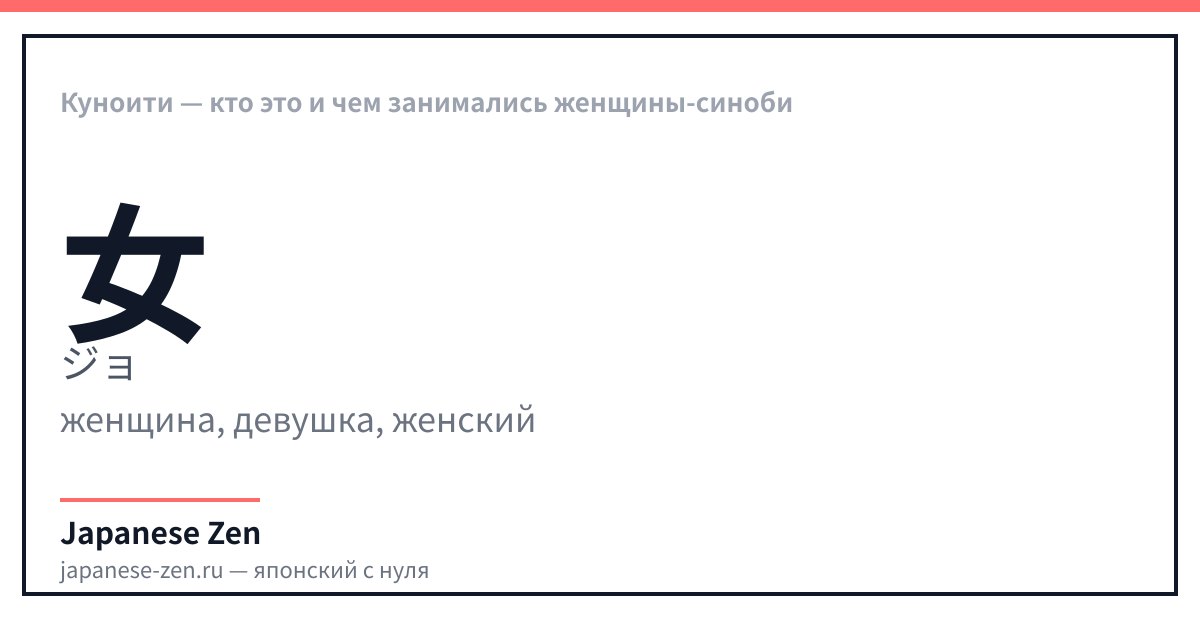
If you break down the character 女 ("woman") into its strokes in writing order, you get exactly three marks — and an entire word is built on this breakdown. The first stroke resembles the hiragana く, the second the katakana ノ, the third, the final horizontal one, the character 一 ("one"). Put them in order — く + ノ + 一 — and you get the same character 女. That is how the spelling "kunoichi" works: formally not a kanji, but a charade made of three ordinary signs of Japanese writing.
女 — значение: woman, girl, female — онъёми: ジョ、ニョ、ニョウ — кунъёми: おんな、め — 3 штрих(ов). 女 — "woman": 3 strokes, exactly those hidden in the spelling くノ一. The same character appears in 女性 (josei, "female person") and 女神 (megami, "goddess").
In dictionaries くノ一 is noted primarily as a conventional designation for the word "woman" in general, with no connection to ninja. The spelling is linked to espionage by the treatise Bansenshukai (万川集海, 1676): its eighth scroll describes the "kunoichi technique" (くノ一の術) — using a woman to infiltrate places a man cannot enter. The modern meaning — "female ninja" — became established only in the twentieth century, through Futaro Yamada's series of ninja novels. In the sense of "female ninja" the word first appears in the novel Ninpo Hakkenden (忍法八犬伝, 1964): before that, Yamada himself called his heroines simply "female ninja," and kept "kunoichi" as a colloquial word. By the end of the 1960s the new meaning had become generally accepted.
| Japanese | Reading | Translation |
|---|---|---|
| くノ一 | kunoichi · kunoichi | "Female ninja" — the word itself |
| 女 | onna · onna | "Woman" — the same character hidden in the spelling くノ一 |
| 忍者 | ninja · ninja | The male form of the same trade |
| 忍び | shinobi · shinobi | A historical name for a spy of any gender |
| 女中 | jochū · jochū | A maid — a common cover for a female spy |
| 伊賀 | Iga · Iga | The province that produced many spies, including women |
Listen to how kunoichi, onna, and related words sound, and repeat them aloud.
Are there kunoichi today?
The female spies of the Sengoku period are gone: the age of wars that needed them ended along with the shinobi trade itself. What remains is memory in the form of museums and festivals. In the city of Iga, in Mie Prefecture, the Iga-ryu Ninja Museum (伊賀流忍者博物館) operates — an exhibition, shuriken throwing, and ninjutsu demonstrations. In the neighboring city of Koka (the same name as the Koga school, just a modern reading), in Shiga Prefecture, there is the themed village Koka-no-sato Ninjutsu-mura (甲賀の里忍術村) with a museum, an obstacle course, and a dojo for weapon throwing.
Kunoichi as a costume, not a position
Once a year, in spring, Iga holds the Iga Ueno NINJA Festa: for weeks tourists in ninja costumes walk the streets, and the mayor and city council members, also in costume, hold a session — the so-called "ninja parliament." Costume rentals honestly offer a choice of image: at the Koka-no-sato village you can rent a costume and feel like a ninja or specifically a kunoichi. In Iga, costumes are sewn not only in black but also in red, blue, and pink. From the trade of a spy, the kunoichi has turned into a role: something you try on for a day, not something you study seriously.
Kunoichi in anime, games, and film
- Naruto (manga since 1999, by Masashi Kishimoto; anime since 2002) — here kunoichi is not a nickname but a direct rank: female ninja like Sakura Haruno and Hinata Hyuga are called exactly that in the series.
- Ninja Scroll (獣兵衛忍風帖, 1993, Madhouse studio, directed by Yoshiaki Kawajiri) — the kunoichi Kagero, official poison taster at the court of the Mochizuki clan: poison accumulated in her body over years and is now lethal to anyone who touches her.
- Basilisk (2005, Gonzo studio, an adaptation of Futaro Yamada's novel The Kouga Ninja Scrolls) — Oboro, heir and leader of the Iga clan, one of its ten spies in a deadly tournament against ten Koga warriors; here the kunoichi fight on equal terms with men.
What film added to the image
All three examples descend from a single line that began with Futaro Yamada's novels and their first film adaptations in the 1960s. The kunoichi as a fearless warrior woman or a femme fatale is a plot device, not a historian's observation. In Kagero's case the poison in her body works as a weapon, in Oboro's case in Basilisk it is martial techniques on equal terms with men; in Sengoku-era espionage the calculation was the opposite — not to stand out and not to fight.
FAQ
- Who are the kunoichi?
- Kunoichi (くノ一) — a woman used as a spy. In treatises this is not a separate rank but a technique: a woman disguised as a servant, a nun, or a traveling performer would get into places where a man could not go. Documents know of no professional female shinobi on equal terms with men — they were added later by twentieth-century literature.
- Did kunoichi really exist?
- Women were indeed used in espionage: the treatise Bansenshukai (1676) describes the "kunoichi technique" — infiltration into places a man cannot enter. But the combat seductress with daggers is an image from much later, from twentieth-century literature and film.
- Where did the word "kunoichi" come from?
- The spelling くノ一 is the character 女 ("woman") broken down into its strokes: く + ノ + 一. In the Edo period this was simply a coded way of writing the word "woman," with no connection to ninja. The meaning "female ninja" came to the word only in the twentieth century, through Futaro Yamada's novels.
- What did the kunoichi actually do?
- Undercover espionage: they hired on as servants, wandering nuns, or traveling performers and gained access to places a man would not be allowed — the women's quarters, the kitchen, the temple community. From there the tools were not daggers but rumors and trust.
- Is a kunoichi the same as a shinobi?
- Shinobi (忍び) is a general name for a spy, regardless of gender. "Kunoichi" in old texts simply meant "woman" and only in the twentieth century came to mean the female version of this trade. So they are not two classes, but a word from different eras and different meanings.
- In which anime are there kunoichi?
- In Naruto it is an official rank for female ninja like Sakura and Hinata. In Ninja Scroll (1993) the kunoichi Kagero is poisoned so thoroughly that her touch is lethal. In Basilisk (2005) the kunoichi Oboro leads the Iga squad in a tournament against the Koga clan.
Sources
Updated: 2026-09-12