Hattori Hanzō — who he was and what he is famous for
Hattori Hanzō (服部半蔵, 1542–1596) was a samurai and commander of a unit of men from Iga in the service of Tokugawa Ieyasu; searches often spell it "hattori hanzo", though the correct spelling is Hanzō. He is famous for leading Ieyasu through the mountains of Iga in 1582 after the death of Oda Nobunaga, and earned the nickname Demon Hanzō for his ferocity in battle. The Hanzōmon gate in Tokyo bears his name.
Popular culture turned him into an immortal invisible ninja from anime and games, and texts even garble the name itself — "Hanzo" instead of "Hanzō". Let's look at what Hanzō was really like: what he did besides the march through the mountains of Iga, where the nickname Demon Hanzō came from, and why a gate in central Tokyo is named after him.
Who Hattori Hanzō really was
Hattori Hanzō is the name-title by which Hattori Masanari (服部正成) is known, a samurai from the Hattori family tied to Iga Province. He was born in 1542 and served Tokugawa Ieyasu from a young age, eventually commanding a unit recruited from natives of Iga — an open military formation, not a secret group of lone spies. He earned the nickname Demon Hanzō (鬼半蔵) for his ferocity in battle: this distinguished him from another of Ieyasu's vassals, Watanabe Moritsuna, nicknamed Spear Hanzō (槍半蔵). Both were counted among the "Sixteen Tokugawa Generals". He died in 1596, in his fifty-fifth year.
| Year | Event |
|---|---|
| 1542 | Born into a samurai family of the Hattori clan |
| 1579 | According to legend, he was to be the second at the seppuku of Ieyasu's son, but could not raise his sword over his lord |
| 1582 | Led Tokugawa Ieyasu through the mountains of Iga after the death of Oda Nobunaga at Honnō-ji |
| 1590 | Commanded the unit from Iga that guarded one of the gates of Edo Castle |
| 1593 | Founded the Buddhist temple Sainenji and took the tonsure under the name Sainen |
| 1596 | Died, buried at Sainenji |
What else Hanzō did besides the march through Iga
Leading Ieyasu through Iga is not the only thing he is known for. Hanzō commanded the guard at one of the gates of Edo Castle, and the unit of men from Iga gave that gate the name that survives to this day. In his final years he took Buddhist vows under the name Sainen and founded Sainenji temple in Edo at his own expense — it is said, in memory of Ieyasu's deceased son. He was buried there too, and the spear kept at the temple, said to have been given by Ieyasu himself, is still listed as a cultural property of the district.
Name and kanji: 服部半蔵
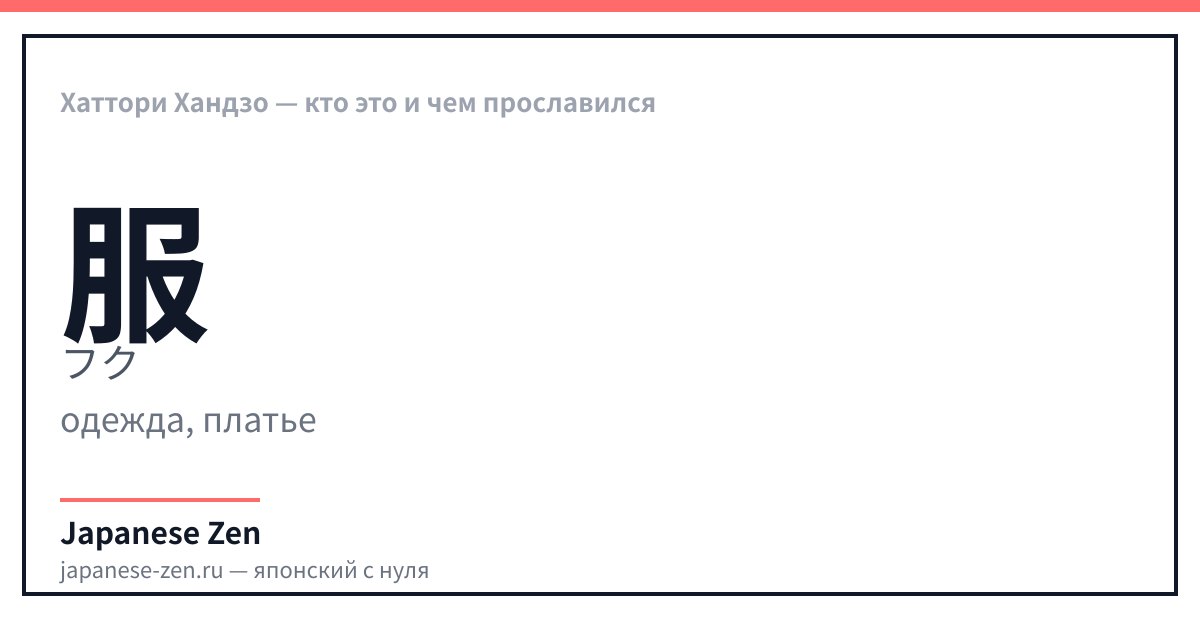
服 — значение: clothing, garment — онъёми: フク — 8 штрих(ов). 服 — "clothing": the first character of the surname Hattori (服部). The family is traced to the hatori-be — a hereditary guild of weavers that served the court before its descendants became warriors; the character for "clothing" in the surname is a trace of that craft.
Hanzō or Hanzo — and why several people bore the name
In English the name is written two ways. "Hanzō" more accurately reflects the sound of 半蔵 (はんぞう); "Hanzo" is a simplification that became established through the English transliteration Hanzo and the Hollywood film Kill Bill. Both variants are searched for, but the correct spelling is Hanzō.
The confusion is compounded by the fact that "Hanzō" is not a personal name but an inherited title-name. The first to bear it was his father, Hattori Yasunaga, and the most famous Hanzō — Yasunaga's son, Masanari — inherited the name along with a post at the Tokugawa court. After Masanari the title passed to his own son: at least three in a row were called Hanzō.
| Japanese | Reading | Translation |
|---|---|---|
| 服部半蔵 | Hattori Hanzō · Hattori Hanzō | Full name — surname and inherited title |
| 服部 | Hattori · Hattori | Surname — traces back to the hatori-be weavers' guild |
| 半蔵 | Hanzō · Hanzō | Title borne by several generations of the family |
| 半蔵門 | Hanzōmon · Hanzōmon | A gate in Tokyo named in his honor (today a subway station and line are also called this) |
| 鬼 | oni · oni | "Demon" — from the nickname Demon Hanzō |
| 伊賀 | Iga · Iga | The province his unit came from |
Listen to how Hanzō, Hanzōmon and the word oni ("demon") sound — the app will rate your pronunciation.
Hattori Hanzō in film, games and anime
- Quentin Tarantino's Kill Bill (2003) — Hanzō here is a retired master swordsmith, played by Sonny Chiba; he forges a final sword for the heroine, though the real Hanzō never forged swords.
- The Shinobi film series (Daiei studio, 1962–1966) — in the second film (1963), Hanzō, an ally of Tokugawa, helps the ninja Ishikawa Goemon; the role was played by Saburō Date.
- The anime and manga Basilisk (2005, Gonzo studio, based on Yamada Futaro's novel) — Hanzō here once reconciled the feuding Iga and Koga, placing both clans in Ieyasu's service.
- The Samurai Warriors game series (Koei Tecmo) — Hanzō is shown as Ieyasu's ninja bodyguard and a rival of Fuma Kotaro, far closer to a secret agent than to the real military commander.
What film and games added
Almost everywhere Hanzō is a fighter with special, often mystical ninja abilities, rather than the open military commander known from the sources. The retired swordsmith from Kill Bill does not even pretend to be historical: Tarantino took a famous name for a character with no connection to the real biography.
Myths about Hattori Hanzō: a commander, not an invisible man
Popular culture paints Hanzō as a super-ninja: a shadow who strangles enemies without a sound and can turn invisible. The real Hattori Masanari was an open military commander and a Tokugawa hatamoto: he commanded a unit from Iga and fought with a spear on the battlefield, rather than sneaking into palaces under cover of night. Japanese reference works also note: literally speaking, the shinobi was apparently more likely Masanari's father, the first bearer of the name, while he and his successors were no longer ninja in the strict sense.
- Myth: he was an elusive lone assassin operating in secret. The sources say the opposite — Hanzō openly commanded an entire unit, rose to hatamoto, and was responsible for guarding the gates of Edo Castle.
- Myth: one and the same immortal Hanzō lived through the centuries. In fact "Hanzō" is an inherited name-title: at least three generations of the Hattori family bore it in a row, and pop culture often merges them into one unchanging character.
- Myth: he grew up in Iga among spies. Masanari was born and fought in Mikawa, a Tokugawa domain; his link to Iga was his father, Hattori Yasunaga, who came from a landowning family there.
Where the Hanzōmon gate came from
The Hanzōmon gate (半蔵門) in central Tokyo bears his name, but accounts differ as to exactly why. According to one, the name stuck because of Hanzō's residence that stood nearby; according to another, because from 1590 his unit of men from Iga guarded this gate of Edo Castle. Today a subway station and the Hanzōmon line bear the same name — the memory of him long outlived the man himself.
FAQ
- Was Hattori Hanzō a real person or a fiction?
- A real person: the samurai Hattori Masanari (服部正成, 1542–1596), a vassal of Tokugawa Ieyasu and commander of a unit from Iga. The image of the elusive invisible ninja from anime and games is a later addition of pop culture, not part of his real biography.
- What is Hattori Hanzō famous for?
- For leading Tokugawa Ieyasu through the mountains of Iga in 1582 after the death of Oda Nobunaga at Honnō-ji, saving his life. He also commanded the unit from Iga that guarded Edo Castle and earned the nickname Demon Hanzō for his ferocity in battle.
- How is the name correctly spelled — Hanzō or Hanzo?
- "Hanzō" more accurately reflects the sound of 半蔵 (はんぞう); "Hanzo" is a simplification that became established through the English transliteration Hanzo and the film Kill Bill. Both spellings appear in searches, but the correct one is Hanzō.
- Why is Hattori Hanzō considered a ninja if he was a samurai?
- Because he commanded a unit of men from Iga — a province famous for its ninjutsu school — and led Ieyasu through the mountains of Iga in 1582. He himself, however, held the post of military commander and hatamoto, and did not work as a spy personally.
- Is Hattori Hanzō from Kill Bill the same person who lived in the 16th century?
- No, only the name is shared. In Tarantino's film Hanzō is a fictional retired swordsmith played by Sonny Chiba. The historical Hattori Masanari was not an armorer but served as a military commander under Tokugawa Ieyasu.
- Why is there a Hanzōmon gate in Tokyo?
- The Hanzōmon gate (半蔵門) in central Tokyo bears his name: according to one version, because of Hanzō's residence that stood nearby; according to another, because from 1590 his unit from Iga guarded it. Today a subway station and line bear the same name.
Sources
Updated: 2026-09-12