Fuma Kotaro — Who He Was and Why Different People Shared the Name
Fuma Kotaro is not one person but an inherited title held by the head of the Fuma band (風魔党), which served the Hojo clan of Odawara with reconnaissance, night raids, and arson during the Sengoku wars. Tradition counts five leaders in a row under this name; the most famous is the "fifth Kotaro," active at the end of the 16th century. Documents about him are almost nonexistent, and his image was assembled by later books.
Popular culture long ago turned him into a two-meter super-warrior from video games, while sources from his own era are almost entirely silent about him. We look at where the name Fuma Kotaro actually came from and how many leaders bore it. What in the legend of the night raid and giant stature is confirmed by texts, what was added by books half a century later and beyond — and where the band went after the fall of the Hojo house.
Who Is Hidden Behind the Name Fuma Kotaro
Fuma Kotaro is a name-title borne by the head of the Fuma band (風魔党, also written 風間党) in the service of the Hojo clan of Odawara. The band carried out reconnaissance, night raids, and arson during the Sengoku wars, operating in small groups behind enemy lines rather than in open formation. An important detail: "Fuma Kotaro" is not the name of one specific person but a title passed from one leader to another. Tradition counts five such Kotaro in a row; the last and most famous of them was active at the twilight of the Hojo house, in the final decades of the 16th century.
| Year | Event |
|---|---|
| 1581 | According to tradition, a band of "four captains" and two hundred fighters under Fuma makes a night raid on Takeda's camp at the Kisegawa River |
| 1590 | The Hojo house of Odawara is defeated by Toyotomi Hideyoshi; the band is left without a lord |
| 1603 | According to tradition, Fuma Kotaro and his men are captured and executed by the Tokugawa shogunate |
Why This Name Means an Office, Not One Man
Each new head of the band received the name "Fuma Kotaro" along with the position, not at birth. According to tradition, five leaders in a row bore it; the last of them was active under Hojo Ujimasa and his son Ujinao, right up to the fall of the Hojo house. The band was based in Sagami Province, in Hojo territory, and the last Kotaro witnessed the decline of the house — under Hojo Ujimasa and his son Ujinao.
The Name and the Kanji: 風魔小太郎
The word 風魔小太郎 splits into two meaningful parts: 風魔 — "wind demon," where 魔 is the same character as in the word for "demon," and 小太郎 — a very ordinary male name, a diminutive of the classic name for a firstborn son, Taro. The band's leader was seemingly called by a neighborly name rather than a warrior's nickname, though in reality it was a title, not a birth name.
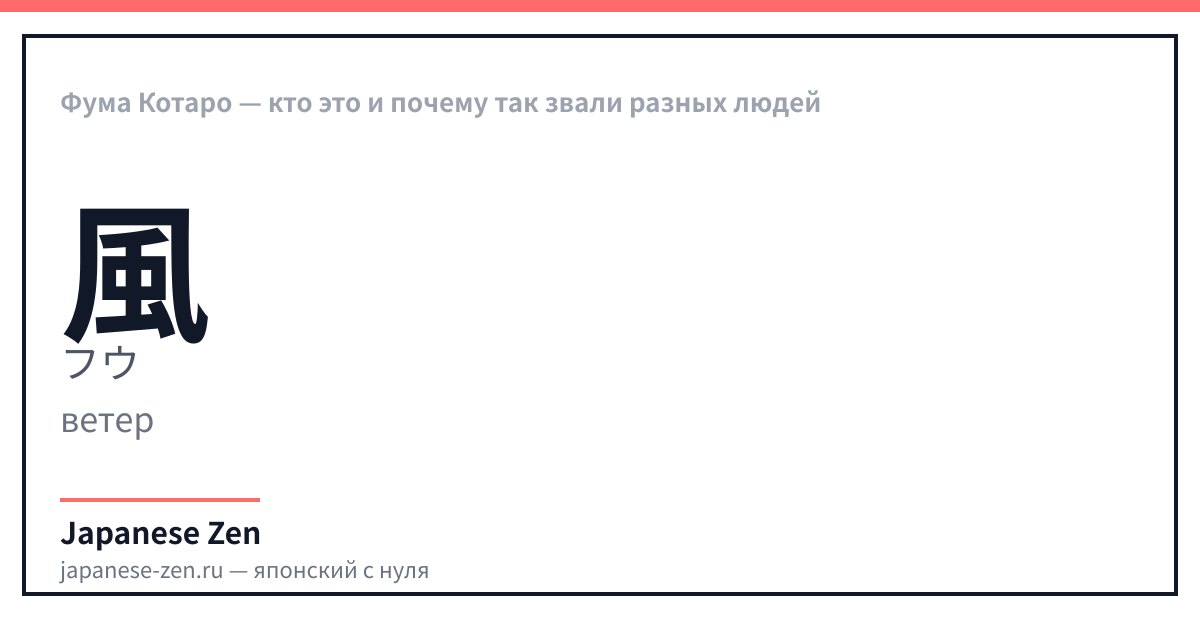
風 — значение: wind — онъёми: フウ、フ — кунъёми: かぜ、かざ- — 9 штрих(ов). 風 — "wind": 9 strokes, an N5-level character, one of the most frequent kanji in Japanese. The same character stands at the beginning of both spellings of the band's name — 風魔 and 風間.
Why the Band Is Called Sometimes Fuma, Sometimes Kazama
Besides 風魔, the spelling 風間 also appears — the same sounds but with a different second kanji, which in ordinary surnames is read "Kazama." The band's base is thought to have been a valley at the foot of Mount Ashigara, and both spellings may go back to its name. In Hojo house documents there is also a vassal named Kazama Dewa-no-kami (風間出羽守): he is sometimes identified with the leader of the Fuma band, though there is no direct proof of this.
| Japanese | Reading | Translation |
|---|---|---|
| 風魔小太郎 | Fūma Kotarō · Fūma Kotarō | The name that the band's leaders bore from generation to generation |
| 風魔党 | Fūma-tō · Fūma-tō | The band that served the Hojo clan of Odawara |
| 風 | kaze · kaze | Wind — the first character in the band's name |
| 乱波 | rappa · rappa | What scouts like Fuma's men were called in the Sengoku era |
| 城 | shiro · shiro | Castle — Odawara, where the Hojo clan's court stood |
Listen to how "wind" and "castle" sound — two words from the story of the Fuma band.
Fuma Kotaro: Where Facts End and Literature Begins
Sources give no exact dates of birth and death for the leader at all — where the years of life should be listed, reference works put two question marks. Almost everything told about him goes back to a single book — the Hojo Godaiki (北条五代記), published in 1641 by Miura Josin, a former vassal of the Hojo house, half a century after the clan's fall. It is the only source that describes the leader's appearance in detail: height seven shaku two sun, about 218 centimeters, a wide mouth, a black beard, and four fangs protruding outward.
Other texts of the same circle — the Kembunshu and the Kamakura Kanrei Kudai-ki — added further touches to the image, including a variant spelling of the name. The overlap of several retellings created the legend: no chronicle of the Sengoku era confirms such a vivid description, and modern reference works speak cautiously — "according to tradition," not "proven."
According to tradition, after the defeat of the Hojo house in 1590 the band was left without a lord and turned into a gang of robbers near Edo. Also according to tradition, in 1603 Fuma Kotaro and his men were captured and executed by the Tokugawa shogunate after a denunciation. But even this date is known only from later retellings, not from the shogunate's own documents.
- Fact: the Fuma band (風魔党) in the service of the Hojo clan of Odawara carried out reconnaissance and sabotage during the Sengoku wars — its very existence is not questioned.
- Tradition: the name "Fuma Kotaro" was borne by five leaders in a row; the last and most famous of them was active in the final decades of the 16th century.
- Legend: a height over two meters, a black beard, and fangs — a description from a 1641 book, not testimony from contemporaries.
- Unconfirmed: the exact years of life, the circumstances of the night raid on Takeda's camp, and the date of execution are known only from retellings, not from documents of the Sengoku era itself.
Fuma Kotaro in Games: From Fate/Grand Order to Nioh 3
Modern culture turns to this name far more readily than the documents of his era. In Fate/Grand Order, Fuma Kotaro is a three-star Assassin-class servant who calls himself the fifth head of the clan. In the Sengoku BASARA series, he is a silent mercenary killer in Hojo service with his face hidden under armor: from a faceless opponent in the first game to a playable character in the Eiyu Gaiden expansion. In Samurai Warriors, starting with the second game in the series, he is a giant ninja over two meters tall and the main rival of Hattori Hanzo on the battlefield. And in Nioh 3, released in February 2026, he is an optional opponent in the Iinoya lands. There he is made a shinobi of the Hojo house of Sagami — that is, closer to tradition than most of his genre neighbors.
FAQ
- Who is Fuma Kotaro?
- Fuma Kotaro is an inherited name-title of the head of the Fuma band (風魔党), which in the service of the Hojo clan of Odawara carried out reconnaissance, night raids, and arson during the Sengoku wars. Tradition counts five such leaders in a row; the most famous is the "fifth Kotaro," active at the end of the 16th century.
- Is Fuma Kotaro a real person or entirely invented?
- The existence of the Fuma band in Hojo service is confirmed by clan documents, but the detailed portrait of the leader himself comes from a single book of 1641, written half a century after the events. The height of nearly two meters, the beard, and the fangs are a literary description, not testimony from contemporaries.
- What did the Fuma band do?
- The band served the Hojo clan of Odawara with reconnaissance, night raids, and arson of enemy camps during the Sengoku wars — a role called "rappa" (乱波) in the documents of the era. According to tradition, after the fall of the Hojo house in 1590, Fuma's men were left without a lord and took up banditry near Edo.
- Is it true that Fuma Kotaro was over two meters tall?
- This figure comes from a 17th-century book: there the leader is described as seven shaku two sun tall — about 218 centimeters — with a black beard and fangs. No document from his own era confirms such a description, so this is more a literary image than a measured fact.
- In which games does Fuma Kotaro appear?
- Most often in games: in Fate/Grand Order he is a three-star Assassin-class servant, and in the Samurai Warriors series he is a playable giant ninja and the rival of Hattori Hanzo. In the Sengoku BASARA franchise he is a faceless mercenary killer in Hojo service with his face under armor. A recent example is Nioh 3 (2026), where he is an optional boss and is called a shinobi of the Hojo clan.
- Why is the name Fuma Kotaro written differently — 風魔 and 風間?
- These are two ways of writing the same sounds: 風魔 is read as "wind demon," while 風間 uses the same sounds with different kanji, familiar from the ordinary surname Kazama. Both may go back to the name of a valley at Mount Ashigara, where the band was based, rather than to the leader's personal name.
Sources
Updated: 2026-09-12