Ishikawa Goemon — Who He Was and Why He Was Executed
Ishikawa Goemon was a legendary outlaw of the Azuchi–Momoyama period who in 1594 in Kyoto was boiled alive in a cauldron together with his son for robbery and, according to legend, for an attempt on Toyotomi Hideyoshi's life. Reliable information about his life is almost nonexistent: neither the year nor the place of his birth is known, and most of his biography comes from kabuki and books of the 18th–19th centuries.
Popular culture turned him into a noble robber who stole from the rich to give to the poor, while sources from his era are silent about almost everything except one day in Kyoto. We look at what is actually known about him, where the bath named after him came from, and why even his own death poem seems to have been invented for him only two centuries later.
Who Was Ishikawa Goemon and Why Was He Executed
Ishikawa Goemon was an outlaw of the Azuchi–Momoyama period, about whose life almost no reliable information survives: neither the year nor the place of his birth is known. One thing is certain — his execution: in 1594 in Kyoto he was boiled alive in a cauldron together with his young son, accused of robbery. Almost everything else in his "biography" — from studying under a ninjutsu master to the attempt on Toyotomi Hideyoshi's life — appeared two centuries later, from kabuki and adventure books, not from documents of his era.
| Year | Event |
|---|---|
| 1594 | Executed on the bank of the Kamo River in Kyoto together with his son — according to various records, by boiling or by slow fire in a cauldron of oil |
| 1778 | The kabuki play "Sanmon Gosan no Kiri" (楼門五三桐) cements the image of the noble outlaw — the same play is the source of the verses later attributed to him as his death poem |
How We Know About Goemon's Execution
A testimony from almost a contemporary is a rarity for a 16th-century Japanese outlaw: the Jesuit Pedro Morejón mentioned the execution by boiling in Kyoto in notes to the memoirs of the Spanish merchant Bernardino de Avila Girón, who lived in Nagasaki for many years. This is perhaps the only European record of Goemon's fate — and it also differs in details from Japanese sources, some of which speak not of water but of boiling oil.
Name and Kanji: 石川五右衛門
The surname 石川 (Ishikawa) means "stone river" and remains one of the most common in Japan. The name 五右衛門 (Goemon) was a common male name of the Edo period: the suffix "-emon" goes back to the old palace guard and carries almost no independent meaning.
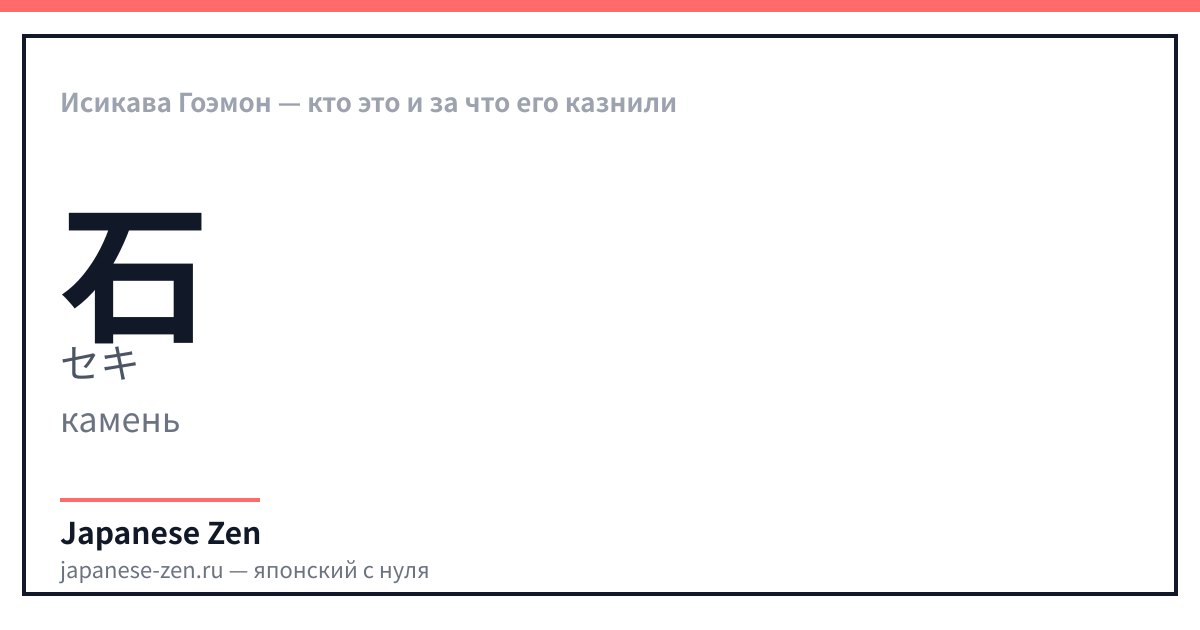
石 — значение: stone — онъёми: セキ、シャク、コク — кунъёми: いし — 5 штрих(ов). 石 — "stone": 5 strokes. The first kanji of the surname 石川 (Ishikawa, "stone river") — one of the most common in Japan. The same character appears in 石段 (ishidan, "stone steps") and 宝石 (hōseki, "precious stone").
The Bath Named After Him
五右衛門風呂 (goemon-buro) is a cast-iron cauldron bath heated directly from below by an open fire; it was named in memory of the manner of his execution. It is a thoroughly everyday object: such baths existed in Japan for centuries, and in some places they are still heated this way.
| Japanese | Reading | Translation |
|---|---|---|
| 石川五右衛門 | Ishikawa Goemon · Ishikawa Goemon | Full name |
| 石川 | Ishikawa · Ishikawa | Surname — "stone river" |
| 五右衛門風呂 | Goemon-buro · Goemon-buro | Cauldron bath named after him |
| 泥棒 | dorobō · dorobō | Thief, robber |
| 石 | ishi · ishi | Stone — the first character of his surname |
| 釜 | kama · kama | Cauldron — the instrument of his execution |
Listen to how "stone" and "cauldron" sound — two words from the story of his surname and execution.
Outlaw or Ninja: What the Legend Invented
Three stories are told about Goemon, and none of them rests on documents from his era — only on theater and books that appeared almost two centuries later. Separating them is simple: everything known for certain fits in one line, everything else came from the stage.
- Fact: executed in 1594 in Kyoto together with his son — this is confirmed both by Japanese records and by a note from a European contemporary, the Jesuit Pedro Morejón.
- Legend: study under a ninjutsu master named Momochi Sandayu. The master himself does not appear in documents of the era — the name is entirely literary.
- Legend: the attempt on Toyotomi Hideyoshi's life. According to legend, Goemon made his way into his bedroom but brushed against the "Chidori" incense burner, which was said to cry out when a stranger appeared.
- Legend: a noble robber who gave his loot to the poor. Sources from his era know nothing of such generosity — the image was assembled by adventure literature of the 18th–19th centuries.
- Legend: a death poem about thieves who never run out — made famous by kabuki in 1778, not recorded by contemporaries of the execution.
Goemon in Manga, Anime, and Games
Goemon's most recognizable trace in culture is not a coincidence but a direct borrowing of the name. In the manga "Lupin III" (since 1968, by Monkey Punch), there is Ishikawa Goemon XIII — a thirteenth-generation descendant of the outlaw, a samurai with a sword that cuts through anything. In the anime adaptations produced since 1971 by Tokyo Movie (later TMS Entertainment), he is one of Lupin's regular companions. A second borrowing is more direct: Konami's video game series "Ganbare Goemon," launched in 1986, made a playable hero modeled directly on the outlaw of the Azuchi–Momoyama period.
FAQ
- Who is Ishikawa Goemon?
- Ishikawa Goemon was an outlaw of the Azuchi–Momoyama period, executed in 1594 in Kyoto together with his son. Very little is known about his real life: even the year and place of his birth are not established, and most of the stories about him come from theater and books of a much later time.
- Is it true that Ishikawa Goemon was boiled in a cauldron?
- The execution did happen: in 1594 he was boiled alive in Kyoto together with his son, as both Japanese records and a European contemporary — the Jesuit Pedro Morejón — write. But some sources specify that the cauldron was filled not with water but with boiling oil — so it is more accurate to say not "boiled" but "fried alive."
- Was Ishikawa Goemon a ninja?
- Documentarily, this is not confirmed. Goemon was an outlaw, and the connection with ninjutsu is entirely legendary: in later books he acquires a ninja teacher named Momochi Sandayu, but that name itself does not appear in sources of the era and was most likely invented entirely.
- What is goemon-buro?
- Goemon-buro (五右衛門風呂) is a cast-iron cauldron bath heated directly from below by an open fire; it was named in memory of the manner of Goemon's execution. It is a thoroughly everyday object: such baths existed in Japan for centuries and can still be found today.
- Where does Ishikawa Goemon appear in pop culture?
- Most often as Ishikawa Goemon XIII, a thirteenth-generation descendant of the outlaw from the manga and anime "Lupin III" (since 1968). A separate line is Konami's video game series "Ganbare Goemon" (since 1986), where the playable hero is modeled directly on the historical outlaw.
- Is it true that before his execution Goemon composed a death poem?
- The famous lines about the coastal sand that will not run out as long as there are thieves are not a record by contemporaries but lines from the kabuki play "Sanmon Gosan no Kiri" (1778). This is a literary image formed almost two centuries after the execution, not Goemon's genuine dying words.
Sources
Updated: 2026-09-12