Rappa and Suppa — What Spies Were Called Before the Word "Ninja"
Rappa (乱波) and suppa (素破) are old names for spies in Japan before the word "ninja." The rappa served the Hojo house in Kanto, while suppa were used in the lands from Kai westward — the same region where Takeda Shingen kept such men. These were not secret techniques but the people themselves: former bandits and peasants doing reconnaissance, arson, and night raids. The general word "ninja" became common only in the 20th century.
Ninja had many names in old Japan — long before the word "ninja" became the general term for all of them. Let's look at where rappa and suppa came from and where each word was used. Separately, we'll see how this connects to the verb "suppa-nuku," to expose someone else's secret, and why the character 潜 "to infiltrate secretly" best captures the essence of this trade.
Rappa, Suppa, and Other Names Before the Word "Ninja"
Rappa (乱波) was the name for spies in Kanto, the lands around Odawara where the Hojo house was based: in sources, the Fuma unit most often appears under this name, and its leader was called the "leader of the rappa." Suppa (素破, also written 透波) was used in the provinces from Kai westward. The early 19th-century reference work "Buke Meimokusho" directly contrasts these two words: suppa operated secretly, while rappa were noisy and disorderly.
In the Takeda house's military chronicle "Koyo Gunkan," its spies are also called "mitsumono" (三ツ者) — a word of their own, not connected to the general "suppa." There was no strict, unified system of names for all of Japan: only regional speech habits that changed from house to house.
| Word | In Japanese | Where it was used |
|---|---|---|
| rappa | 乱波 | Kanto — Hojo house, Fuma unit |
| suppa | 素破 (透波) | from Kai westward — served Takeda |
| mitsumono | 三ツ者 | Kai province — the Takeda house's own word |
| kusa | 草 | according to some accounts — the Sanada house in Shinano |
| shinobi | 忍び | throughout Japan — the most frequent word in documents |
When Spies Began to Be Called "Ninja"
The words "ninja" and "shinobi" share the same character 忍: in 忍者 it is read with the Chinese-derived reading, "nin," and in 忍び with the native Japanese reading, "shinobi." "Ninja" became commonplace not in the Sengoku period but only in the second half of the 1950s and the 1960s, through postwar novels and films about spies. Before that, documents wrote "shinobi," while "rappa" and "suppa" remained regional words for the same trade.
"Suppa-nuku" — How a Spy Became a Verb
The verb "suppanuku" (すっぱ抜く) means "to suddenly expose, to reveal someone else's secret." Dictionaries link it to the word "suppa" only tentatively: a spy would find out what was hidden from him and bring it to light. If this theory is correct, the memory of the spy's trade still lives on in an ordinary Japanese verb.
"Rappa" Is Also a Trumpet, but with a Different Character
The word "rappa" has a sound-alike: 喇叭 (rappa) — "trumpet, bugle," an ordinary wind instrument. It is written with different characters and is unrelated to the spy trade — simply a homophone that is easy to confuse by ear.
潜 — To Infiltrate Where You Shouldn't
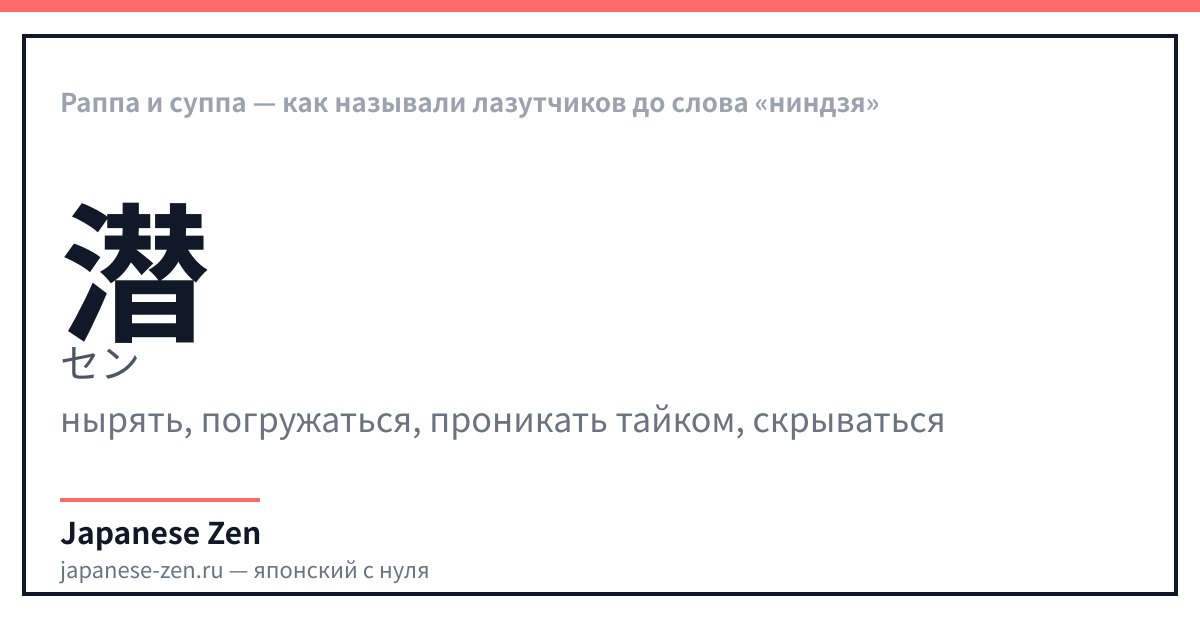
潜 — значение: to dive, to submerge, to infiltrate secretly, to hide — онъёми: セン — кунъёми: ひそ.む、もぐ.る、かく.れる、くぐ.る、ひそ.める — 15 штрих(ов). 潜 — "to dive, to infiltrate secretly": for the topic of rappa and suppa, this best describes the very essence of their trade. The same character appears in 潜入 "secret infiltration" and 潜水 "diving underwater."
Why the Character 潜 Here, and Not the Characters of the Words Themselves
None of the characters in the words "rappa" (乱波) and "suppa" (素破) directly names the spy's occupation: 乱 means "disorder," 波 means "wave," 素 means "plain, ordinary." Some of these characters seem to have been chosen not only for their sound: the secret nature of suppa echoes the alternative spelling 透波, where 透 means "to seep through," and the noisy, scattered rappa echoes 乱 "turmoil." But for our topic, the character 潜 is more important, as it directly names the spy's main skill — 潜入, "to infiltrate secretly."
潜 is read as セン in words like 潜入 and 潜水, while its kun readings are ひそむ "to lie low" and もぐる "to dive, to submerge": both refer to the same skill of remaining unnoticed.
| Japanese | Reading | Translation |
|---|---|---|
| 潜入 | sennyū · sennyū | Secret infiltration — what rappa and suppa did |
| 素破 | suppa · suppa | A spy in the service of the Takeda house |
| 乱波 | rappa · rappa | A spy in the service of the Hojo house |
| 潜む | hisomu · hisomu | To lie low, to hide |
| 潜水 | sensui · sensui | Diving underwater |
| 忍び | shinobi · shinobi | A later general word for a spy |
Write 潜 along the guides — the character for "to infiltrate secretly," which best describes the trade of rappa and suppa.
FAQ
- Who were the rappa and suppa?
- Rappa (乱波) and suppa (素破) are old regional names for spies in Japan: people hired for reconnaissance, arson, and night raids, not warriors in open battle. The rappa served the Hojo house in Kanto, while suppa were used in Kai province and the lands to the west — the same region where Takeda Shingen hired such men. Later, both were called by the general word "shinobi," and then "ninja."
- How did rappa differ from suppa?
- By the region where they were hired, not by their trade: rappa is a Kanto word, where the Hojo house was based, and suppa is from the provinces from Kai westward, where Takeda Shingen served. The early 19th-century reference work "Buke Meimokusho" adds another distinction: suppa operated secretly, while rappa were noisy and disorderly. The tasks of both were the same — reconnaissance, arson, night raids.
- What other names were ninja called in old Japan?
- Besides rappa and suppa, sources mention "kusa" (草, "grass") — according to some accounts, this was used in the Sanada house. There is also "mitsumono" (三ツ者) — the Takeda house's own word, and "shinobi" (忍び) — the most frequent word in documents throughout Japan. There was no unified system of names: in each region, spies were called somewhat differently.
- When did the word "ninja" appear?
- The words "ninja" (忍者) and "shinobi" (忍び) share the same character 忍, read differently: with the Chinese-derived reading and the native Japanese reading. But "ninja" became commonplace not in the Sengoku period, but only in the second half of the 1950s and the 1960s, along with a wave of postwar novels and films. Before that, documents wrote "shinobi," "rappa," or "suppa."
- Where did the expression "suppa-nuku" come from?
- "Suppanuku" (すっぱ抜く) means "to suddenly expose someone else's secret." Dictionaries link the verb to the word "suppa": a spy would find out what was hidden from him. But this is a conjecture, not a proven origin of the word.
- How is "rappa" written in kanji?
- 乱波, also written 乱破. 乱 means "disorder, turmoil," 波 means "wave": there is no direct connection to reconnaissance in the characters themselves, and some sources link their choice to the noisy, disorderly nature of rappa raids — as opposed to the secretive suppa. The word has a sound-alike homophone 喇叭 "trumpet, bugle," unrelated to spies.
Sources
Updated: 2026-09-15