Kusa — "Grass": The Lurking Scout and the Legend of "Sleeper Agents"
Kusa (草, "grass") is one of the regional names for a Japanese scout in the Sengoku period, alongside rappa and suppa. Dictionaries define it literally: one who "lay hidden in the grass, watching for the enemy" on the battlefield. Some sources use it for the scouts of the Sanada house. But stories of ninja "grass" living under a false identity with a family for decades are later embellishment, not period documents.
"Kusa" sounds poetic, but in the military language of the Sengoku period it was a dry designation for a scout on enemy territory. Let's look at what the word meant according to dictionaries and chronicles, how kusa differed from rappa and suppa, and what in modern retellings is no longer history but a comparison with 20th-century "sleeper agents."
"Lurking in the Grass": How Kusa Conducted Reconnaissance
Kusa (草) is one of several regional names for a scout in Sengoku-era Japan, alongside rappa, suppa, and others. An old Japanese dictionary explains it through the image itself: "because one lay hidden in the grass, watching for the enemy." On the battlefield it referred to someone secretly observing the opponent among hills and fields, as well as to the activity itself.
Unlike rappa and suppa, which were tied to specific houses — the Hojo and the Takeda — "kusa" in the sources sounds more like a figurative nickname for an observer than a formal title of a single school or house.
The Sanada House and Its "Grass" Scouts
The word is most often associated with the Sanada house in Shinano Province: according to some accounts, it was there that scouts were traditionally called kusa. Few direct documents from the Sengoku period itself with this name survive, and details about the work of Sanada kusa specifically are known mainly from later retellings.
Kusa and Modern "Sleeper Agents": What Is Confirmed and What Is Invented
The idea of a scout who lives on enemy land not for days but for years, posing as an ordinary resident, does echo the modern concept of a "sleeper agent." But the specific details repeated by ninja websites — decades undercover, a family of one's own, the kusa role passed from father to son — appear neither in dictionaries nor in the descriptions examined above. This is a retelling from the 20th–21st centuries, not a document of the Sengoku period.
What Researchers Confirm and What They Do Not
Researchers at Mie University studying the scouts of the Sanada house describe them primarily as local specialist warriors — experts in horsemanship, marksmanship, and the handling of gunpowder. They took part in battles and defense, and did not form a secret network of long-term informants. So the "grass" that puts down roots in enemy land for decades is an image of much later origin than the term itself.
根 — Root Instead of Grass
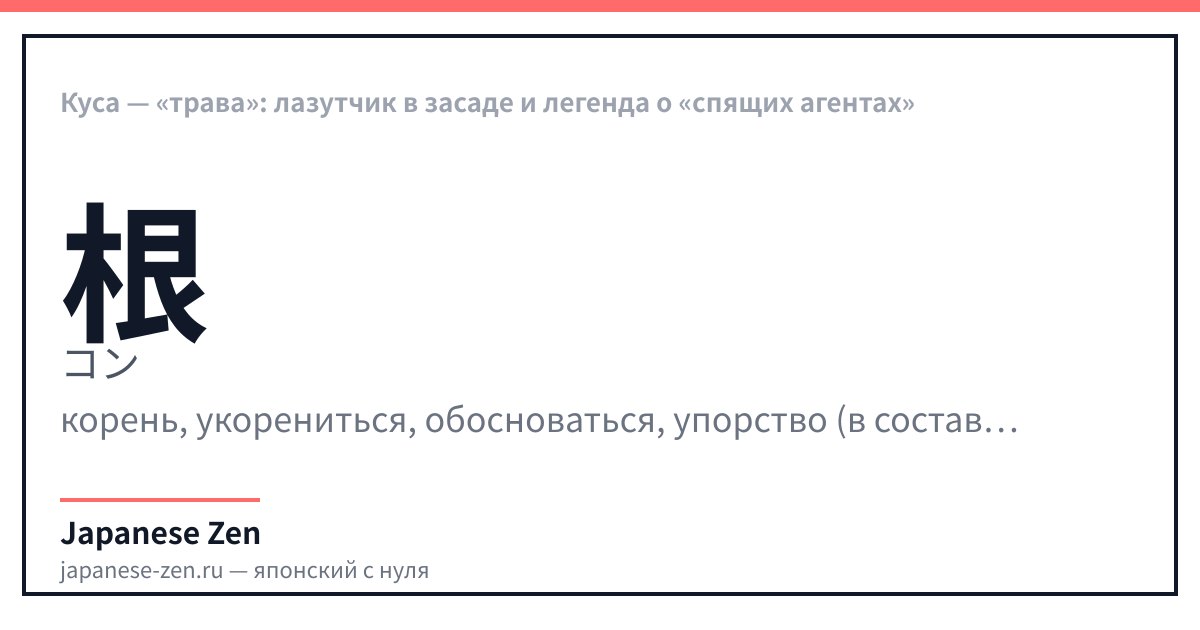
根 — значение: root, to take root, to settle in, perseverance (in compounds) — онъёми: コン — кунъёми: ね、-ね — 10 штрих(ов). 根 — "root": not the same plant as "grass" 草, but the same idea — to settle in and stay for a long time. The same character appears in 大根 (daikon) "radish" and in 根気 (konki) "perseverance, endurance."
Why 根 Here and Not 草 Itself
草 is an ordinary kanji for "grass," which by itself says nothing about reconnaissance. Instead, 根 "root" is more important for this topic — through the expression 根を下ろす, "to put down roots, to settle in a place": this image was applied by later stories to the "grass" scout who supposedly lived on foreign land for years. 根 is read コン in 根気 "perseverance" and 大根 "radish," and ね in the word "root" itself and in 根を下ろす.
| Japanese | Reading | Translation |
|---|---|---|
| 根を下ろす | ne o orosu · ne o orosu | To put down roots, to settle in a place |
| 草 | kusa · kusa | "Grass" — an old name for a scout on enemy territory |
| 根 | ne · ne | Root |
| 根気 | konki · konki | Perseverance, endurance |
| 大根 | daikon · daikon | Daikon radish: here 根 is read "kon" |
| 忍び | shinobi · shinobi | A later general word for a scout |
Write 根 along the guides — the "root" character from the expression 根を下ろす, "to put down roots."
根を下ろす — Not Only for Plants
Literally, 根を下ろす is said of a plant that has put down roots in new soil, but just as often of a person who has settled in a new place for a long time: moved and took root, like a tree. This same metaphor was applied by later stories to kusa — scouts who supposedly lived on foreign land for years.
FAQ
- Who are kusa in Japan?
- Kusa (草) is one of the regional names for a scout in Sengoku-era Japan, alongside the words rappa and suppa. Dictionaries define it through the image itself: one who "lay hidden in the grass, watching for the enemy" on the battlefield. Some sources associate this word specifically with the Sanada house in Shinano Province.
- Why were scouts called "grass"?
- The direct explanation is in the image itself: a person lying in the grass and watching the enemy is as unnoticeable as the grass underfoot. This is an interpretation, not a strictly proven etymology: the meaning of the word is known from Sengoku-period chronicles, not from an author's explanation.
- How did kusa differ from other ninja?
- By name and by region, not by a special craft: rappa and suppa were tied to specific houses — the Hojo and the Takeda. "Kusa" in the sources sounds more like a figurative nickname for an observer on enemy territory, associated with the Sanada house. The occupation was the same for all — reconnaissance and covert observation.
- Is it true that kusa lived on foreign land for generations?
- Dictionaries and chronicles do not have verified confirmation of this: researchers studying the scouts of the Sanada house describe them primarily as local specialist warriors who took part in battles, not as a long-term network of informants with families on enemy territory. Stories of decades undercover are a later addition to the image.
- How is "kusa" written in kanji?
- 草, read くさ (kusa) — the same character as in the ordinary word "grass." There was no special "spy" kanji for this occupation: the meaning rests entirely on the image of a person hiding among the grass and watching the opponent.
Sources
Updated: 2026-09-15