What Is Bento: A Lunch Box, Ekiben, and Kyaraben
What is bento? It is a boxed meal you take with you: most often rice, something meaty or fishy, and vegetables arranged in compartments, though there is also bento without rice — with sandwiches or pasta. This kind of bento is taken to school, to work, and on trips. For food from the station there is a separate word, "ekiben," and a children's bento shaped like cartoon characters is called "kyaraben."
Bento has no fixed contents — the only mandatory rule is that the food is easy to carry with you. Let's look at the difference between everyday homemade bento, station ekiben, and the fancy kyaraben, where the word "bento" itself came from, and why the second kanji 弁当 appears in the most ordinary words like 本当 — "truth."
A Box You Take with You: What's Inside Bento
Bento is a general word for food packed in a container and taken from home, a store, or a cafe. Most often it is rice, one or several side dishes to go with it, and vegetables arranged in separate compartments of the box. But there is no formal requirement that rice must be inside: bento with sandwiches or pasta also exist, just less often.
Not Only Rice: Who Takes Bento with Them and When
Bento is taken to school, to work, on a trip, or on a walk — in any situation where there is no opportunity or desire to eat at a cafe. It is both made at home and bought already assembled: in supermarkets, convenience stores, specialty shops, train stations, and airports.
Makunouchi, Ekiben, Kyaraben, Konbini Bento — in One Table
| Type | What It Is | When It Appeared |
|---|---|---|
| Makunouchi bento | Rice and several side dishes in separate compartments — the classic type of bento | Took shape in the Edo period; the name is linked to the intermissions of kabuki theater |
| Ekiben | Bento sold at train stations and on trains | According to a widely accepted version — since 1885, Utsunomiya Station; there are other contenders for the title of the first |
| Kyaraben | Children's bento, with food shaped like cartoon and game characters | The word came into use in the 1990s, the trend in the 2000s, from cooking blogs |
| Konbini bento | Bento sold at convenience stores | Spread along with konbini chains starting in the 1970s–80s |
Why Ekiben Has No Undisputed "First"
The most famous version names as the first ekiben onigiri with pickled takuan radish, wrapped in bamboo bark and sold at Utsunomiya Station on July 16, 1885. But this is only one version: for example, ekiben in a folding wooden orizume box, familiar even today, was first sold at Himeji Station in 1890, and supporters of this version consider that format to be the first.
From the Chinese "Convenient" to a Box with a Lid
The word "bento" has several versions of origin. One links it to the Sengoku military era, when food was quickly distributed to a large number of people in simple dishes. Another leads to the Chinese colloquial word "便当" of the Southern Song era, meaning "convenient, by the way": this same word is still used in some Chinese dialects. The kanji 弁当 in this case are interpreted as "prepare and put to use" — that is, assemble food from what was at hand.
Azuchi-Momoyama and Edo: How the Current Look of Bento Took Shape
In the Azuchi-Momoyama period, lacquered food boxes similar to today's bento appeared — they were taken to cherry blossom viewing and tea ceremonies. At the beginning of the Edo period, the dictionary "Nippo Jisho," compiled by Portuguese missionaries, already described "bento" as "a box with a sliding drawer, similar to a writing case, in which food is placed to carry with you." At the same time, in the Edo period, makunouchi bento was born from the intermissions of kabuki theater — a set of rice with side dishes that spectators ate between acts.
当: The Sign That "Hits the Mark" in Different Words
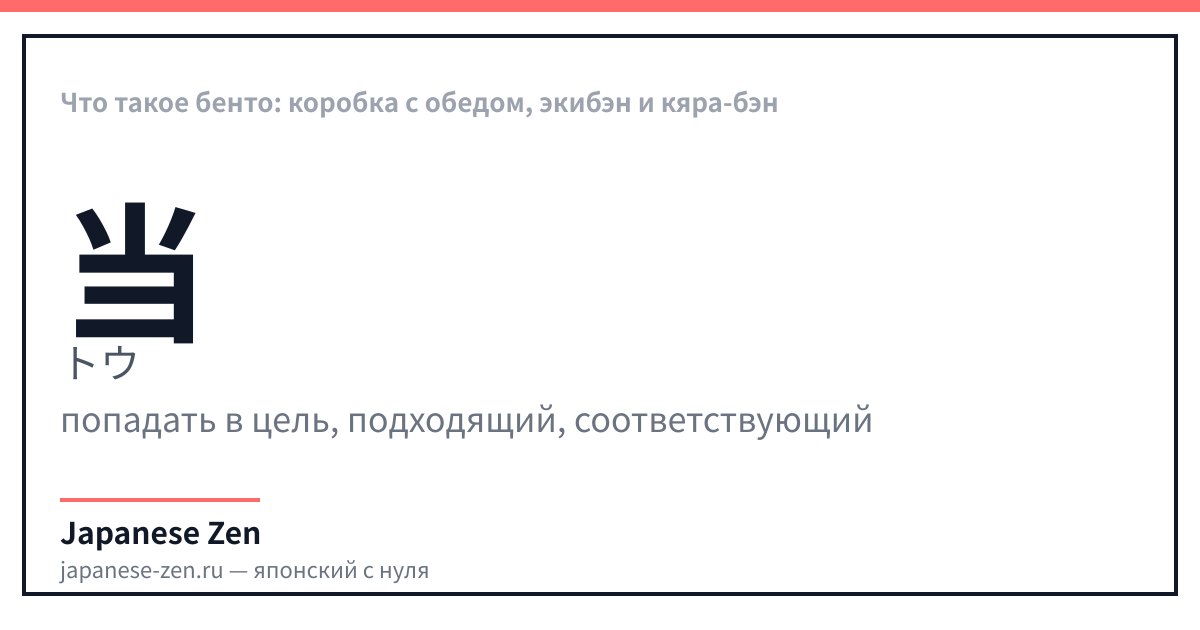
当 — значение: to hit the mark, suitable, corresponding — онъёми: トウ — кунъёми: あ.たる、あ.たり、あ.てる、あ.て、まさ.に、まさ.にべし — 6 штрих(ов). 当 — "to hit the mark, suitable": the second character of the word 弁当. The same character is in 本当 (truth) and 当たる (to hit, come true).
The on'yomi of the character 当 is トウ (tō), the kun'yomi is あ.たる (ataru), "to hit." Both readings sound far beyond food: 本当 (hontō) means "truth," 当日 (tōjitsu) — "that very day," and 当たる — "to hit" or "come true," for example about a weather forecast.
弁 — The Sign That Absorbed Three Different Old Ones
Before the writing reform, the old form of the character in the word "bento" was 辨 — "to distinguish, recognize." But in modern Japanese the simplified character 弁 has become common for three formerly different kanji: besides 辨 "recognize," it also replaced 瓣 "petal, valve" and 辯 "speech, eloquence." That is why 弁 today has such a diverse set of meanings — from "distinguish" to "petal" and "speech."
| Japanese | Reading | Translation |
|---|---|---|
| 弁当 | bentō · bentō | Bento |
| 弁当箱 | bentōbako · bentōbako | Bento box |
| 幕の内弁当 | makunouchi bentō · makunouchi bentō | Classic bento with rice and side dishes |
| 駅弁 | ekiben · ekiben | Bento sold at train stations |
| 本当 | hontō · hontō | Truth |
| 当たる | ataru · ataru | To hit, come true |
Write 当 along the guides — the second character of the word bento, which appears in dozens of ordinary words.
FAQ
- What is bento?
- Bento is a boxed meal you take with you: to school, to work, on a trip. Most often inside is rice, a side dish to go with it, and vegetables arranged in compartments, though there is no strict rule about rice. Bento is made at home or bought already assembled — in stores, cafes, train stations, and airports.
- How does makunouchi bento differ from ekiben?
- Makunouchi bento is about the contents: rice with several side dishes in separate compartments, a classic set that took shape back in the Edo period. Ekiben is about the place of sale: any bento sold at a train station or on a train, and in form it can be anything, including the same makunouchi bento.
- What is kyaraben?
- Kyaraben is a children's bento in which rice and side dishes are shaped like characters from cartoons, games, or animals: faces made of nori seaweed, rice colored in different colors, shaped vegetables. The word itself appeared in Japanese newspapers in the 1990s, and the real trend came in the 2000s, when home cooking blogs began showing such boxes to each other; later kyaraben became known outside Japan as well.
- Is it true that the first ekiben was sold in 1885 at Utsunomiya Station?
- This is the most famous version, but not the only one: on July 16, 1885, at Utsunomiya Station, onigiri with takuan radish in bamboo wrapping was indeed sold. However, there are other contenders for the title of the first — for example, ekiben in a folding box from Himeji Station in 1890, and the debate about what counts as "first" is not closed.
- Where did the word "bento" come from?
- The word has several versions of origin. One links it to the Sengoku era, when food was quickly distributed to many people in simple dishes. Another leads to the Chinese colloquial word "便当" from the Southern Song era, meaning "convenient, by the way" — it is still found in some Chinese dialects.
- How is "bento" written in kanji?
- 弁当, read as べんとう. The old, pre-reform form of the first character is 辨, "to recognize." The second character, 当, means "to hit the mark, suitable" and appears in ordinary words like 本当 (hontō) — "truth."
Sources
Updated: 2026-09-15