Fukuoka — the "Hill of Good Fortune" and Hakata: One City with Two Names
Fukuoka is the largest city on the island of Kyushu and the center of the prefecture of the same name. The name 福岡 means "hill of good fortune": in 1601, Kuroda Nagamasa gave this name to his new castle — in honor of the family estate of Fukuoka in Bizen Province, at the other end of the country. It became a city in 1889, uniting two neighboring settlements — the samurai town of Fukuoka and the merchant town of Hakata — while the train station was named after the latter.
We'll explore what the distant Bizen Province on the other side of Japan has to do with this, how in 1890 another name — "Hakata" — almost won, and why the train station is still called something different from the city itself. And at the end — the Mongol invasions of Hakata Bay, a local festival with giant floats, and the character 博 that links Fukuoka to museums and local ramen.
A Castle from Bizen: Why the "Hill of Good Fortune" Was Named After Another Place
福岡 is read ふくおか (Fukuoka) and is made up of 福 "good fortune, happiness" and 岡 "hill." In 1600, after the victory at Sekigahara, Kuroda Nagamasa was granted Chikuzen Province on the island of Kyushu and the following year began building a new castle there. He took its name not from the place itself, but from his family history.
The Family Estate in Bizen, Hundreds of Kilometers from Kyushu
The Kuroda clan came from the village of Fukuoka in Bizen Province — today part of the city of Setouchi in Okayama Prefecture. It was in honor of this family name that Nagamasa named his new castle on Kyushu, and along with the castle, the town that grew around it.
How Samurai Fukuoka and Merchant Hakata Became One City
Until 1889, Fukuoka and Hakata were neighboring but separate settlements on the banks of the Naka River: in Fukuoka lived samurai around the castle, in Hakata — merchants and artisans. When they merged into a single city, the new name was taken from the castle half, even though merchant Hakata was no smaller and far older.
The Vote That Almost Renamed the City
In 1890, the city council proposed renaming the city to Hakata. The votes were split evenly, and the chairman's vote from the Fukuoka side was decisive — the name stayed the same. But the railway station, opened a year earlier, in December 1889, on the Hakata side, is still called "Hakata."
Mongol Invasions, a Festival with Floats, and Spicy Cod Roe
In 1274 and 1281, Hakata Bay twice became the landing site of the Mongol-Korean fleet attempting to conquer Japan — these two campaigns are known in Japanese historiography as Bun'ei and Kōan, after the era names of the time. After the first invasion, a stone defensive wall was built along the bay, the remains of which still survive.
The Yamakasa Festival and Life in Hakata Without a Castle
Merchant Hakata has long been famous for the Hakata Gion Yamakasa festival. According to legend, it dates back to 1241, when the monk Shōichi Kokushi is said to have ridden through the city on a platform and sprinkled the streets with holy water to stop an epidemic. Among local dishes are mentaiko, spicy marinated cod roe, which began to be sold in Fukuoka in the late 1940s, and rich tonkotsu ramen in pork broth, which in Japan is firmly associated with Hakata.
博 — The Character for "Vast," Which Links Hakata to Museums
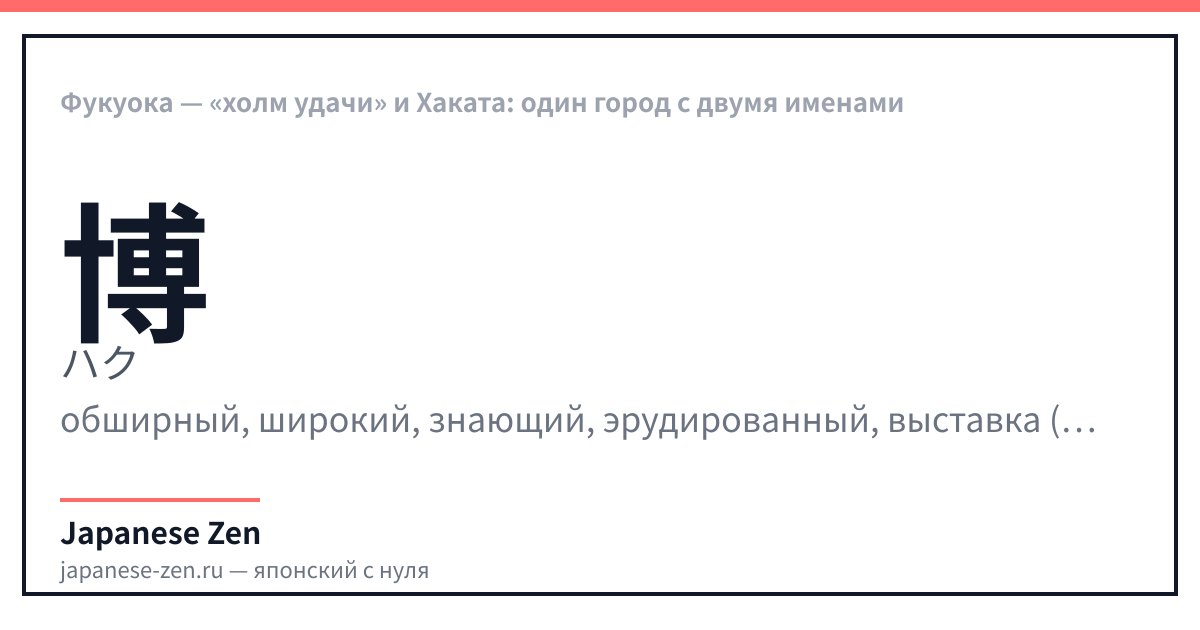
博 is read ハク or バク and means "vast, wide, knowledgeable." In the name Hakata (博多), it does not yield to a simple semantic analysis: most likely, both characters here were also chosen for their sound rather than translating the original meaning of the name.
博 — значение: vast, wide, knowledgeable, erudite, exhibition (in compounds) — онъёми: ハク、バク — 12 штрих(ов). 博 — "vast, erudite": the first character in the name Hakata, the historic merchant half of Fukuoka. The same character appears in 博物館 "museum" and 博士 "doctor of science."
Why the Card Shows 博, Not 岡
岡 "hill" from the official name Fukuoka is an ordinary terrain character, of which there are many in Japanese place names. For our topic, 博 is more important: it links the city to its second, merchant name Hakata — and many Japanese today still say "Hakata ramen" and "Hakata dialect," not "Fukuoka."
| Japanese | Reading | Translation |
|---|---|---|
| 博多 | Hakata · Hakata | Hakata — the merchant half of the city, which gave its name to the station |
| 福岡 | Fukuoka · Fukuoka | Fukuoka — the official name of the city |
| 博物館 | hakubutsukan · hakubutsukan | Museum — a common word with the same character |
| 明太子 | mentaiko · mentaiko | Spicy marinated cod roe, a local delicacy |
| 豚骨 | tonkotsu · tonkotsu | Pork bone broth for local ramen |
Write 博 along the guides — the character for "vast" from the name Hakata, the second half of Fukuoka.
FAQ
- What does the name "Fukuoka" mean?
- 福岡 means "hill of good fortune": 福 — "good fortune, happiness," 岡 — "hill." The name was given to the city in 1601 by Kuroda Nagamasa — not after the local terrain, but in honor of the family estate of Fukuoka in distant Bizen Province, where his clan came from.
- Are Fukuoka and Hakata one city or two different ones?
- Today it is one: until 1889 they were neighboring but separate settlements — samurai Fukuoka and merchant Hakata. The merged city was named Fukuoka, and in 1890 a proposal to rename it to Hakata failed on a tie vote: the council chairman's vote decided it.
- Why is the station in Fukuoka called "Hakata"?
- The station was opened in December 1889 on the land of historic Hakata and named after the place. When a year later the dispute over the city's name was decided in favor of Fukuoka, the station's name remained the same — so the city ended up with two names: one on the map, another on the train departure boards.
- What do the Mongol invasions have to do with this?
- In 1274 and 1281, the Mongol-Korean fleet landed twice at Hakata Bay, trying to conquer Japan — these campaigns are known as Bun'ei and Kōan. After the first invasion, a stone defensive wall was built along the coast, the remains of which survive today.
- What food is Fukuoka famous for?
- Rich tonkotsu ramen in pork broth, which in Japan is firmly associated with Hakata, and spicy marinated cod roe mentaiko — it began to be sold here in the late 1940s. Both dishes have long spread far beyond Kyushu and are sold all over the country.
- What is behind the kanji in the names Fukuoka and Hakata?
- Fukuoka — 福岡, "hill of good fortune," a name brought from Bizen Province. Hakata — 博多, where the first character 博 means "vast," but both characters here were probably also chosen for their sound rather than their meaning. So one city ended up with two names of different origins.
Sources
Updated: 2026-09-15