Issun-bōshi — the one-sun-tall boy: Japan's "Tom Thumb"
Issun-bōshi (一寸法師) is the hero of a Japanese folk tale who is only one sun tall — about 3 centimeters. A childless old couple prays for him at Sumiyoshi Shrine. When he grows up, he sails to the capital in a rice bowl, with a sewing needle as his sword. Swallowed by an oni, the hero is saved not by strength but by his size: he stabs the demon from inside and escapes through its eye, and the terrified oni drops the magic mallet, uchide no kozuchi.
Issun-bōshi is a rare Japanese folk tale in which the hero wins not because he is strong, but because he is small: too small to be swallowed without consequences, and too awkward to fight in the usual way. Let's look at where the story came from, what Sumiyoshi Shrine has to do with it, and what the "monk" part of the name means for a hero who was never a monk.
Plot: a bowl instead of a boat and a needle instead of a sword
Issun-bōshi is born one sun tall and never grows any taller, no matter how many years pass. When he comes of age, he decides to go to the capital: a rice bowl serves as his boat, chopsticks as oars, and a sewing needle stuck in a straw as his sword in place of a scabbard. In the capital he enters the service of a noble house and falls in love with the master's daughter.
How a needle defeats the demon from the inside
When an oni attacks the girl during a pilgrimage, the demon swallows the tiny companion in one gulp. Inside, Issun-bōshi does not lose his nerve: he stabs the demon with his needle-sword, and when it becomes unbearable, he escapes through its eye — then climbs back in, repeating this until the demon flees in terror, dropping the magic mallet, uchide no kozuchi. The mallet grants wishes, and the hero's first wish is to become a grown, tall man.
From a prayer at Sumiyoshi to an otogizōshi collection
The version of the tale familiar today comes from the otogizōshi — a collection of short stories from the late Middle Ages: the exact year of composition is unknown, but scholars date it at the latest to the end of the Muromachi period. The motif of the "tiny hero" in Japanese tradition is older than the tale itself — it is traced back to the deity Sukunahikona from the myths of the creation of the land, who was also tiny and appeared by the water.
Why the hero is linked specifically to Sumiyoshi Shrine
In the old otogizōshi text, the childless old couple prays for a child not in the abstract but specifically at Sumiyoshi Shrine in Osaka — and receives a son one sun tall as a reward for their long prayer. It is also from there, from Sumiyoshi, that the hero sets off on his journey in a bowl-boat: the shrine still tells this episode on its website today.
一寸法師 — a unit of length and a word that no longer means "monk"
一寸 literally means "one sun" — an old unit of length equal to about 3 centimeters, a tenth of a shaku. 法師 literally means "Buddhist monk." But in names like 一寸法師 or 影法師 (literally "shadow-person," i.e., a silhouette), this word works differently — as a suffix for a "figure, character," not as an indication of monastic rank. The little hero of the tale was never a monk.
Sun in a proverb about the future
The same sun appears in the proverb 一寸先は闇 — "one sun ahead is darkness": it is said of how even the nearest future cannot be predicted. Here the unit of length denotes the smallest distance — a step beyond which nothing can be seen.
寸 — the sign of the measure that measured the hero
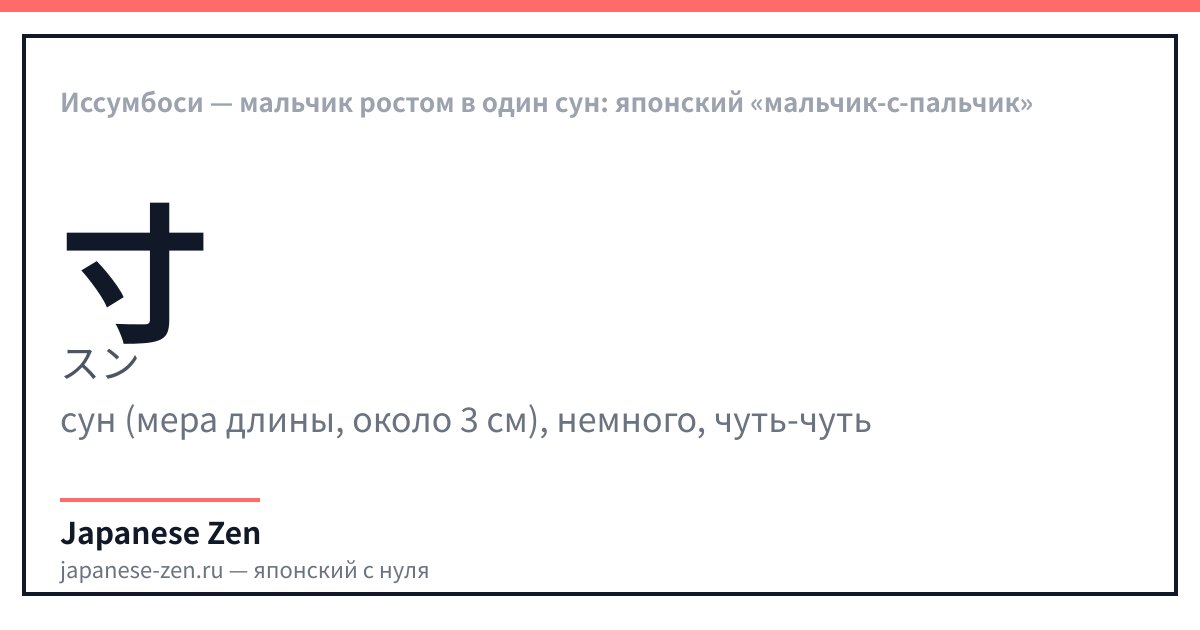
寸 — значение: sun (unit of length, about 3 cm), a little, slightly — онъёми: スン — 3 штрих(ов). 寸 — "sun," an old unit of length of about 3 centimeters, which gave the hero his name: 一寸法師 literally "a little man one sun tall." The same character appears in 寸法 "size, measurement" and in the proverb 一寸先は闇.
| Japanese | Reading | Translation |
|---|---|---|
| 一寸法師 | Issun-bōshi · Issun-bōshi | The hero's name — "a little man one sun tall" |
| 打出の小槌 | uchide no kozuchi · uchide no kozuchi | The magic mallet that grants wishes |
| 寸法 | sunpō · sunpō | Size, measurement |
| 一寸先は闇 | issun saki wa yami · issun saki wa yami | "One sun ahead is darkness" — the future is unpredictable |
| 針 | hari · hari | A needle — the hero's sword |
The only reading of the character 寸
寸 is read in only one way — スン (sun), both in the hero's name and in the word 寸法 "size." The character is simple — three strokes — and it is a convenient way to learn that in Japanese words for units of length are often written with a single kanji: 寸 sun, 尺 shaku.
Write 寸 along the guides — the unit of length that measured Issun-bōshi's height.
FAQ
- Who is Issun-bōshi in the Japanese folk tale?
- The hero of a Japanese folk tale who is one sun tall — about 3 centimeters — and never grows, no matter how many years pass. When he comes of age, he sails to the capital in a rice bowl, enters the service of a noble house, and defeats a demon with a needle instead of a sword, hiding inside it.
- How does the tiny Issun-bōshi defeat the demon?
- The demon swallows the hero whole, but inside he stabs it with his needle-sword and escapes through its eye again and again. The demon flees in terror, dropping the magic mallet, uchide no kozuchi — and with it Issun-bōshi makes himself grown and tall.
- What does Sumiyoshi Shrine have to do with it?
- In the otogizōshi text, the childless old couple prays for a son specifically at Sumiyoshi Shrine in Osaka — and receives a child one sun tall as a reward for their long prayer. It is also from there, from Sumiyoshi, that the hero later sets off on his journey in a bowl-boat.
- Why does Issun-bōshi's name contain the word "monk" if he is not a monk?
- 法師 literally means "Buddhist monk," but in names like 一寸法師 or 影法師 ("shadow-person"), this word is used as a suffix for a "figure, character," not as an indication of spiritual rank. The hero of the tale was never a monk.
- How much is one sun, Issun-bōshi's height?
- One sun is an old Japanese unit of length, about 3 centimeters, a tenth of a shaku. The same measure appears in the proverb 一寸先は闇 — "one sun ahead is darkness," meaning that even the nearest future cannot be predicted.
Sources
Updated: 2026-09-15