Momotaro — the "Peach Boy": the tale, its variants, and the hero's name
Momotaro (桃太郎) is the hero of Japan's most famous folk tale. In the familiar version, an old couple finds him inside a peach that comes floating down the river, and the boy, who grows up fast, sets off with a dog, a monkey, and a pheasant to win back treasure from the oni on Onigashima. The name literally means "peach eldest son": 桃 "peach" plus 太郎 — a common name for a firstborn son.
The familiar story of the boy from the peach took hold only in Meiji-era textbooks; before that, villages told another version too — one with a peach that didn't birth the hero but rejuvenated the old couple. Let's look at what in the Momotaro story is fixed canon, what is local legend, and why there is nothing mysterious in the hero's name.
Plot: the journey from the river to the island of demons
In the version known today, a childless old man and old woman find a giant peach in the river; when the old woman carries it home and cuts it open, a baby is inside. The boy is named Momotaro, and he grows by leaps and bounds. Learning of the oni who ravage the countryside from Onigashima, the grown Momotaro takes kibidango — millet dumplings — on his journey and along the way feeds them to a dog, a monkey, and a pheasant, who become his companions in return.
On the island the band defeats the demons and returns with the treasure they win back. The tale describes this in different ways: in some retellings, an invisibility cloak and a wish-granting mallet; in others, simply gold and coral.
Why the companions are a dog, a monkey, and a pheasant
According to one interpretation, proposed as early as 1811 by the writer Takizawa Bakin, the choice of animals is tied to Chinese geomancy. Demons come from the northeast — the direction of the "demon gate" 鬼門 — and the monkey, the rooster, and the dog are zodiac signs standing on the opposite side of the circle. This is not the only explanation, but it is the oldest one recorded in writing.
From oral tradition to school canon
Researchers date the oral prototype of the tale to the late Muromachi period — early Edo, that is, roughly the 16th–17th centuries, though an exact date cannot be given. The oldest printed edition that has come down to us is a chapbook, "Momo Taro," from 1723; earlier texts studied by historians of the genre have not survived to the present day.
The peach that at first didn't birth the hero
In printed books of the early and middle Edo period, another variant appears more often: the old man and old woman eat the peach that floats to them, grow young again, and afterward conceive a son. The variant in which the boy emerges directly from the fruit became widespread only closer to the Meiji era. It was cemented by Meiji-era school textbooks and by the writer Iwaya Sazanami's retelling at the end of the 19th century.
- The Okayama region links the tale to a local legend about the commander Kibitsuhiko, who defeated a demon named Ura — this is a local legend, not an accepted origin of the plot.
- In 2018, Japan's Agency for Cultural Affairs included "the city where the legend of Momotaro was born" in its list of Japan Heritage sites, but this is a tourism brand for the region, not proof that Okayama has historical priority.
- The propaganda feature-length animated film "Momotaro: Sacred Sailors" was released in 1945 by Shochiku studio on commission from the Navy Ministry — a rare case of a children's tale being turned directly into wartime propaganda.
太郎 — an ordinary name, 桃 — a charm against evil
桃太郎 is made of two parts: 桃 "peach" and 太郎 — the most common name for an eldest son in Japanese families, like "firstborn." By itself the name says nothing about the hero's character or his fate — it is exactly the same as the name of thousands of ordinary boys in old Japan.
Why a peach and not any other fruit
In old beliefs, the peach drives away evil spirits and is associated with longevity. In the Kojiki, the oldest collection of Japanese myths, the god Izanagi escapes from pursuers from the land of the dead by throwing peaches at them — researchers consider this episode one of the sources of the idea of the peach as a protective fruit. The peach as a charm is also linked to Momo no Sekku — the "Peach Festival," another name for the spring Hinamatsuri.
桃 — the peach sign in the hero's name
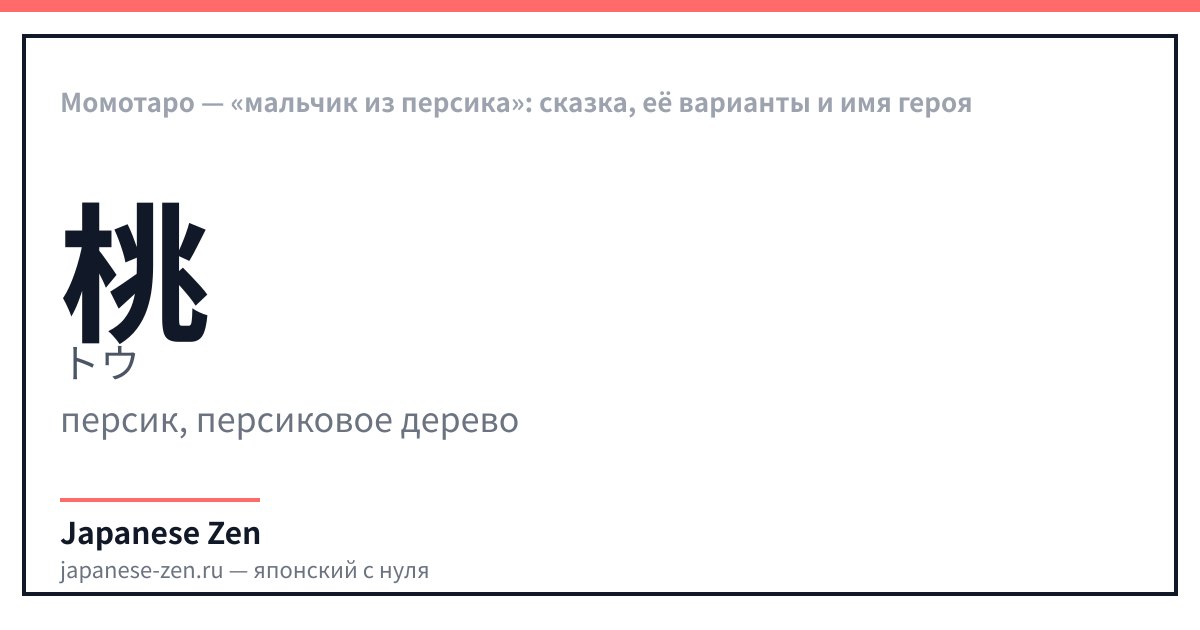
桃 — значение: peach, peach tree — онъёми: トウ — кунъёми: もも — 10 штрих(ов). 桃 — "peach," the fruit tied to the name of the tale's hero. The same sign appears in the name of the festival 桃の節句 and in the word 桃色 (momoiro) "pink, peach-colored."
| Japanese | Reading | Translation |
|---|---|---|
| 桃太郎 | Momotarō · Momotarō | The hero's name — "peach eldest son" |
| 桃 | momo · momo | Peach |
| 鬼ヶ島 | Onigashima · Onigashima | "Island of demons" — the goal of the expedition |
| 黍団子 | kibidango · kibidango | Millet dumplings that Momotaro shares with his companions |
| 桃の節句 | momo no sekku · momo no sekku | "Peach Festival" — another name for Hinamatsuri |
How 桃 is read on its own and in compound words
On its own and in everyday words, 桃 is read もも (momo) — that is simply how you say "peach." In compound words of Chinese origin, the on reading トウ (tō) is used — for example, 白桃 (hakuto) "white peach." In the hero's name, as in the word "peach," it is もも.
Trace 桃 along the guides — the peach sign that gave Momotaro his name.
FAQ
- Who is Momotaro?
- The hero of Japan's most famous folk tale: in the familiar version, a boy found inside a peach who grows up fast and, together with a dog, a monkey, and a pheasant, sets off to defeat the demons on Onigashima. The plot has no author: it lived in oral tradition, and written records appeared in the Edo period.
- Is it true that Momotaro was born directly from a peach?
- This is the best-known version, but not the only one. In printed books of the early and middle Edo period, another version appears more often: the old couple eat the peach that floats to them, grow young again, and afterward conceive a son. The variant in which the boy is born directly from the fruit became established as the main one only closer to the Meiji era.
- Why are Momotaro's companions a dog, a monkey, and a pheasant?
- According to one old interpretation, these animals are zodiac signs on the side of the circle opposite the northeastern "demon gate," from which, by belief, the oni come. This explanation was proposed in the early 19th century by the writer Takizawa Bakin; there is no universally accepted interpretation of the choice of companions.
- What does the Okayama region and the commander Kibitsuhiko have to do with it?
- This is a local legend: in Okayama, the tale is linked to the legend of the commander Kibitsuhiko, who defeated a demon named Ura. In 2018, the region was officially recognized as a Japan Heritage site as "the city where the legend of Momotaro was born," but this is a tourism status, not a proven historical origin of the plot.
- What does the name 桃太郎 mean?
- 桃太郎 is made up of 桃 "peach" and 太郎 — a common name for an eldest son in a Japanese family, like "firstborn." The name itself says nothing about the hero's character: thousands of ordinary boys in old Japan had the same name.
- What is the wartime animated film based on Momotaro?
- "Momotaro: Sacred Sailors" is a 1945 feature-length propaganda animated film by Shochiku studio, made on commission from Japan's Navy Ministry. This is a rare case of a children's tale being used directly in wartime propaganda.
Sources
Updated: 2026-09-15