Kintaro — who is he and what is he famous for
Kintaro is a legendary strong child, and mythology knows him exactly like that: he grew up in the Ashigara mountains, wrestled with bears, and visited animals without any fear. According to one version of the tale, as an adult he became the samurai Sakata no Kintoki — one of the four legendary guardians of the hero Minamoto no Raiko — and took part in the famous hunt for the demon Shuten-dōji.
Kintaro is a child version of a superhero a thousand years before comics: a child stronger than an adult bear, with an axe at the ready and absolutely zero anxiety about it.
Who Kintaro really is
Kintaro is a hero of Japanese folklore, a child with superhuman strength who grew up alone in the Ashigara mountains under the care of his mother — in some versions she is called a yamamba, a mountain hermit. The boy wrestled bears on equal terms, held mock sumo matches with monkeys and hares, and went everywhere with a masakari axe and a red bib with the character for 'gold'. His legend is considered to be partly based on a real historical figure — the samurai Sakata no Kintoki, who served the warlord Minamoto no Yorimitsu.
| Year/period | Event |
|---|---|
| Childhood | grows up wild in the Ashigara mountains, wrestles animals |
| Coming of age | noticed by warlord Minamoto no Yorimitsu, taken into service |
| Service | becomes Sakata no Kintoki — one of the four legendary guardians |
| Main feat | takes part in the squad that defeated the demon Shuten-dōji on Mount Ōe |
What happened to him later, in adult life
Even in the adult, samurai part of the legend, Kintaro retains his childlike image: he is often depicted as the same sturdy, ruddy boy with an axe, rather than a warrior in armor. The contrast between the naive strength of a child and the harsh service of a samurai became part of his iconography.
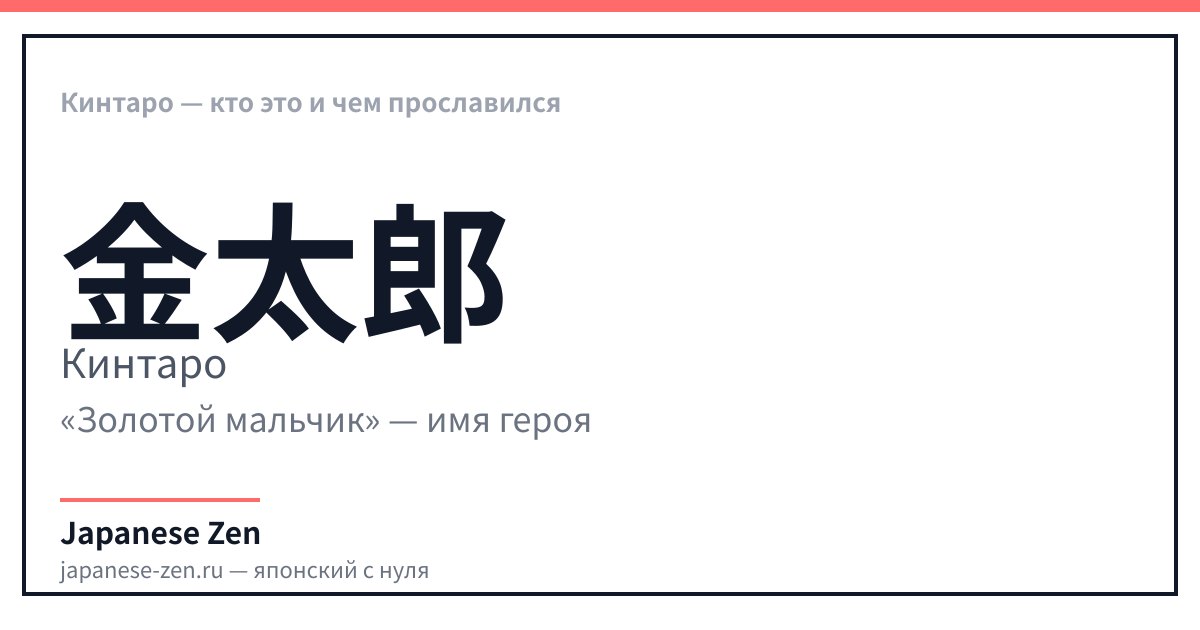
金太郎 — 'golden eldest son'
| Japanese | Reading | Translation |
|---|---|---|
| 金太郎 | Kintarō · Kintarō | 'Golden boy' — the hero's name |
| 金 | kin · kin | Gold |
| 坂田金時 | Sakata no Kintoki · Sakata no Kintoki | The hero's adult, samurai name |
| 熊 | kuma · kuma | Bear |
| 五月人形 | gogatsu ningyō · gogatsu ningyō | May doll — Kintaro figurines for Children's Day |
What the name is made of
金太郎 is read きんたろう (Kintarō): 金 'gold' plus the common name suffix 太郎 'Tarō', literally 'eldest son'. After coming of age, the same character appears under a completely different name — Sakata no Kintoki — this is common practice for Japanese legendary heroes, whose childhood nickname and adult name diverge.
金 — значение: gold — онъёми: キン、コン、ゴン — кунъёми: かね、かな-、-がね — 8 штрих(ов). 金 — 'gold, metal, money': a pictograph of nuggets in the earth. The same character appears in 金曜日 (Friday) and dozens of words about money.
Listen to the name Kintaro and repeat — the app will evaluate your pronunciation.
What was made up about him
The real Sakata no Kintoki most likely did not wrestle bears in his childhood — that part of the story appeared in folk tales much later and gradually attached itself to the more modest biography of an actual samurai. The popularity of the child image so far outpaced the adult version that today most Japanese associate the name Kintaro with the strong boy, not the warrior.
- Fact: a samurai named Sakata no Kintoki existed and served the Minamoto clan.
- Fiction: a childhood of bear wrestling is a later fairy-tale addition.
- Fact: Kintaro figurines are indeed given to boys on the May 5 holiday.
- Fiction: details of participation in the hunt for Shuten-dōji are heavily embellished in later retellings.
FAQ
- Who is Kintaro?
- A legendary strong boy from Japanese folklore who grew up in the Ashigara mountains and wrestled bears. According to legend, as an adult he became the samurai Sakata no Kintoki.
- What is Kintaro famous for?
- For his superhuman strength in childhood and, as an adult samurai, for participating in the legendary squad that defeated the demon Shuten-dōji on Mount Ōe alongside the warlord Minamoto no Yorimitsu.
- What is the name 金太郎 made of?
- 金太郎 (きんたろう): 金 'gold' plus the name suffix 太郎. In the adult part of the legend, the same hero is known by a different name — Sakata no Kintoki.
- Is Kintaro a real person or a legend?
- Partly both: the historical prototype, the samurai Sakata no Kintoki, probably existed, but the childhood with bear wrestling is a later fairy-tale addition to his biography.
- Does Kintaro appear in anime?
- The image of the boy with a red belly and an axe is periodically cited in historical and children's anime as a recognizable cultural symbol of strength and health.
- When did Kintaro live?
- The historical prototype, the samurai Sakata no Kintoki, served in the 10th century under the warlord Minamoto no Yorimitsu. The fairy-tale childhood part of the biography has no precise dating.
Sources
Updated: 2026-08-29