Yakuza — Who They Are and What They Are Famous For
Yakuza is the historical and modern name for Japanese organized crime groups. Their history does not begin with samurai, contrary to a popular myth, but with itinerant tekiya peddlers and bakuto street gamblers. The name comes from the losing card combination 8-9-3 in the game oichō-kabu. Yakuza numbers have been falling for the twentieth year in a row: in 2024 the police counted 18,800 members and associates, against more than 184,000 at the peak in the 1960s.
The yakuza are often called the heirs of the ronin and keepers of the samurai code of honor — this is a beautiful legend, not a fact: the real roots of these criminal groups are far more down-to-earth, from street peddlers and gamblers. The name itself comes from a losing card combination, not from martial valor. Let's look at where the name came from, what these groups do today, and why their numbers shrink every year.
Who the Yakuza Are
Yakuza (ヤクザ) is a collective name for Japanese organized crime groups whose lineage goes back not to ronin warriors but to the Edo-period classes of itinerant tekiya (的屋) peddlers and bakuto (博徒) street gamblers. The myth of samurai descendants is a later romanticization that the groups themselves happily encourage. The yakuza took their modern form in the 20th century, especially after World War II, filling the power vacuum in black markets. Today they are not historical exotica but active structures whose numbers are declining under pressure from the law.
| Name | Role | Fate |
|---|---|---|
| Kazuo Taoka (1913–1981) | 3rd head of the Yamaguchi-gumi syndicate from 1946 | Turned a regional group into the country's largest criminal syndicate |
| Yoshio Kodama (1911–1984) | Right-wing fixer, intermediary between politics, business, and the yakuza | Convicted in the Lockheed corruption case in 1976 |
| Kenichi Shinoda (b. 1942) | 6th head of the Yamaguchi-gumi from 2005, known as Shinobu Tsukasa | In 2015, under him, the syndicate suffered its largest split — the Kobe-Yamaguchi-gumi broke away |
What the Yakuza Actually Do
Historically, the tekiya peddled goods at fairs and near temples, while the bakuto ran gambling houses — both classes lived outside the normal guild structure of Edo. After World War II, the groups entrenched themselves in racketeering, loan sharking, and control over entertainment districts. Today construction contracting and financial fraud have been added, and part of the business is shifting to anonymous online groups — "tokuryū" with no office and no charter.
The Name and the Kanji: ヤクザ
The word "yakuza" has meant a loser since roughly the 19th century — from the card game oichō-kabu, where the combination of cards 8, 9, and 3 adds up to zero points, the worst hand in the game. It came to describe those who live outside the normal order — first gamblers, then the whole milieu of organized crime. The groups themselves prefer the self-designation 極道 (gokudō, "the extreme path") — originally a Buddhist term for a monk who has fully mastered the path of the Buddha.
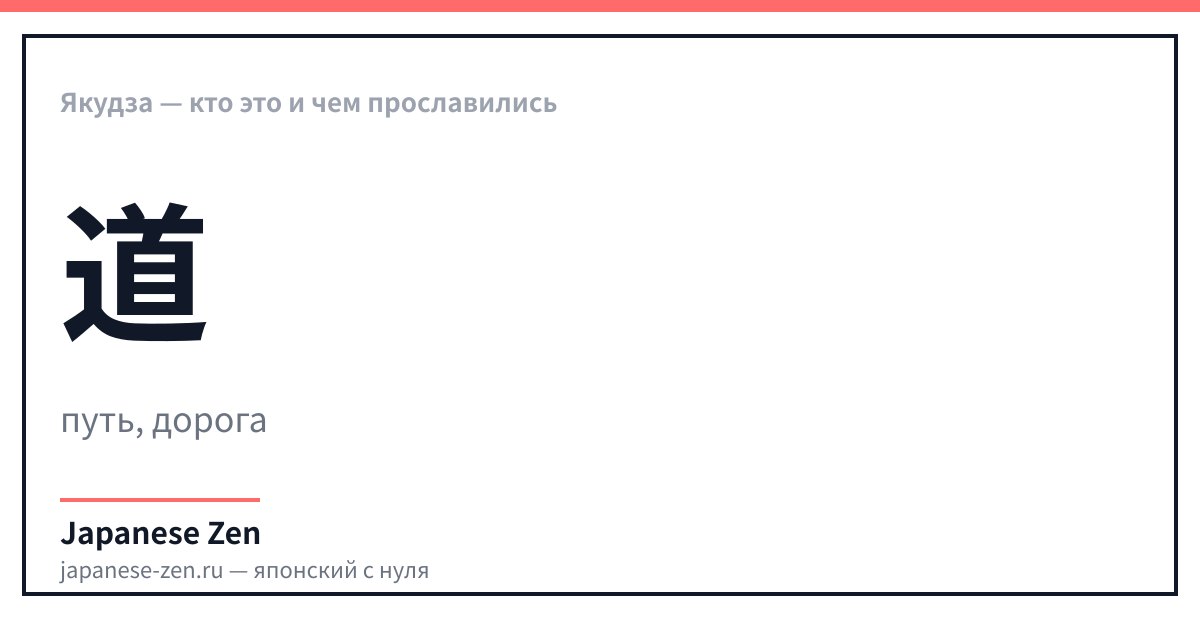
道 — значение: path, road — онъёми: ドウ、トウ — кунъёми: みち、いう — 12 штрих(ов). 道 — "path, road": 12 strokes, one of the most common kanji in the language. The same character appears in 柔道 (jūdō, "judo") and 剣道 (kendō, "sword fencing"); in the yakuza self-designation 極道 it stands second — "the path taken to its limit."
What the Yakuza Call Themselves
The official term 暴力団 (bōryokudan, "violent group") is not used by the groups themselves. Among them, 任侠 (ninkyō, "chivalry") is common — the image of protectors of the weak that the yakuza cultivate in films and manga about themselves. The real history is extortion, loan sharking, and financial fraud, not defending the downtrodden: the "code of honor" here remains a claimed image, not a confirmed practice.
| Japanese | Reading | Translation |
|---|---|---|
| ヤクザ | yakuza · yakuza | General name for the organization |
| 八九三 | yakuza · yakuza | Kanji spelling "8-9-3": the losing card combination in oichō-kabu from which the word comes |
| 極道 | gokudō · gokudō | "The extreme path" — the self-designation the yakuza prefer to the official term |
| 組 | kumi · kumi | Group, clan — used in names like 山口組 (Yamaguchi-gumi) |
| 任侠 | ninkyō · ninkyō | "Chivalry" — the image the yakuza cultivate about themselves |
| 組長 | kumichō · kumichō | Clan head, boss |
Write 道 along the guides — the second character in the yakuza self-designation 極道.
What Is Happening with the Yakuza Today
Since 1992, a law against bōryokudan has been in force, and from 2010–2011 all 47 prefectures introduced "bōryokudan exclusion" ordinances: companies are forbidden to do business with them under threat of public disclosure of the violator's name. Numbers have been falling for the twentieth year in a row. According to the National Police Agency, in 2024 there were 18,800 members and associates in the country — 1,600 fewer than the year before. Of these, 9,900 are full members — for the first time fewer than ten thousand, compared with over 80,000 in 2009 and more than 184,000 at the peak in the 1960s. An aging membership and local ordinances are pushing the business into a new form — tokuryū: anonymous online groups that recruit operatives through social media.
The cultural footprint has outlived the decline in numbers. The video game franchise Ryū ga Gotoku (known in the West as Yakuza, since 2005) is built around former yakuza Kazuma Kiryu and the fictional district of Kamurocho, modeled on Tokyo's Kabukichō. The manga and anime Gokusen (2000–2007) — about the heiress of a yakuza clan who becomes a schoolteacher — was adapted both into a drama and into a 2004 anime. And The Way of the Househusband (極主夫道) plays on the word 極道 itself: a legendary yakuza swaps the battlefield for the kitchen, and the title replaces the yakuza "path" with the "path of the househusband."
FAQ
- "Yakuza history": what is this organization?
- Yakuza is the collective name for Japanese organized crime groups that trace their lineage to itinerant tekiya peddlers and bakuto street gamblers, not to samurai ronin, contrary to a popular myth. Today they are active criminal structures, not historical exotica: their numbers have been falling for two decades.
- When did the yakuza appear?
- The prototypes of the yakuza — tekiya peddlers and bakuto gamblers — took shape in Japanese cities by the 17th–18th centuries, in the Edo period. The word itself in this meaning became established later, in the 19th century, and the groups acquired their organized modern form in the 20th century, especially after World War II.
- What does the name "yakuza" mean?
- "Yakuza" comes from the card game oichō-kabu: the combination of cards 8, 9, and 3 adds up to the worst score in the game — zero points. It originally referred to losers and people outside the normal order, and later to the whole milieu of organized crime.
- What do the yakuza do?
- Historically — gambling, racketeering, and street peddling; later — loan sharking, control over the entertainment business, and ties to the construction industry. After the laws of the 1990s and the decline in numbers, part of the criminal business is shifting to anonymous online groups — "tokuryū."
- Where are the yakuza shown in games and anime?
- The video game series Ryū ga Gotoku (known in the West as Yakuza) is built around former yakuza Kazuma Kiryu. The manga and anime Gokusen is about the heiress of a yakuza clan who becomes a schoolteacher. The Way of the Househusband plays on the word 極道 itself — a legendary yakuza becomes a househusband.
- How many yakuza are there now?
- According to Japan's National Police Agency, in 2024 the country counted 18,800 members and associates of the yakuza — 1,600 fewer than the year before, and the twentieth consecutive year of decline. Of these, 9,900 are full members, for the first time fewer than ten thousand.
Sources
Updated: 2026-09-11