Urashima Taro — the fisherman, the Ryugu-jo palace and the forbidden box
Urashima Taro (浦島太郎) is a fisherman from a well-known Japanese tale: he saves a turtle, which carries him to the palace of the sea lord Ryugu-jo, where the princess Otohime lives. After spending several years in the palace, Urashima returns home with the forbidden box tamatebako and, opening it against the warning, instantly turns into an old man — on land not years but centuries had passed.
Urashima Taro is one of the few Japanese tales with a precise written lineage. The story of a man who sailed to another world and returned centuries later was recorded as early as the 8th century under a different name and with a different ending. Let us examine what changed in the tale over thirteen centuries and how an ordinary box became a metaphor for irreversible change.
Plot: the turtle, the palace and the box that must not be opened
In the version known today, the fisherman Urashima Taro saves a turtle that is being tormented by village children. A few days later it swims back and carries him on its back to the underwater palace Ryugu-jo, where Urashima is greeted by the princess Otohime — it turns out the turtle was her form. After staying in the palace for several years, the fisherman begins to long for home and asks to be released.
Why the box must not be opened
As a farewell, Otohime gives him the box tamatebako and strictly forbids him to open it. On the shore, Urashima finds neither his home nor familiar faces: on land not days but long years had passed. In despair he opens the box — white smoke rises from it, and the fisherman instantly turns into a very old man: the youth he had lost during the years in the underwater palace was stored in it.
From the 8th-century Nihon Shoki to the tale of the fisherman
The story of a man who sailed to another world is recorded in the earliest Japanese written monuments — the Nihon Shoki (720), the Man'yoshu and a surviving fragment of the provincial gazetteer Tango no kuni fudoki. In the Nihon Shoki, under the 22nd year of the reign of Emperor Yuryaku, that is 478, it is briefly mentioned how Urashimako from the province of Tanba (later these lands were separated as Tango) caught a large turtle in the sea. It turned into a beautiful woman, and together they set off for the land of Horai.
How the ancient version differs from the tale
In the early records the hero is not called Urashima Taro but Urashimako (浦嶋子, where 子 is an honorific name suffix). And the land he reaches is not called Ryugu-jo but Horai or Tokoyo — a mythical land of immortals, not an underwater palace. The motif of the saved turtle that repays kindness and the palace Ryugu-jo appeared in the otogizoshi of the Muromachi period, and the name of the princess Otohime became established even later.
浦島太郎状態 — a tale that became a diagnosis for those who lag behind
浦島太郎状態 ("Urashima Taro state") is how in Japanese one speaks of a person who has long fallen out of familiar life and, on returning, discovered that everything around had changed. A typical example is an employee returning from a long leave, who finds new faces and unfamiliar rules at work. The same tale gave its name to a physics term — 浦島効果, the "Urashima effect." In Japan this is what relativistic time dilation is called when moving close to the speed of light — a reference to the fact that in the palace Ryugu-jo years passed differently than on land.
The box that became a word for a secret
The word 玉手箱 (tamatebako) has long lived separately from the tale: it refers to a carefully kept thing that is shown to no one — a "treasure under lock and key." And the expression 開けてびっくり玉手箱 "open the box and gasp" is said when inside there turned out to be something completely different from what was expected.
亀 — the turtle that turned a fisherman's life upside down
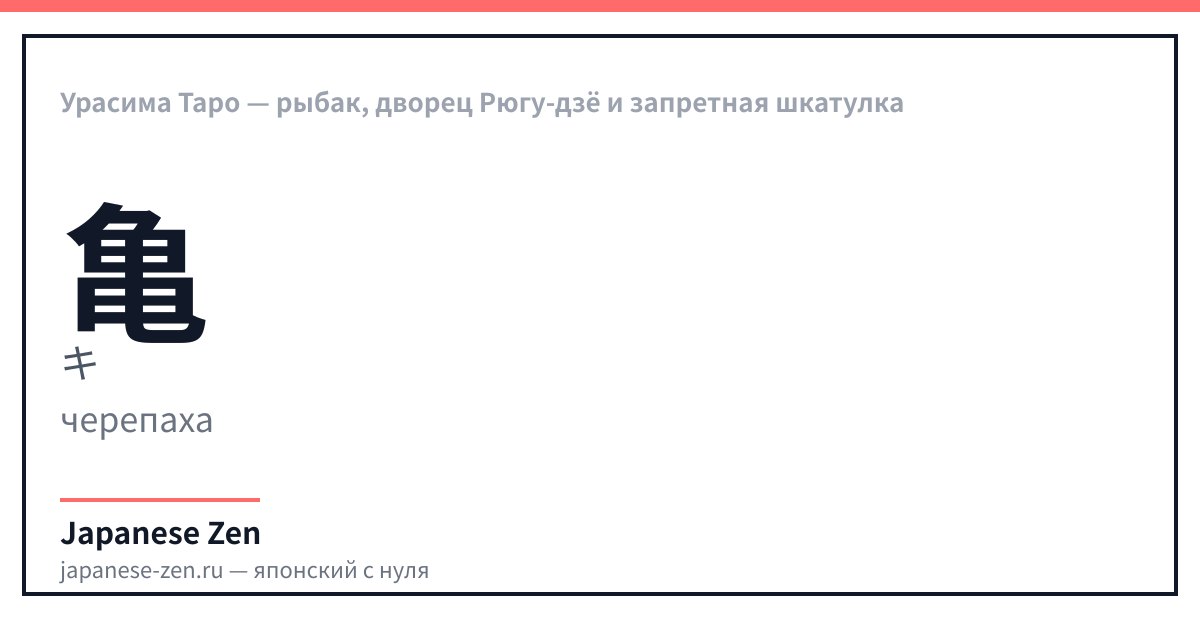
亀 — значение: turtle — онъёми: キ、キュウ、キン — кунъёми: かめ — 11 штрих(ов). 亀 — "turtle," the animal with which the whole tale begins: if Urashima had not saved the turtle, there would have been neither the palace nor the box. The same character appears in the proverb 鶴は千年、亀は万年 about longevity.
| Japanese | Reading | Translation |
|---|---|---|
| 浦島太郎 | Urashima Tarō · Urashima Tarō | Name of the tale's hero |
| 亀 | kame · kame | Turtle |
| 竜宮城 | Ryūgū-jō · Ryūgū-jō | Palace of the sea lord |
| 玉手箱 | tamatebako · tamatebako | The forbidden box — the source of forgotten old age |
| 鶴は千年、亀は万年 | tsuru wa sennen, kame wa mannen · tsuru wa sennen, kame wa mannen | "The crane lives a thousand years, the turtle ten thousand" — a wish for longevity |
How 亀 is read on its own and in compound words
On its own, 亀 is read かめ (kame) — the ordinary word for "turtle." In compound words of Chinese origin it has the Sino-Japanese reading キ (ki), but in the hero's name and in everyday speech it is almost always かめ.
Write 亀 along the guides — the character for the turtle with which the tale of Urashima Taro begins.
FAQ
- Who is Urashima Taro?
- A fisherman from a well-known Japanese tale who saves a turtle and in gratitude is brought to the underwater palace of the sea lord Ryugu-jo. Returning home with the forbidden box, he opens it against the warning and instantly ages: on land not years but centuries had passed.
- Why was it forbidden to open the tamatebako box?
- In the box, according to the tale, was stored the youth that Urashima had lost without noticing during his years in the palace. Opening it against the princess Otohime's prohibition, he instantly grew old — white smoke rose from the box, and time caught up with him in a single moment.
- Does the tale of Urashima Taro have an ancient written record?
- Yes: in the Nihon Shoki (720), under the 22nd year of Yuryaku's reign, that is 478, it is briefly recorded how Urashimako caught a turtle that turned into a woman and sailed away with her to the land of Horai. A similar story appears in the Man'yoshu and in a surviving fragment of the Tango no kuni fudoki.
- How did the early version of the tale differ from today's?
- In the early records the hero is called Urashimako, and the land he reaches is Horai or Tokoyo, the land of immortals, not an underwater palace. The saved turtle and Ryugu-jo appeared in the otogizoshi of the Muromachi period, and the name Otohime became established even later.
- What does the expression "Urashima Taro state" mean?
- 浦島太郎状態 is said of a person who has long fallen out of familiar life and, on returning, discovered that everything around had changed without them — for example, an employee returning from a long leave. From the same tale, Japan also names the "Urashima effect" 浦島効果 — time dilation when moving close to the speed of light.
Sources
Updated: 2026-09-15