Shuri Castle — the palace of the Ryukyu kings on Okinawa
Shuri Castle was the residence of the Ryukyu kings from 1406 to 1879 in the city of Naha on Okinawa: its Chinese-Ryukyuan architecture and red lacquer sharply distinguish it from Japanese castles. The fortress was destroyed by fire in the Battle of Okinawa in 1945, rebuilt in 1992, and on October 31, 2019, the main hall burned down again. It is now being restored: the reconstruction is promised to be finished by autumn 2026.
Shuri is a gusuku unlike Japanese castles: the fortress of a kingdom that balanced between China and Japan for centuries and left its mark on the palace architecture itself. Let's look at what the kanji 首里城 mean, how this place differs from mainland castles, and what state the famous reconstruction is in after the 2019 fire.
Shuri Castle: the palace of the Ryukyu Kingdom
Shuri Castle (首里城) in Naha on Okinawa was the residence of the Ryukyu kings from 1406 to 1879. The kingdom paid tribute to China for centuries, and from 1609 it also depended on the Japanese Satsuma domain. Chinese influence is visible in the architecture: instead of the white plaster of Japanese tenshu, there is red lacquer, and the layout is closer to Chinese palaces than to Japanese fortresses. Okinawan fortresses are written with the same character 城, but read グスク (gusuku).
- Residence of the royal dynasty from 1406 to 1879, until the islands were annexed by Japan
- Chinese-Ryukyuan architecture: red lacquer instead of white plaster, carved dragons on the ridge of the main hall
- Destroyed in the Battle of Okinawa in 1945 — the Japanese army headquarters was located under the castle
- Rebuilt in 1992
- Burned again on October 31, 2019 — this time the main hall and several other buildings
- Since 2000, the castle ruins have been part of the UNESCO site "Gusuku and Related Properties of the Kingdom of Ryukyu"
首里城: "main village" or the Okinawan sui
首里城 is read しゅりじょう (Shuri-jō): 首 "head, main", 里 "village", 城 "castle". Shuri was the capital of the kingdom for centuries, and the reading "main village" suits it. But in Okinawan the place is called スイ (sui), and the castle すいぐしく (suigushiku), so the characters may have been chosen to match the local sound as well.
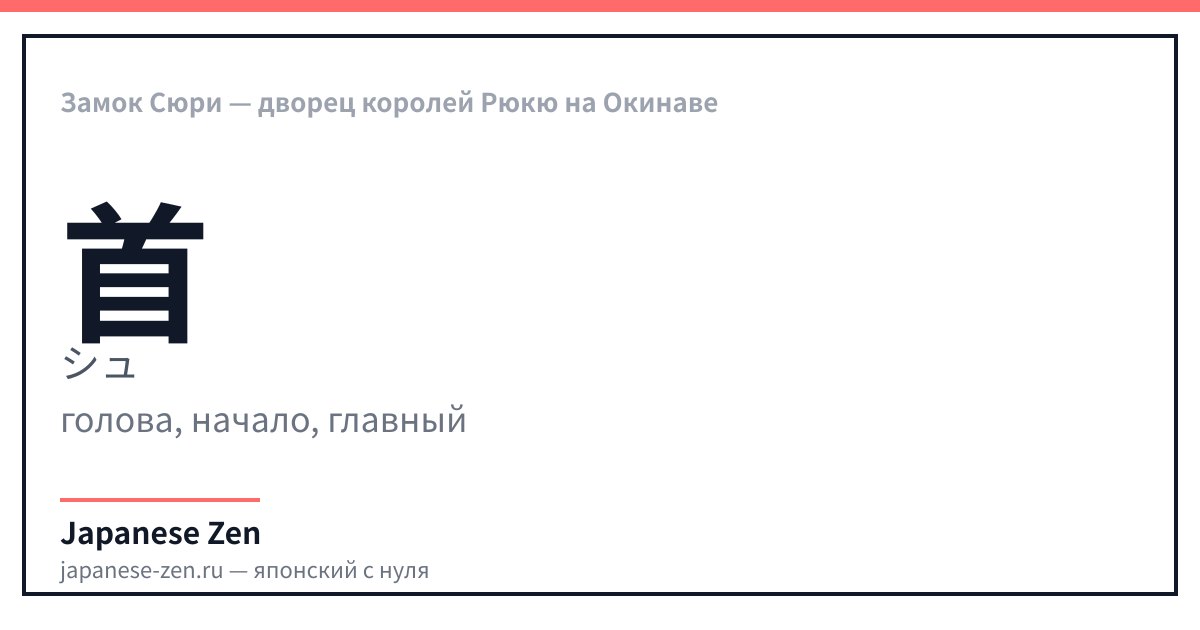
首 — значение: head, beginning, main — онъёми: シュ — кунъёми: くび — 9 штрих(ов). 首 — "head, beginning, main": the first character in the name of Shuri, the historical capital of the Ryukyu Kingdom.
| Japanese | Reading | Translation |
|---|---|---|
| 首里城 | Shuri-jō · Shuri-jō | The name of the castle |
| グスク | gusuku · gusuku | The Okinawan word for a fortress — the local equivalent of the Japanese 城 |
| 正殿 | seiden · seiden | The main hall of the castle — the very building that burned down in 2019 |
| 琉球王国 | Ryūkyū Ōkoku · Ryūkyū Ōkoku | The Ryukyu Kingdom — the state to which the castle belonged |
The same character in the word for "capital"
首 in a figurative sense means "first, main": the same character appears in the word 首都 (shuto) — "capital", literally "main city". And 里 in old place names usually just means "village, settlement".
Write 首 along the guides — the first character in the name of Shuri Castle.
Shuri after the fire: donations and a festival
There are not many high-profile screen adaptations of Shuri Castle — but its modern history itself resembles a story of rebirth. After the 2019 fire, funds for restoration were collected partly through public donations: thousands of people across Japan and beyond sent money to restore the main hall. The castle had already gone through a similar path after World War II, when it was rebuilt by 1992.
Today Shuri is not a movie set but a symbol of Okinawan identity: the annual Shuri Castle Festival with a procession in royal court costumes draws tourists to Naha regardless of the state of the palace itself. The wooden reconstruction of the main hall is planned to be finished by autumn 2026 — earlier than the rest of the complex's buildings.
FAQ
- What is Shuri Castle?
- Shuri Castle (首里城) in Naha on Okinawa was the residence of the Ryukyu kings from 1406 to 1879 — its Chinese-Ryukyuan architecture and red lacquer distinguish it from Japanese castles. The fortress burned several times, including in 1945 and 2019, and another restoration of the main hall is currently underway.
- How does Shuri Castle differ from Japanese castles?
- In architecture and color: instead of the white plaster of Japanese tenshu, there is red lacquer and carved dragons, and the layout is closer to Chinese palaces than to Japanese fortresses. Okinawan fortresses are written with the same character 城, but read グスク (gusuku) and are considered a special type of fortification.
- When was the fire at Shuri Castle?
- The most recent was on October 31, 2019: the fire destroyed the main hall and several other buildings. Before that, the castle burned several times, including during the Battle of Okinawa in 1945, after which it was rebuilt in 1992.
- Has Shuri Castle already been restored?
- Not completely: the wooden reconstruction of the main hall (正殿) is planned to be completed by autumn 2026, and the other burned buildings — after that. The restoration is being funded partly by public donations.
- What do the kanji in the name of Shuri Castle mean?
- 首里城 (しゅりじょう, Shuri-jō): 首 "head, main", 里 "village", 城 "castle" — together it can be read as "castle of the main village", and that suits the capital of the Ryukyu Kingdom. But in Okinawan the place is called スイ (sui), and the castle すいぐしく (suigushiku), so the characters may have been chosen to match the sound as well.
- Is Shuri Castle a UNESCO site?
- Yes, since 2000 — as part of the site "Gusuku and Related Properties of the Kingdom of Ryukyu". An important detail: the UNESCO-protected value is the underground ruins and stone foundations, not the above-ground wooden buildings, which have already been rebuilt twice.
Sources
Updated: 2026-09-13