Kobudo — Okinawan weapons: bo, sai, tonfa, nunchaku and where they came from
Kobudo (古武道) in its most common sense is the Okinawan art of weapons: bo, sai, tonfa, nunchaku and several other types studied alongside karate. In a broad sense, the word refers to old Japanese martial arts schools in general, not only Okinawan ones. The legend of peasants who supposedly invented these weapons from farm tools is a widespread version, not a proven fact.
Bo, sai, tonfa and nunchaku look like ordinary household objects, and that is no accident — but the history of each is more contested than it seems at first glance. Let's break down what actually belongs to kobudo, how it differs from karate, what the characters 古武道 mean, and where historical truth ends and the beautiful legend of unarmed peasants begins.
What kobudo is and which weapons it includes
The word "kobudo" has two meanings. In the broad sense, it refers to old Japanese martial arts schools in general (古武道, koryu), from sword fencing to archery. In the narrow and most common sense, it is the Okinawan, or Ryukyuan, art of weapons (琉球古武道, also 琉球古武術), studied alongside karate in the same dojo.
- Bo (棒) — a straight staff, the most developed kobudo weapon: training often begins with it.
- Sai (釵) — a metal trident without a blade, held in pairs.
- Tonfa (トンファー) — a stick with a side handle, spun around the forearm.
- Nunchaku (ヌンチャク) — two sticks connected by a cord or chain.
- Kama (鎌) — a fighting sickle, the same tool as in kusarigama, only without the chain.
- Eku (エーク, sometimes 櫂) — a fisherman's oar with a sharpened edge.
- Tekko (鉄甲) — metal knuckle guards, like brass knuckles.
- Tinbe and rochin (ティンベー・ローチン) — a shield of turtle shell or wood paired with a short spear.
The bo staff — the main kobudo weapon
The basic staff in kobudo is called rokushakubo (六尺棒) — "six-shaku staff." A shaku is an old unit of length, about 30.3 cm, so six shaku give roughly 180 cm: about the height of a person or slightly taller. The bo forms the foundation of many schools, and other weapons are often studied after it.
From millstone, sickle or actually from China: the origin of kobudo weapons
| Weapon | Japanese writing | What it came from (according to one version) | How it is used |
|---|---|---|---|
| Bo | 棒 | an ordinary staff for carrying loads | strikes with both ends, blocks, sweeps |
| Sai | 釵 | according to one version, not a peasant tool but a weapon of the Okinawan guard | block and trap a blade, strike with the pommel |
| Tonfa | トンファー | the handle of a hand mill or a smaller Chinese weapon (versions differ) | spinning around the forearm, strikes with the long and short ends |
| Nunchaku | ヌンチャク | horse harness or a flail for threshing grain (versions differ) | strikes with spinning, trapping and choking techniques |
| Kama | 鎌 | an ordinary sickle for harvesting | cutting strike, hooking the opponent's staff or arm |
Is it true that these are peasant tools?
The most famous version links kobudo to two prohibitions: the decree of King Sho Shin in the late 15th century, which restricted personal ownership of swords and bows, and the policy of the Satsuma clan after the subjugation of Ryukyu in 1609. According to this version, peasants turned the sickle, oar and millstone into weapons because they had no other choice — and many Okinawan schools still retell this story today.
But the version has weak points. According to Japanese reference works, even after subjugation to Satsuma, the warrior nobility (shizoku, 士族) were not deprived of weapons, except firearms. The sai appears to have been a weapon of the guard, not of peasants, and some items may have come ready-made from China and Southeast Asia.
古武道 — "the way of the ancient warrior": why the weapons have names of different spirit
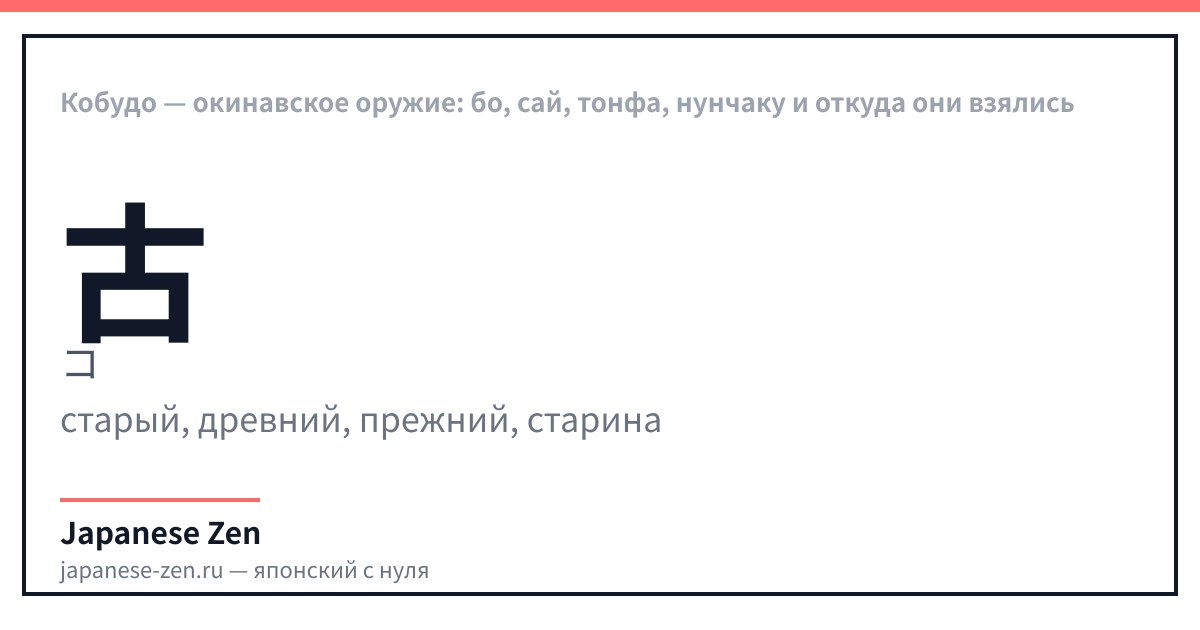
古武道 is read こぶどう (kobudō) and is made up of three characters: 古 "ancient," 武 "martial," and 道 "way" — the same second half as in budo (武道), the "martial way" of judo, karate-do and other 20th-century disciplines. In the narrow Okinawan sense, the same art is called 琉球古武道 or 琉球古武術 — "ancient martial art of Ryukyu," with an explicit reference to the region.
古 — значение: old, ancient, former, old times — онъёми: コ — кунъёми: ふる.い、ふる- — 5 штрих(ов). 古 — "old, ancient": the first character in 古武道 (kobudō). The same character appears in the ordinary adjective 古い (furui) "old."
| Japanese | Reading | Translation |
|---|---|---|
| 古武道 | kobudō · kobudō | the Okinawan art of weapons |
| 古武術 | kobujutsu · kobujutsu | the same art, a more technical name |
| 棒 | bō · bō | staff — the basic kobudo weapon |
| 釵 | sai · sai | a trident without a blade |
| 鎌 | kama · kama | fighting sickle |
| 琉球 | Ryūkyū · Ryūkyū | Ryukyu — the islands and former kingdom where kobudo developed |
Why Okinawan weapons have both Japanese and non-Japanese names
棒, 釵 and 鎌 are written with ordinary Japanese characters — these are Japanese words for universal objects: a staff, a hairpin in shape, a sickle. But トンファー and ヌンチャク are written in katakana: these are Okinawan, and according to one version partly Chinese, words that entered Japanese as loanwords, like any foreign term. Hence the inconsistency in spelling within the same list of weapons.
Write 古 along the guides — the character for "ancient" from the name "kobudo."
Kobudo weapons in film and comics: from Bruce Lee to the Teenage Mutant Ninja Turtles
- In the Teenage Mutant Ninja Turtles comics (Mirage Studios, 1984, by Kevin Eastman and Peter Laird), each turtle has his own kobudo weapon: Donatello has the bo, Raphael the sai, Michelangelo the nunchaku. Leonardo has the katana, which does not belong to kobudo.
- Bruce Lee made nunchaku famous worldwide in the film "Fist of Fury" (1972) — in the dojo fight scene.
- Elektra Natchios from Marvel comics, first appearing in Daredevil #168 (1981, by Frank Miller), fights with a pair of sai — the same weapon as Raphael.
Screen fights: spectacle instead of technique
Screen fights with nunchaku are almost always more spectacular than real technique: stunt choreographers build in continuous spinning for show, not because it is safer or more effective in a real fight. For the same reason, sai on screen are more often thrown than used to block — it looks more impressive, although in kobudo throwing the sai is not a core technique.
FAQ
- What is kobudo?
- The art of Okinawan weapons — the bo staff, sai, tonfa, nunchaku and other items — studied alongside karate. The word 古武道 itself means "ancient martial way," so it is also used for old Japanese martial arts schools in general.
- Which weapons are included in kobudo?
- The core set is the bo (staff), sai (trident), tonfa (stick with a handle) and nunchaku (two sticks on a cord). To these are added the kama (fighting sickle), eku (oar), tekko (metal knuckle guards) and tinbe with rochin — a shield and short spear as a pair.
- How does kobudo differ from karate?
- Karate is unarmed combat, while kobudo is work with weapons: bo, sai, tonfa and the rest. In Okinawa they are often studied in the same dojo because stances and footwork are largely shared, but armed and empty-hand techniques are different disciplines.
- Is it true that peasants invented kobudo?
- This is a widespread version, not a proven fact. Even after the subjugation of Ryukyu to the Satsuma clan in 1609, Okinawan aristocrats were not deprived of weapons, except firearms, and the sai was probably a tool of the guard, not of peasants. Some weapons may have come ready-made from China and Southeast Asia.
- What is the bo staff and how long is it?
- The full name of the staff is rokushakubo (六尺棒), "six-shaku staff": a shaku is an old Japanese unit of length of about 30.3 cm. Multiplying by six gives roughly 180 cm, the height of an adult. Training in kobudo often begins with this staff.
- How is "kobudo" written in kanji?
- 古武道, read こぶどう. 古 means "ancient," 武 "martial," 道 "way." The same second half of the word appears in budo (武道), the general name for judo, karate-do and other 20th-century disciplines, only without Okinawan weapons.
Sources
Updated: 2026-09-14