Nunchaku — where they really come from and what they are called in Japanese
Nunchaku are two short wooden sticks connected by a cord or chain. In Japanese they are called ヌンチャク (nunchaku): the word is Okinawan, and its etymology is unknown. The origin of the weapon itself is also disputed: some trace it to horse tack, others to a flail for threshing grain, and still others to a Chinese battle flail. The Chinese name for the weapon is 双節棍 (sōsetsukon), "a stick of two links".
Nunchaku gained worldwide fame thanks to Bruce Lee, not thanks to Japanese or Okinawan masters of the past — that is worth remembering right away. Let's look at how the weapon is constructed, why it has no single proven history of origin, how it differs from the related three-section staff and tonfa, and how to say it correctly in English — "nunchaku" or "nunchucks".
Nunchaku: construction and two versions of origin
Nunchaku are two sticks of equal length, roughly the length of a forearm, joined end-to-end by a cord or a short chain. One stick is held in the hand, the second is used to strike after a swing, or both are used as a lever to trap an opponent's neck or arm. The history of nunchaku has no single confirmed beginning: no documents that would settle the question have survived.
- Okinawan version: a flail for threshing rice or soybeans — an ordinary agricultural tool whose two connected rollers were turned into a weapon.
- Another Okinawan version: a piece of horse tack that resembles nunchaku in shape and proportions.
- Chinese version: old military treatises describe a similar battle flail, which, according to one hypothesis, reached Okinawa through trade.
Why Bruce Lee made nunchaku famous
Before the 1970s, nunchaku were almost unknown outside Okinawa and Japan. Bruce Lee showed the weapon in the film "Fist of Fury" (1972, Hong Kong) — in the dojo fight scene. In the posthumous "Game of Death" (1978, completed using 1972 footage), Lee's famous nunchaku duel against Dan Inosanto was preserved.
Nunchaku, three-section staff, tonfa and kusarigama: what's the difference
| Feature | Nunchaku | Three-section staff (三節棍) | Tonfa | Kusarigama |
|---|---|---|---|---|
| Construction | two sticks on a cord or chain | three sticks on two short chains | stick with a side handle | sickle and a chain with a weight |
| Combat distance | close, with sharp closing | close and medium at the same time | close, at grappling range | medium, by throwing the chain |
| Risk to the fighter | high: rebound strike if the grip is wrong | higher than nunchaku: harder to control three links | low: the handle fixes the grip | low with correct distance control |
Are nunchaku a ninja weapon?
No: nunchaku are an Okinawan kobudo weapon studied alongside karate, not a secret weapon of the shinobi. The image of "nunchaku in a ninja's hands" is an invention of 20th-century cinema and comics: in sources about the shinobi, this item is almost never found.
ヌンチャク and 双節棍: the Okinawan and Chinese names of one weapon
ヌンチャク is an Okinawan word, and its etymology has not been fully clarified: as with the weapon itself, the name has several versions with no clear winner. In Chinese, the same weapon is called 双節棍 (sōsetsukon): 双 "pair", 節 "joint, link", 棍 "stick, club" — together "a stick of two links". The related three-link weapon is called 三節棍 (sansetsukon).
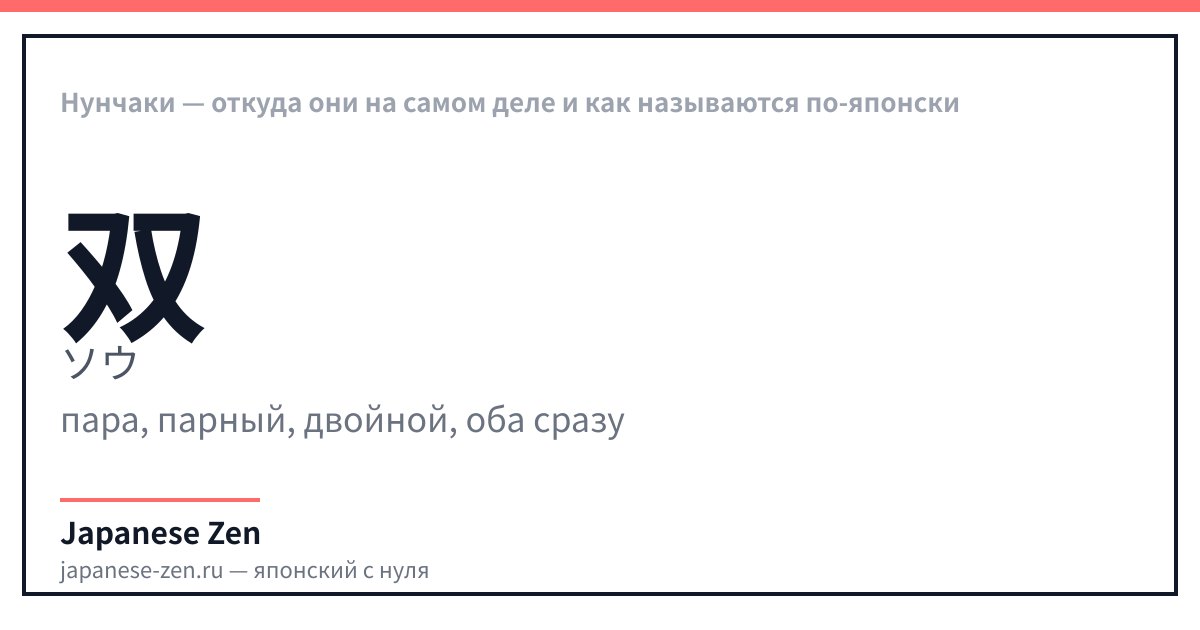
双 — значение: pair, paired, double, both at once — онъёми: ソウ — кунъёми: ふた、たぐい、ならぶ、ふたつ — 4 штрих(ов). 双 — "pair, double": the first character of the Chinese name for nunchaku, 双節棍 (sōsetsukon). In Japanese the same character appears in 双子 (futago) "twins".
| Japanese | Reading | Translation |
|---|---|---|
| ヌンチャク | nunchaku · nunchaku | the weapon itself |
| 双節棍 | sōsetsukon · sōsetsukon | Chinese name for nunchaku, "a stick of two links" |
| 三節棍 | sansetsukon · sansetsukon | related three-link weapon |
| 双子 | futago · futago | twins — a common word with the same first character |
| 棒 | bō · bō | stick, staff — a general word for many types of kobudo weapons |
| 紐 | himo · himo | cord, rope — what nunchaku sticks are often joined with |
Nunchaku or nunchucks: spelling and pronunciation
The Japanese ヌンチャク is romanized in Hepburn as nunchaku and pronounced nun-cha-ku, in three short, even syllables. In casual English the weapon is also called nunchucks; when talking about the Japanese word itself, nunchaku is the precise form.
Write 双 along the guides — the character for "pair", with which the Chinese name for nunchaku begins.
From Bruce Lee to the "Teenage Mutant Ninja Turtles": nunchaku on screen
From the training hall to movie-meme status
- Bruce Lee — "Fist of Fury" (1972) and the posthumous "Game of Death" (1978): it was these scenes that made nunchaku a recognizable weapon far beyond Asia.
- Michelangelo from the "Teenage Mutant Ninja Turtles" comics (Mirage Studios, 1984, created by Kevin Eastman and Peter Laird) — the most widely circulated fictional nunchaku fighter, though this was the authors' choice of weapon for a specific character, not a reference to real practice.
- In the comedy "Napoleon Dynamite" (2004), the title character in a famous line brags about nonexistent "nunchaku skills": the quote became a meme precisely because the viewer immediately reads nunchaku as a symbol of a goofy action-movie tough guy.
FAQ
- What are nunchaku?
- Nunchaku (ヌンチャク, nunchaku) are an Okinawan weapon made of two wooden sticks connected by a cord or chain. They are used to strike with a swing and to perform traps. They are studied in kobudo alongside the bō, sai and tonfa.
- Are nunchaku a Japanese or Chinese weapon?
- It is not known for certain. The word ヌンチャク is Okinawan, and the versions of the weapon's origin differ: some point to local horse tack or a grain-threshing flail, others to a Chinese battle flail that could have reached Okinawa through trade. No version has been definitively proven.
- What are nunchaku called in Japanese?
- ヌンチャク, read as "nunchaku". The weapon also has a Chinese name — 双節棍 (sōsetsukon), literally "a stick of two links": this word is more often used when one wants to emphasize the Chinese origin of a particular specimen or technique.
- Who made nunchaku famous?
- Bruce Lee — in the films "Fist of Fury" (1972) and the posthumous "Game of Death" (1978, completed using 1972 footage). Before these films, nunchaku were almost unknown outside Okinawa and Japan, and afterward the weapon became a recognizable symbol of martial arts cinema worldwide.
- How do nunchaku differ from a three-section staff?
- The three-section staff (三節棍, sansetsukon) is a related Chinese weapon with three links instead of two: it is longer, works at both close and medium range at once, but is also harder to control. Nunchaku are more compact and simpler in basic technique.
- Is it true that nunchaku are a ninja weapon?
- No. Nunchaku are an Okinawan kobudo weapon studied alongside karate, not secret shinobi equipment. The persistent image of "nunchaku in a ninja's hands" took shape in 20th-century cinema and comics and is almost unconfirmed in historical sources about the shinobi.
Sources
Updated: 2026-09-14