Tonfa — the Okinawan side-handle baton: from kobudo to police
The tonfa is an Okinawan baton about the length of a forearm, with a short handle fixed at a right angle near one end: this lets you spin the stick around your forearm and strike with either the long or the short arm. Its origin is disputed — a hand mill handle or a scaled-down copy of the Chinese weapon 拐 (guai). The American police baton PR-24 also descends from it.
The tonfa is a rare case where an Okinawan kobudo weapon did not remain a historical exhibit but directly influenced 20th-century police equipment. Let's look at the design and the theories of the baton's origin, the difference between the tonfa and its descendant the PR-24, what the rare spelling 旋棍 means, and in which games characters fight with it.
Tonfa: design, theories of origin, and the path to the police
The tonfa is a straight wooden stick about the length of a forearm, with a short handle fixed perpendicularly about a third of the way from one end. Gripping the handle gives two working arms — long and short — and allows you to freely rotate the stick around your forearm, moving from strike to block with a single turn of the wrist. The tonfa is usually held in pairs.
Where the tonfa came from: millstone or China
There is no single proven origin for the tonfa — there are two main theories, and neither is considered conclusive. One traces the tonfa's shape to the removable handle of a hand millstone used for grinding grain. The other says that the larger Chinese weapon 拐 (guai) reached Ryukyu and over time was reduced to its present size.
The tonfa in police use
In the early 1970s, the American Lon Anderson developed a side-handle police baton based on the tonfa — the Monadnock company's model known as the PR-24. It allowed officers to block a strike, restrain an offender, and strike with the long arm much like the Okinawan weapon. The PR-24 was adopted by many police departments in the United States.
旋棍 — 'rotating stick': the literary name of the tonfa
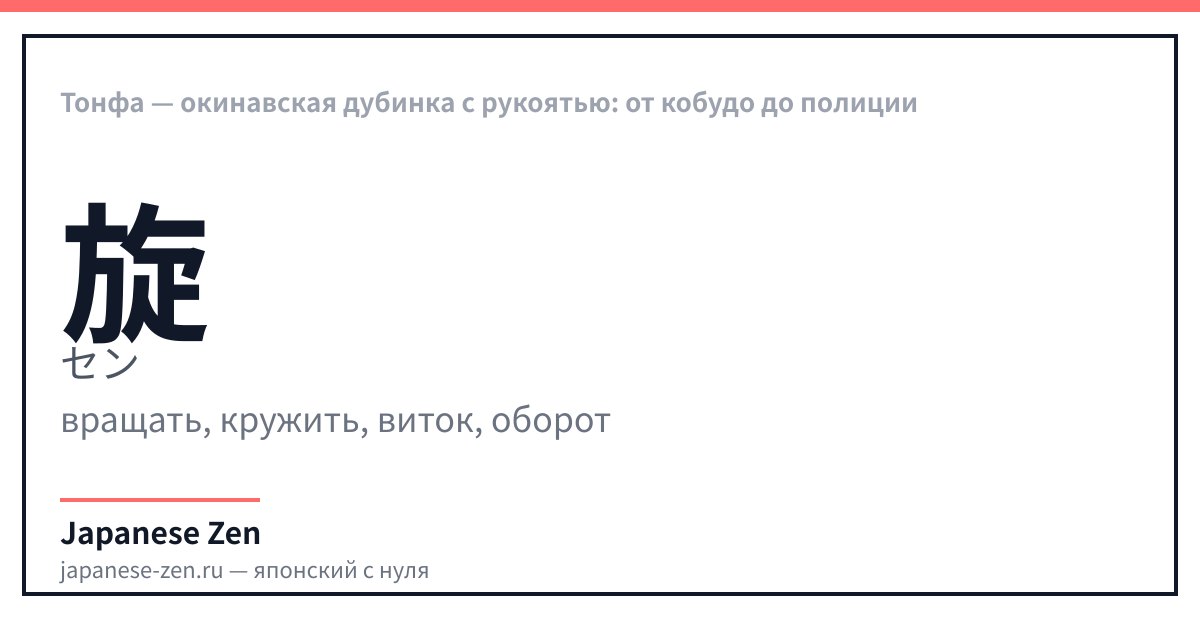
旋 — значение: to rotate, to turn, a turn, a revolution — онъёми: セン — кунъёми: め.ぐる、いばり — 11 штрих(ов). 旋 — 'to rotate, to turn': the character from the literary Japanese name of the tonfa, 旋棍 (senkon), which describes the weapon's main technique — rotation around the forearm.
トンファー is an Okinawan word, and its exact etymology is not established, just as with nunchaku. In Japanese, the weapon has a separate literary name — 旋棍 (senkon), 'rotating stick': 旋 'to rotate', 棍 'stick, club'. In everyday use, Japanese almost always use the katakana トンファー, while 旋棍 appears in specialized kobudo literature.
| Japanese | Reading | Translation |
|---|---|---|
| トンファー | tonfā · tonfā | the weapon itself |
| 旋棍 | senkon · senkon | the literary Japanese name for the tonfa, 'rotating stick' |
| 棒術 | bōjutsu · bōjutsu | the art of fighting with a staff, a neighboring kobudo discipline |
| 古武道 | kobudō · kobudō | the Okinawan martial art of weapons, which includes the tonfa |
| 警棒 | keibō · keibō | police baton — a general word that also covers the tonfa's descendant |
How 警棒 differs from a tonfa with a handle
警棒 (keibō) simply means 'police baton', a general word for any form, straight or with a handle. A side-handle baton like the PR-24 is only one type of keibō, not a synonym: an ordinary straight baton is also a keibō, but has nothing to do with the tonfa.
Write 旋 along the guides — the character for 'rotation' from the literary name of the tonfa, 旋棍.
Tonfa in video games: Jax and Maki
Which video game fighters wield the tonfa
- Jax from 'Mortal Kombat: Deadly Alliance' (2002, Midway) switches to a fighting style with tonfa.
- Maki, who first appeared in 'Final Fight 2' (1993, Capcom), and later in 'Capcom vs. SNK 2' and 'Street Fighter Alpha 3 MAX', fights with the tonfa: this weapon defines her entire fighting style.
FAQ
- What is a tonfa?
- The tonfa is an Okinawan wooden baton with a short handle fixed perpendicularly near one end. Gripping the handle gives a long and a short arm and allows you to rotate the stick around your forearm, moving from strike to block. The tonfa is usually held in pairs.
- Where did the tonfa come from?
- It is not known for certain: two theories compete, and neither can be considered proven. One derives the tonfa's shape from the removable handle of a hand millstone. The other speaks of the larger Chinese weapon 拐 (guai), which was reduced in size after it reached Ryukyu.
- Are the tonfa and the police baton the same thing?
- No, they are different objects based on the same idea. The tonfa is an Okinawan kobudo weapon, wooden and used in pairs. Based on it, in the early 1970s the American Lon Anderson developed the PR-24 baton for US police — with a side handle, but usually made of plastic and carried one per belt.
- How do you say 'tonfa' in Japanese?
- トンファー is the usual katakana spelling used in conversation. The weapon also has a literary Japanese name, 旋棍 (senkon), 'rotating stick', but it is hardly used in everyday speech — it appears in specialized kobudo literature.
Sources
Updated: 2026-09-14