Sai — the Okinawan truncheon: how it's built and why it was carried in pairs
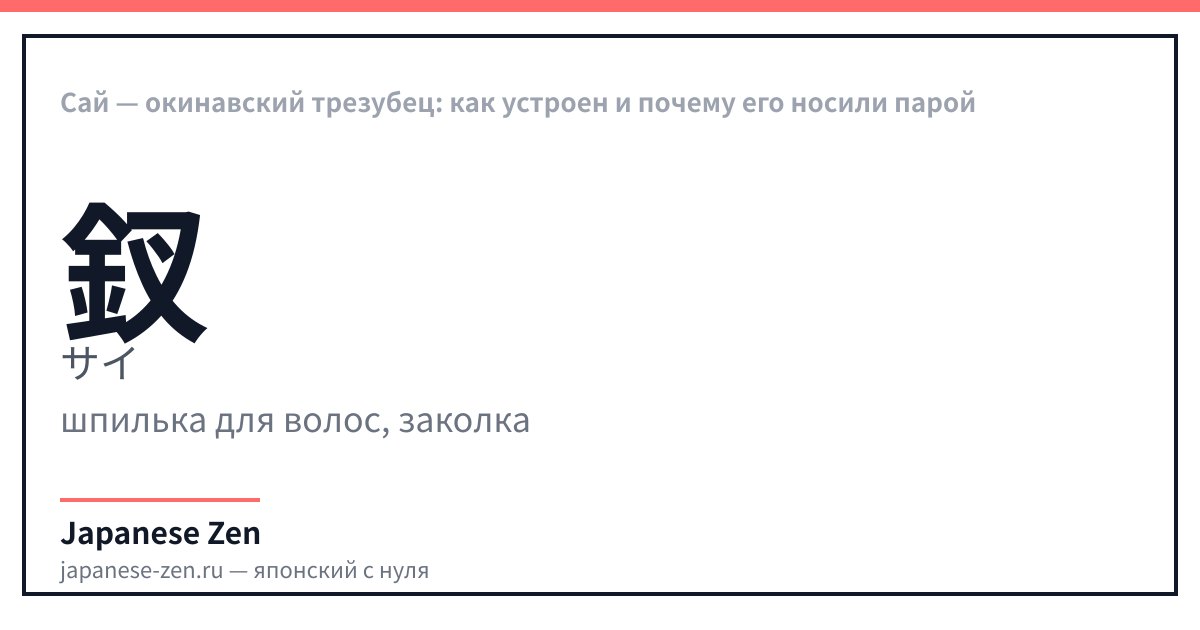
The sai weapon is an Okinawan truncheon: a steel central shaft and two curved side guards on a short handle, with no blade at all. The name 釵 (sai) literally means "hairpin" — the weapon was named for its similar shape. Fighters held it in pairs, blocked and caught the opponent's blade with the guards, and finished the technique with a strike from the blunt pommel.
The sai looks menacing, but by one account it began life not as a peasant's weapon at all, but as equipment of the Okinawan guard. Let's break down the truncheon's structure, how it differs from the jitte and an ordinary dagger, what the kanji 釵 means, and why in movies the sai is more often thrown than used for its intended purpose — blocking and trapping.
Sai: structure and who used it
The sai consists of four parts. The central steel shaft (物打ち, monouchi) is the main thrusting and striking element. Two curved side guards (翼, yoku) extend from its base in the same direction. The handle (柄, tsuka) is sized for one grip, and the blunt pommel (柄頭, tsuka-gashira) caps it at the end. No part is sharpened like a blade — the sai works by thrusting, striking, and trapping, not by cutting.
- Monouchi (物打ち) — the central shaft, the point for thrusting strikes.
- Yoku (翼) — the side "wing" guards, used to catch and hold the opponent's blade or staff.
- Tsuka (柄) — the handle for a single grip.
- Tsuka-gashira (柄頭) — the blunt pommel of the handle for close-range strikes.
What the sai is actually for
The main techniques are blocking the opponent's weapon with the guards, trapping and disarming with a pull, thrusting with the monouchi, and finishing with the pommel at close range. The sai was carried in pairs, and some kobudo schools also describe the custom of tucking a third sai into the belt — as a spare, in case one of the pair was thrown at an opponent or knocked from the hand. In the Ryukyu Kingdom the sai is associated primarily with the 大筑 (ufuchiku) — guard captains — and the 筑佐事 (chikusaji) — their subordinates, who captured criminals and dispersed crowds. The version about this particular weapon's peasant origin is supported far more weakly than for the sickle or the oar.
Sai, jitte, and dagger: three ways to disarm an opponent
| Feature | Sai (釵) | Jitte (十手) | Tanto / dagger |
|---|---|---|---|
| Region and period | Ryukyu, guards and officials | Edo-period Japan, doshin guards | everywhere, various classes |
| Does it cut? | no, only thrusts and strikes | no, most models have only a hook and a striking part | yes, a full blade |
| How it disarms | catches the blade between shaft and guard | catches the blade with a hook at the base | does not disarm — it cuts and thrusts |
| How it was carried | in pairs, sometimes with a third as a spare | one at a time, at the belt | one or a pair, as a primary or secondary weapon |
Sai and jitte — related or coincidence?
Sources do not prove a direct kinship, but the resemblance is no accident: both ideas solve the same problem — catching a blade with a hook without being cut. The sai was even called "nanban jitte" (南蛮十手), "the jitte from the south," emphasizing its visual similarity to the mainland guard's weapon. Yet they are built differently: the sai's guards are set wider and enclose the blade or arm entirely, while the jitte's hook is usually single and smaller.
釵: how a hairpin's name became a weapon's name
釵 is read さい (sai) and in dictionaries first of all means kanzashi — a woman's hairpin decorated with tortoiseshell or metal. The weapon got the same name from the similarity of silhouette: the central shaft resembles a long hairpin, and the side guards its curve. The character itself is composed of 金 "metal" and 叉 "fork" — also a reference to the forked shape.
釵 — значение: hairpin, hair clip — онъёми: サイ、サ — кунъёми: かざし、かんざし — 11 штрих(ов). 釵 — "hairpin": the same character names a lady's ornament and the Okinawan weapon that took its name from the similar shape.
Why the name comes from an ornament, not from battle
This happens not only with the sai: Okinawan weapons are more often named after the everyday object they resemble than after their combat purpose. Bo is simply "staff," kama is "sickle," and sai is "hairpin": the name describes the shape, not what you do with it in a fight.
| Japanese | Reading | Translation |
|---|---|---|
| 釵 | sai · sai | the weapon itself |
| サイ術 | saijutsu · saijutsu | the art of fighting with the sai |
| 十手 | jitte · jitte | a hooked club, the weapon of Edo-period guards |
| 簪 | kanzashi · kanzashi | hairpin — the sai got its name from it |
| 物打ち | monouchi · monouchi | the central shaft of the sai |
Trace 釵 along the guides — the character for "hairpin" that became the weapon's name.
The sai in comics: Raphael, Elektra, and the myth of throwing
- Raphael from the Teenage Mutant Ninja Turtles comics (Mirage Studios, 1984, by Kevin Eastman and Peter Laird) is the most recognizable wielder of a pair of sai in popular culture.
- Elektra Natchios from Marvel comics first appeared in Daredevil #168 (1981, by Frank Miller) and has fought with a pair of sai ever since.
What the movies invented
On screen the sai is most often thrown at the opponent as the main technique, though in kobudo this is more of a last resort than a core skill: training revolves around blocking, trapping, and close-range striking. A spectacular throw looks good on camera, but it is the hand-to-hand work with the guards and shaft that the sai was actually invented for.
FAQ
- What is a sai?
- The sai (釵) is an Okinawan weapon without a blade: a steel shaft, two curved side guards, a handle, and a blunt pommel. It is used to block and catch the opponent's weapon, thrust with the shaft, and strike with the pommel at close range. The name literally means "hairpin."
- Why are sai carried in pairs?
- A paired grip lets you simultaneously block the opponent's weapon with one hand and strike or thrust with the other. In some kobudo schools a third sai was added to the pair, tucked into the belt as a replacement — in case the primary one was thrown or knocked from the hand.
- Is the sai a Japanese weapon or a Chinese one?
- The sai developed as a weapon specifically in Okinawa. But similar truncheons and fork-like objects were used long before that in India, Thailand, China, and other Asian countries — so the sai cannot be definitively called a "purely Japanese" or "purely Chinese" invention.
- How does the sai differ from the jitte?
- The jitte (十手) is a club with a single hook at the base, used by Japanese guards on the mainland during the Edo period. The sai is an Okinawan weapon with two wide guards that enclose the blade or arm entirely, rather than just catching it with a hook. The purpose is similar, the construction different.
- How is "sai" written in Japanese?
- 釵, read さい (sai). The character first of all means kanzashi — a hairpin: the weapon was named for its similar shape, not for its combat meaning. The character is composed of the "metal" radical (金) and the "fork" element (叉).
Sources
Updated: 2026-09-14