What a kunai looks like — and how the real one differs from anime
What a kunai actually looks like: not a throwing knife from anime, but a flat utility tool — a thick diamond-shaped blade, a short handle, and a ring at the end for a cord. Shinobi dug soil with it, pried mortar out of masonry, and used it as a hook when climbing walls, rather than throwing it at enemies.
The word "kunai" entered English along with anime, but behind the throwing knife on screen stands a far more mundane object — a scout's working tool, not a combat blade. We break down how it is built, why it flies poorly, how it differs from a shuriken, and what the characters 苦無 actually mean — where it is not "suffering" but the sound of the word that they were chosen to match.
What a kunai looks like and what it was needed for
A kunai (苦無) is not a throwing knife but a shinobi's utility tool: a flat crowbar-like trowel with a thick diamond-shaped or leaf-shaped blade and a ring at the end of a short handle for a cord. The side edges were usually left blunt and only the tip was sharpened — cutting with such a blade was not the plan. It was used to dig soil, pry lime mortar out of masonry when infiltrating fortifications, shave wood, and insert into a gap between stones as a step or hook when climbing a wall.
- Blade — flat, diamond-shaped or leaf-shaped, noticeably thicker than an ordinary knife: not for cutting, but to withstand a hammer blow or act as a lever.
- Sharpening — as a rule, only at the tip: the side edges were left blunt, used to chip plaster and wood rather than cut.
- Handle — short, for a single grip.
- Ring at the end of the handle — an attachment for a cord: so as not to lose the tool, to use as an anchor when climbing, or to lash to a stick, making something like a spear.
How long and heavy was a kunai
Exact figures vary among sources far more than one would like. Some describe a blade about 20 to 30 cm long, others separately a "large" kunai around 13–15 cm and a "small" one around 8–10 cm, while still others give a range from 10 to 50 cm. Kunai were not produced to a single blueprint: it was a tool that a craftsman or the shinobi himself adjusted to the task, so one specimen differs from another. The weight is not precisely recorded anywhere, but a dense forged piece feels noticeably heavier than a knife of the same size.
How a kunai differs from a throwing knife and from a katana
You can throw a kunai, but it will fly poorly: the thick blade shifts the balance toward the handle and ring, and the blunt edges help neither rotation nor sticking in a target. A throwing knife is designed for that — thin, symmetrical, sharpened along its entire length, balanced for even flight. The ring on a kunai's handle is not a decorative detail either: it holds the cord with which the tool is attached to a belt, tied to the body, or turned into a makeshift spear by lashing it to a stick.
| Feature | Kunai | Throwing knife |
|---|---|---|
| Purpose when created | utility tool: dig, pry, break open | weapon designed for throwing |
| Sharpening | often only the tip, edges blunt | sharpened along the entire blade |
| Balance | shifted toward the handle and ring, for a comfortable grip | calibrated for even flight and rotation |
| Ring on the handle | present — for a cord, for carrying and safety | usually absent |
Is a kunai a weapon or a tool
There is no single answer — and that is the point of the question. Judging by the few descriptions, there also existed a smaller variety — the tobikunai (飛苦無), which was indeed thrown like a shuriken. But that is a separate, lighter variant, not the kunai with a ring and thick blade that is listed as the shinobi's main tool. A large kunai could serve as a weapon at close range — to stab or poke if nothing else worked — but it was not made specifically as a combat blade. It does not measure up to a katana with its long tempered edge or to a tantō, a compact dagger for close combat — it simply has a different job.
Name and characters: 苦無
苦無 is read くない (kunai) — and here it is easy to make a mistake. If you translate the characters separately, you get "suffering" (苦) plus "none," "without" (無): as if "without suffering" or "no torment." That is incorrect: the spelling 苦無 is ateji (当て字), a way of writing in which kanji are chosen for the sound of the word, not for the meaning.
So the word "kunai" has no translation in the usual sense — it names a specific tool, and that is its only meaning. "Translating" kunai as "without suffering" is a beautiful but false reconstruction in hindsight: first came the sound and the object, and the pleasing characters were chosen later to write down an already existing word.
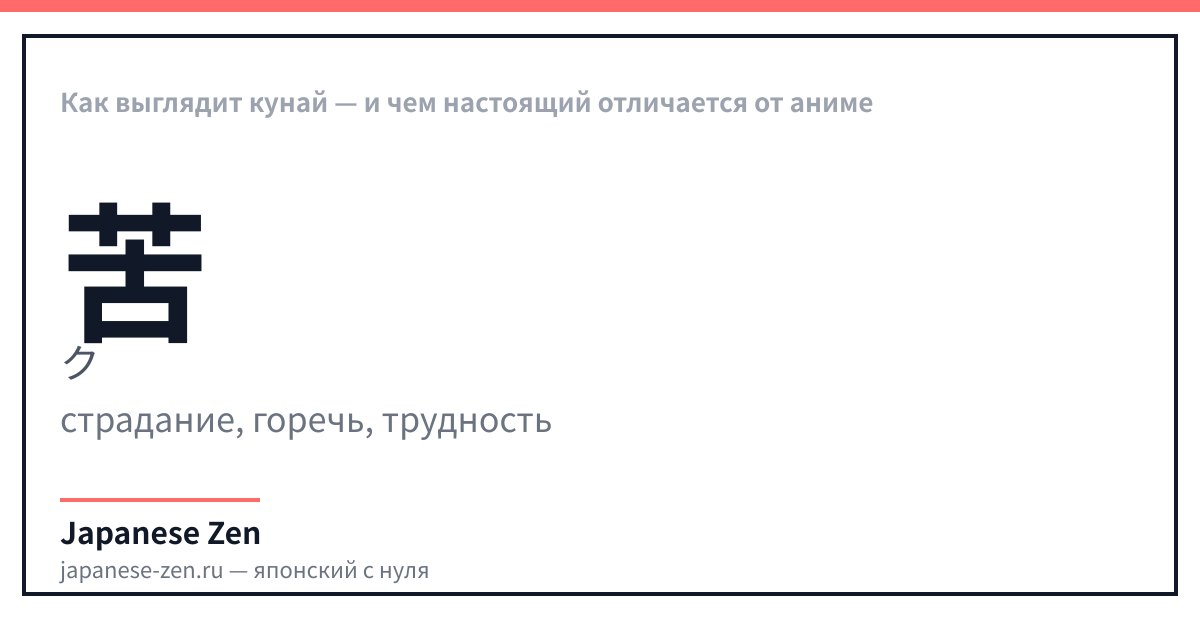
苦 — значение: suffering, bitterness, difficulty — онъёми: ク — кунъёми: くる.しい、-ぐる.しい、くる.しむ、くる.しめる、にが.い、にが.る — 8 штрих(ов). 苦 — "suffering, bitterness": the same character appears in 苦労 (kurō, "hardships") and 苦手 (nigate, "that which one is not good at"). In the spelling 苦無 it is read "ku" — chosen for its sound, not its meaning.
How both characters are read separately
| Japanese | Reading | Translation |
|---|---|---|
| 苦無 | kunai · kunai | the tool itself, the subject at hand |
| 無い | nai · nai | "none," "not there" — an ordinary word, the second half of the sound "kunai" |
| 苦労 | kurō · kurō | "hardships," "troubles" — an ordinary word with the same first character as in "kunai" |
| 無料 | muryō · muryō | "free of charge" — the same second character 無, but read "mu," not "nai" |
| 手裏剣 | shuriken · shuriken | "blade hidden in the hand" — the weapon most often confused with the kunai |
Write 苦 along the guides — the first character in the spelling of kunai (苦無), chosen for the sound "ku," not the meaning "suffering."
Kunai in anime and games: where the image of a throwing weapon came from
- In the manga and anime "Naruto," Minato Namikaze has a special three-pronged kunai with a seal formula on the handle: it serves as a marker for instant teleportation, the "Hiraishin" technique ("Flying Thunder God"). A real kunai has neither three prongs nor a teleportation seal — this is the author's invention, not a historical detail.
- In Ghost of Tsushima, one of Jin Sakai's tools is a kunai thrown to briefly stun an enemy. The throw here works by the laws of game balance, not historical practice.
- In Persona 4, Yosuke Hanamura's weapon is labeled exactly that — a "throwing kunai," even though the story is set in modern Japan, not in the world of the shinobi. An example of how "kunai = throwing knife" has become a genre cliché even outside ninja stories.
How the on-screen kunai differs from the real one
The on-screen kunai is almost always thin and sharp along the entire blade — that is how it becomes suitable for flight and a spectacular strike. The real tool is thick, with unsharpened edges, a ring for a cord, and a completely different task: not to reach a target, but to pry mortar out of masonry or catch hold when climbing.
FAQ
- What does a kunai look like?
- A kunai (苦無) looks like a flat tool with a thick diamond-shaped or leaf-shaped blade and a ring at the end of a short handle for a cord. Only the tip was made sharp, while the side edges were left blunt: the kunai was needed to dig, pry, and break open, not to cut. It does not resemble the thin throwing knife from anime.
- What does the word "kunai" mean?
- As a term, nothing that could be broken down into meaning: "kunai" names a specific tool, and that is its only meaning. The characters 苦無 were chosen for the sound of the word (this is called ateji), not for meaning, so parsing them separately as a translation is a mistake.
- Is it true that "kunai" translates as "without suffering"?
- No. The characters 苦 ("suffering") and 無 ("none," "without") do indeed read that way separately, but in 苦無 they were chosen for the sound of the word, not for meaning. The word and the object appeared before this spelling — "without suffering" merely sounds nice but does not describe the origin of the term.
- Is a kunai a weapon or a tool?
- Primarily a tool: shinobi dug soil with it, pried mortar out of masonry, and used it as a hook when climbing a wall. It could serve as a weapon in an emergency, for a close-range strike, but it was not designed specifically as a combat blade — this is how a kunai differs from a katana and a tantō.
- Can you throw a kunai?
- A large kunai is not suitable for that: a thick blade with balance shifted toward the handle and blunt, almost unsharpened edges. Judging by the few descriptions, there existed a reduced variety, the tobikunai (飛苦無), which was indeed thrown like a shuriken — but that is a separate, lighter tool, not the kunai with a ring that is shown as the main one.
- How does a kunai differ from a shuriken?
- A shuriken (手裏剣) was originally created as a short-range throwing weapon — albeit an auxiliary one, not a primary one. A kunai is a working tool for digging and breaking open that could sometimes serve as a weapon, not the other way around. The different purpose is also visible in the shape: a shuriken is thin and symmetrical, a kunai is thick and one-sided.
Sources
Updated: 2026-09-12