Makibishi — the spikes shinobi scattered under the feet of pursuers
Makibishi are small thorny spikes that shinobi scattered under the feet of pursuers to wound the foot through the thin sole of waraji and buy time to retreat. Simple ones were made from dried water chestnut fruits (hishi), while others were forged from iron: tetsubishi (鉄菱) ranging from 2 to 6 cm. Makibishi were not offensive weapons — they were a passive trap for the feet.
Behind the word "makibishi" lies not military steel but a plant: the thorny fruit of the water chestnut hishi lent the trap both its shape and its name, and iron tetsubishi merely reproduced it in metal. We look into how the character 撒菱 is read, whether the spike really pierced the straw sandal waraji, and where games like Nioh 2 and Tenchu added drama on top of a rather modest original.
Makibishi: spikes scattered underfoot
Makibishi (撒菱) are small thorny spikes scattered on the ground to wound a pursuer's foot and buy time to retreat. The simplest type is dried fruits of the water chestnut hishi with hard horned protrusions. Forged tetsubishi (鉄菱) reproduce the same shape in metal: a pyramid of points, one of which always faces up no matter how it falls. Dictionaries give their size as 2 to 6 cm. A pursuer who stepped on one wounded the foot through the thin sole of waraji and lost speed in the chase.
- Natural, tennenbishi (天然菱) — dried hishi fruits: a ready-made trap straight from the pond, needing only to be gathered and dried.
- Wooden, kibishi (木菱) — a carved copy of the same silhouette: cheap and available where neither nuts nor a blacksmith were at hand.
- Iron, tetsubishi (鉄菱) — forged; dictionaries note that they injured not only foot soldiers but also horses, depriving riders of mobility.
- Clay — fired makibishi have been found in excavations of Hachioji Castle, so any material that held a point was used.
How makibishi were used in practice
Shinobi did not simply drop makibishi while running: more often they laid them out in advance along the retreat route. The shinobi then left with a sliding step, suriashi, without lifting the sole from the ground, so as not to step on their own trap. The goal was not to kill but to make the pursuers hesitate and lose a few seconds.
撒菱 — how the character is written and what the water chestnut has to do with it
撒菱 is read まきびし (makibishi). The first character 撒 comes from the verb 撒く (maku), "to scatter, to strew"; the second, 菱 (hishi), means "water chestnut," a plant with a spiky fruit. When combined, hishi becomes voiced to -bishi. Literally it means "scattered hishi": the name is given by the material and method of use, without a warlike metaphor like the shuriken's "blade hidden in the hand."
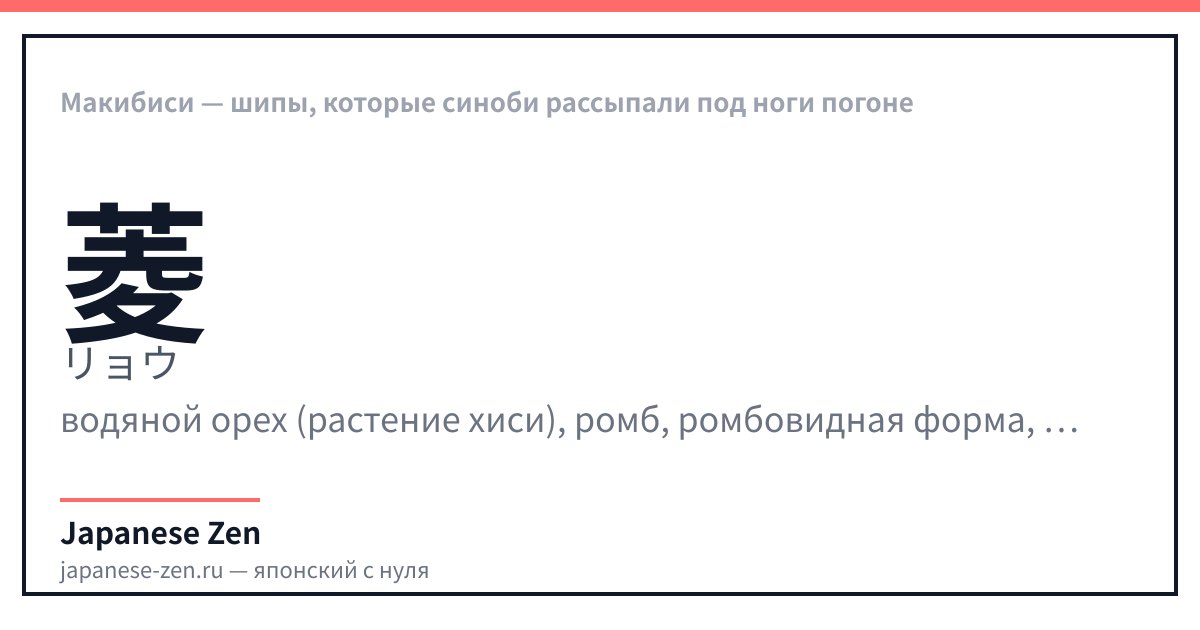
菱 — значение: water chestnut (the plant hishi), rhombus, diamond shape, in compounds — the part "-bishi" — онъёми: リョウ — кунъёми: ひし — 11 штрих(ов). 菱 — "water chestnut, rhombus": the same character appears in 撒菱 (makibishi) and in 菱形 (hishigata, "rhombus shape"). In compounds it becomes voiced to -bishi.
Why the name comes from a plant, not a weapon
| Japanese | Reading | Translation |
|---|---|---|
| 撒菱 | makibishi · makibishi | spikes scattered under the feet of pursuers |
| 鉄菱 | tetsubishi · tetsubishi | "iron hishi" — the forged version of makibishi |
| 菱 | hishi · hishi | water chestnut — the plant whose spiky fruit gave makibishi its name |
| 菱形 | hishigata · hishigata | rhombus shape — the same character 菱 as in makibishi |
| 撒く | maku · maku | "to scatter, to strew" — the verb that gave the first half of the word |
| 追手 | otte · otte | pursuers, chase |
Write 菱 along the guides — the character for the water chestnut hishi that gave makibishi its name.
Makibishi in games and film: more spectacular than they really were
- In the classic Tenchu: Stealth Assassins (1998, Acquire, PlayStation), makibishi are an item thrown under the feet of an enemy behind you: the same trap function as in the sources.
- In Nioh 2 (2020, Team Ninja / Koei Tecmo), makibishi are a consumable item and a technique from the ninja skill tree: spikes are scattered under an opponent's feet, and a "makibishi ball" scatters them on explosion.
- In the co-op mode Ghost of Tsushima: Legends (Sucker Punch, 2020), makibishi are one of the Ronin class abilities: it slows and wounds enemies in the area around.
What games add to makibishi
In games, makibishi usually glint with metal and burst into a cloud of spikes on explosion — a spectacular design detail. The sources speak more modestly: tetsubishi were only one option alongside dried hishi fruits, not the only and obligatory form of the trap. In both cases the goal is the same — to wound and delay, not to kill — but the game version is more spectacular than the modest original.
FAQ
- What is makibishi?
- Makibishi are small thorny spikes that shinobi scattered on the ground to wound the foot of pursuers and buy time to retreat. Dried water chestnut fruits (hishi), forged iron tetsubishi (鉄菱), and even fired clay were all used. Makibishi were not offensive weapons: they are a passive trap for the feet, not something used in face-to-face combat.
- How is makibishi written in kanji and what does it literally mean?
- It is written 撒菱 and read まきびし. The character 撒 comes from the verb 撒く (maku) — "to scatter"; the character 菱 (hishi) means water chestnut, whose spiky fruit became the first such trap. Literally it means "scattered hishi": the name describes the material and method of use, not combat qualities.
- What were makibishi used for?
- Makibishi were scattered on the retreat path to delay pursuers: anyone who stepped on one wounded their foot and lost speed. They were often laid out in advance along the retreat route, while the shinobi left with a sliding step, suriashi, without lifting the sole from the ground, so as not to step on their own trap.
- Is it true that makibishi pierced straw sandals (waraji)?
- Yes, and it is not a cinematic exaggeration: a sharp spike went through the thin woven sole of waraji or at least wounded the foot through it. The shape is designed so that no matter how it falls to the ground, one point faces up, so stepping on it without injury was almost impossible — that was the basis of the shinobi's calculation.
- How do makibishi differ from the European caltrop?
- The principle is the same: several spikes are arranged so that one sticks up no matter how it is thrown. But the European caltrop was forged only from iron and used primarily against cavalry — in the West it has been known since the first centuries AD. Makibishi, on the other hand, were more often made from dried hishi fruits and scattered under the feet of foot pursuers.
Sources
Updated: 2026-09-12