Kaginawa — a hook on a rope that shinobi used to climb walls
Kaginawa (鉤縄) is a metal hook on a rope: it was used to catch onto a ledge, branch, or the top of a wall to climb up without a ladder, cross a moat, or tie up a prisoner. It was one of the "six tools of the shinobi" (忍び六具) along with a woven hat and a medicine kit — a list described in the treatise Shōninki (正忍記, 1681).
A simple device — a rope with a hook at the end — has returned to almost every ninja video game as the "grappling hook." We break down how the word 鉤縄 is written, where the list of six essential shinobi items came from, and what modern Sekiro and Ghost of Tsushima change about this simple tool for the player's convenience.
What kaginawa is and why it was carried
Kaginawa (鉤縄) is a rope with a metal hook at the end. It was thrown onto a ledge, a tree branch, or the top of a wall to climb where there was neither a ladder nor a foothold, or to cross a moat without a bridge. It was also used to tie up a prisoner or pull a needed object closer. In design, it is the same "grappling hook" used by climbers and sailors.
Six items without which a shinobi would not go on a mission
The "six tools of the shinobi" (忍び六具) are listed in the treatise Shōninki (正忍記, 1681): they are not weapons but a minimal kit for every foray. Kaginawa is the most versatile item in it: with a single rope and hook one could climb up, cross over, and tie up a captive.
- Amigasa (編笠) — a woven straw hat that hides the face from prying eyes.
- Kaginawa (鉤縄) — a hook on a rope, for climbing and crossing.
- Sekihitsu (石筆) — a slate pencil made of soft stone, like chalk, for marking.
- Kusuri (薬) — medicines and antidotes for unforeseen cases.
- Sanjaku tenugui (三尺手拭) — a long towel: a headband, bandage, or rope.
- Uchitake (打竹) — a bamboo tube with a smoldering tinder for starting fire.
鉤縄: "rope with a hook" with no second meanings
鉤縄 is read かぎなわ (kaginawa) and is composed of two simple characters: 鉤 "hook" and 縄 "rope." The meaning is literally the same as the purpose of the object: "rope with a hook," with no second meanings.
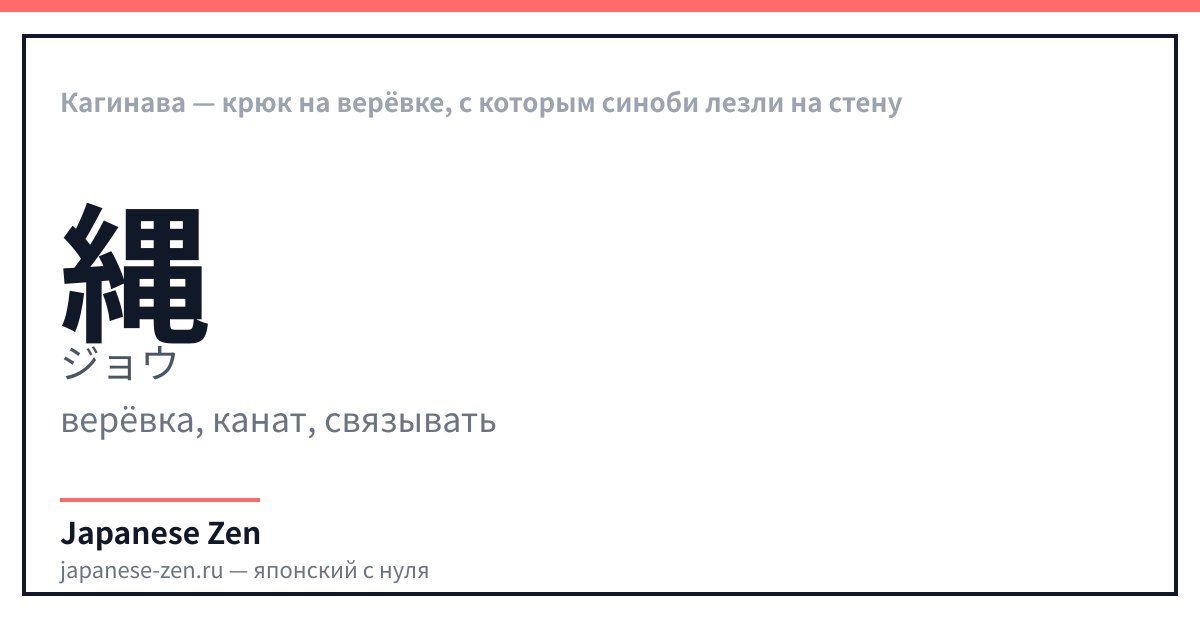
縄 — значение: rope, cord, to tie — онъёми: ジョウ — кунъёми: なわ、ただ.す — 15 штрих(ов). 縄 — "rope": the same character appears in 縄跳び (nawatobi, "jump rope") and 注連縄 (shimenawa, the sacred rope at Shinto shrines).
What each character in the spelling means
| Japanese | Reading | Translation |
|---|---|---|
| 鉤縄 | kaginawa · kaginawa | a hook on a rope — the object itself |
| 鉤 | kagi · kagi | "hook" — the first character in the spelling |
| 縄 | nawa · nawa | "rope" — the second character in the spelling |
| 忍び六具 | shinobi rokugu · shinobi rokugu | "six tools of the shinobi" — a list of equipment that includes kaginawa |
Write 縄 along the guides — the character for "rope," the second in the spelling of kaginawa (鉤縄).
Kaginawa in games: from Tenchu to Sekiro
- Tenchu (天誅, 1998, Acquire studio) — the hook on a rope is always with the shinobi heroes here: they use it to climb onto roofs and walls.
- Sekiro: Shadows Die Twice (FromSoftware, 2019) — the hook is built into the prosthetic arm of the shinobi Wolf, who lost his left arm, and in the Japanese version it is called exactly that: 鉤縄 (kaginawa). With it, one moves up and deeper into the level.
- Ghost of Tsushima (Sucker Punch, 2020) — the kaginawa for the hero Jin Sakai is forged by the blacksmith Taka, and with it Jin infiltrates the captured Kaneda Castle (金田城).
- Assassin's Creed Shadows (Ubisoft, 2025) — the shinobi Naoe has a hook for parkour in her arsenal; whether it is called kaginawa in the Japanese version could not be verified.
What games simplify
In games, the hook flies precisely to the target and pulls the hero up itself — in a fraction of a second. A real rope was thrown until the hook caught onto a ledge, branch, or the top of a wall, and then one climbed up by hand. Kaginawa could not catch onto "anything."
FAQ
- What is kaginawa?
- It is a rope with an iron hook at the end — a Japanese "grappling hook." Shinobi threw it onto a ledge or branch and climbed up, crossed moats, and tied up prisoners. In the treatise Shōninki (1681), kaginawa is one of the six essential items of a scout.
- Is kaginawa a weapon?
- No, it is primarily a tool: with a hook on a rope, a scout climbed where there was neither a ladder nor a foothold, crossed a moat, and tied up a prisoner. In the treatise Shōninki, kaginawa is among the "six tools" of the shinobi, not among weapons.
- How is "kaginawa" written in kanji?
- 鉤縄, read かぎなわ (kaginawa): 鉤 "hook" and 縄 "rope." The word is simply a compound of かぎ and なわ; the sounds do not change at the junction. The meaning matches the purpose — "rope with a hook."
- What was kaginawa used for?
- To climb a wall or tree where there was no foothold, to cross a moat without a bridge, and also to tie up a prisoner or pull a needed object closer. The same rope with a hook served several tasks of a scout at once.
- What is included in the "six tools of the shinobi"?
- A woven amigasa hat, kaginawa, a sekihitsu slate pencil for marking, medicines, a long sanjaku tenugui towel, and uchitake — a bamboo tube with a smoldering tinder for starting fire. The list is described in the treatise Shōninki (正忍記, 1681) as the minimal equipment of a scout.
- In which games does kaginawa appear?
- In Tenchu (1998), the hook is always with the heroes. In Sekiro: Shadows Die Twice (2019), it is built into the prosthetic and is called by its Japanese name — 鉤縄. And in Ghost of Tsushima (2020), it is forged for the hero by the blacksmith Taka to infiltrate Kaneda Castle.
Sources
Updated: 2026-09-13