Tekko-kagi — the iron claws of the shinobi: how they were made and why they were worn
Tekko-kagi (手甲鉤) — metal claws that shinobi attached to the back of the hand or concealed in the palm. They struck opponents with them, caught sword blows on them, and are said to have used them for climbing trees and walls. Originally they were an ordinary grass-cutting tool that spies adapted for their own purposes.
This weapon has an unexpected past: a grass-cutting tool became a spy's gear, capable of replacing both climbing claws and a small shield against a blade. We break down how 手甲鉤 is read and what it is composed of, and how tekko-kagi differ from the similar claws of nekote, which were worn not on the hand but on the fingers.
How tekko-kagi are made
Tekko-kagi (手甲鉤) are several curved metal spikes on a plate or rim. They were attached to the back of the hand or concealed in the palm — this variant is called shushō (手掌). They look like small rakes, and originally were a peasant tool for cutting grass. Japanese encyclopedias classify tekko-kagi as a "concealed weapon" (暗器) of the shinobi: the claws were used to strike an opponent and to catch a sword blow.
- Spikes — several curved metal claws on a plate or rim.
- Attachment — on the back of the hand (main variant) or in the palm — shushō (手掌).
- Type — 暗器, "concealed weapon": something worn unnoticed.
- Origin — a grass-cutting tool, not a weapon from scratch.
What they were worn for
In combat the claws worked both as a weapon and as a small shield: they struck and scratched, and the plate caught the blade. The second use attributed to them is climbing: the spikes catch on tree bark and cracks in stone masonry. And the fact that it was originally a grass-cutting tool helped avoid suspicion from passersby.
Tekko-kagi and nekote: claws on the hand and claws on the fingers
| Feature | Tekko-kagi | Nekote |
|---|---|---|
| What it is | several curved claws on a plate | iron claw-thimbles |
| Where attached | on the back of the hand or in the palm | on the fingertips |
| What they did with them | struck, scratched, and caught a blade blow on the plate | scratched an opponent during a grapple to break free |
| Classification | "concealed weapon" (暗器); according to legend, also for climbing | also a "concealed weapon" |
Tekagi and nekote: where names get confused
手鉤 (tekagi) is simply another name for tekko-kagi, not a separate weapon. Nekote (猫手, "cat's paw") is a different thing: not a plate on the hand, but iron claw-thimbles on the fingertips. They were used to scratch an opponent during a grapple to break free.
手甲鉤: "hook on the back of the hand"
手甲鉤 is read てっこうかぎ (tekkōkagi) and is composed of three characters: 手 "hand", 甲 "shell, back", and 鉤 "hook, claw". Literally — "hook on the back of the hand": the name describes not the combat function but the place of attachment.
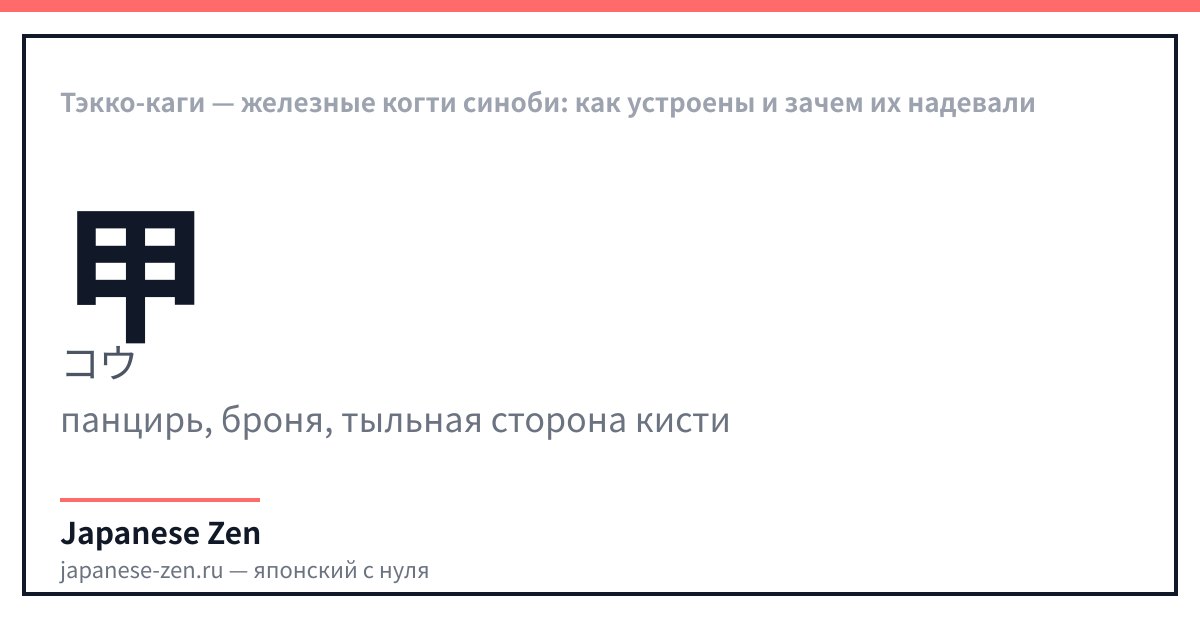
甲 — значение: shell, armor, back of the hand — онъёми: コウ、カン — кунъёми: きのえ — 5 штрих(ов). 甲 — "shell; back": in 手の甲 (te no kō) "back of the hand" the same character names the place where the claws were attached. It is also the first of the ten "heavenly stems" of the old calendar, hence 甲乙 (kōotsu) "first and second".
What characters make up the name
| Japanese | Reading | Translation |
|---|---|---|
| 手甲鉤 | tekkōkagi · tekkōkagi | claws on the back of the hand — the item itself |
| 手鉤 | tekagi · tekagi | another name for the same item |
| 手の甲 | te no kō · te no kō | "back of the hand" — the place from which the character 甲 in the name comes |
| 猫手 | nekote · nekote | "cat's paw" — a claw on each finger, a different item |
| 暗器 | anki · anki | "concealed weapon" — the general Japanese word for such items |
Write 甲 along the guides — the character "back", which gave its name to tekko-kagi (手甲鉤).
Tekko-kagi in games and museums
The most famous "relative" of tekko-kagi in games is Vega from Street Fighter II (Capcom, 1991); in the Japanese version he is called Balrog (バルログ). The masked fighter wears a long three-bladed claw on his hand — the same principle of claws over the hand, although the game's creators never claimed a direct connection to tekko-kagi.
Where to see tekko-kagi for real
Not a movie invention but a museum piece: claws of this type are displayed among the gear of spies at the Iga-ryū Ninja Museum (伊賀流忍者博物館) and at the Koga Ninjutsu Village Museum (甲賀の里忍術村) in Shiga Prefecture.
FAQ
- What are tekko-kagi?
- Tekko-kagi (手甲鉤) are several metal claws on a plate that was attached to the back of the hand or concealed in the palm. This is a "concealed weapon" of the shinobi: the claws were used to strike an opponent and to catch a sword blow. Originally, however, it was a peasant tool for cutting grass.
- Can you go up against a sword with tekko-kagi?
- Only at close range and on the defensive: the plate caught the blade blow, and the claws struck back. They were not suitable for an open duel with a swordsman — a katana blade is at least 60 cm long, and hands with claws simply cannot reach the opponent.
- How is "tekko-kagi" written in kanji?
- 手甲鉤, read てっこうかぎ (tekkōkagi) and composed of the characters "hand" (手), "back" (甲), and "hook, claw" (鉤). The literal meaning is "hook on the back of the hand", based on the place of attachment, not the combat purpose.
- What were tekko-kagi used for?
- In combat — to strike and scratch an opponent and to catch a sword blow on the plate. In addition, tekko-kagi are credited as climbing gear: the spikes catch on tree bark or cracks in stone masonry where there is neither a ladder nor a rope.
- How do tekko-kagi differ from nekote?
- Tekko-kagi are claws on a plate attached to the back of the hand or concealed in the palm. Nekote (猫手, "cat's paw") are separate iron claw-thimbles on the fingertips: they were used to scratch an opponent during a grapple. These are two different items, although both are classified as "concealed weapons".
- Which game characters have a weapon similar to tekko-kagi?
- The closest is Vega from Street Fighter II (1991), called Balrog in the Japanese version: he wears a long three-bladed claw on his hand. The game's creators never claimed a direct connection to tekko-kagi, but the principle is the same — claws over the hand.
Sources
Updated: 2026-09-13