Jitte — the iron truncheon of the Edo guard: how they took criminals alive
The jitte (十手) is a short metal rod with a hook near the handle, a weapon of the Edo city guard. The jitte is not sharpened: it was used to block a blade, catch it with the hook, and disarm an opponent with leverage, as well as to strike and lock joints — the goal was to capture a criminal alive, not to kill. It also served as a badge of authority: a dōshin would show it to people he met, much like a modern police officer shows an ID.
On screen, the jitte usually catches a sword in one spectacular move — and that is not entirely a choreographer's invention, though the real technique looked far less dramatic. Let's look at how this weapon actually disabled a blade, who in Edo was allowed to carry it, and what a detective from a novel — whose name was given to an inspector in "Lupin III" — has to do with it.
The jitte's design: a hook that holds, not cuts
The jitte is a rod about 30–60 cm long made of forged iron, bronze, or hard wood such as oak, with a handle at one end. At the base of the handle, where a sword would have its guard, a short hook (鉤, kagi) extends to the side at a right angle. Neither the rod nor the hook is sharpened: the jitte does not chop or cut — it blocks, catches, and strikes.
Is it true that the jitte caught a sword blade?
Yes, jitte fighting schools describe such a technique; it is not just a movie trick: the fighter would place the hook under the opponent's blade right at the guard and twist the jitte like a lever to wrench the sword from the hand or break the enemy's grip. Jittejutsu, the art of fighting with this weapon, also included techniques without the hook: strikes with the rod, joint locks, and throws, as in jujutsu — to capture a criminal, not necessarily to disarm him in one move.
Who in Edo had the right to a jitte, and who borrowed one unofficially
The jitte was officially allotted to dōshin (同心) — low-ranking investigator officials in the service of the Edo city administration: a jitte at the belt replaced a modern police ID. Dōshin could not handle investigations alone and hired unofficial assistants, called by different names in different regions — okappiki or meakashi: they tracked down criminals and took part in arrests, though formally they were not on government service.
Did the tassel on the jitte's handle mean anything?
The jitte given to okappiki usually had no tassel on the handle — unlike the weapons of regular dōshin, whose tassel, according to descriptions, was dark red or dark blue. So at a glance it was clear who stood before you: an official on duty or his unofficial assistant, who did not have the dōshin's own rights.
From a 1931 novel to the inspector in "Lupin III"
The most famous fictional owner of a jitte is the detective Zenigata Heiji, hero of a series of novels by the writer Nomura Kōdō: the first story came out in 1931, and over the next 26 years there were 383 of them — long and short together. Inspector Zenigata from the anime and manga "Lupin III" is not just a namesake: according to the character's backstory, he is a descendant of that very detective, hence the surname and the persistence in chasing the thief.
Jittejutsu today and the jitte's kinship with the Okinawan sai
Jittejutsu — the art of fighting with the jitte — has survived to this day as a section of some kobudo and classical jujutsu schools, not just a museum exhibit. The jitte also has a distant Okinawan relative — the sai: both weapons catch an opponent's blade without letting themselves be cut. They are built differently: the sai's guard-hook is forked and wider, while the jitte has a single narrow hook closer to the handle.
十手 and 捕: "ten hands" and the word "capture"
The jitte itself has a reliable sign — 十手, read じって: 十 means "ten," 手 means "hand." According to the most common version, the weapon was named so because a fighter with it in battle was worth the work of ten hands — that is, was as effective as several opponents at once. Dictionaries do not give more detailed and equally reliable versions of the origin of this name.
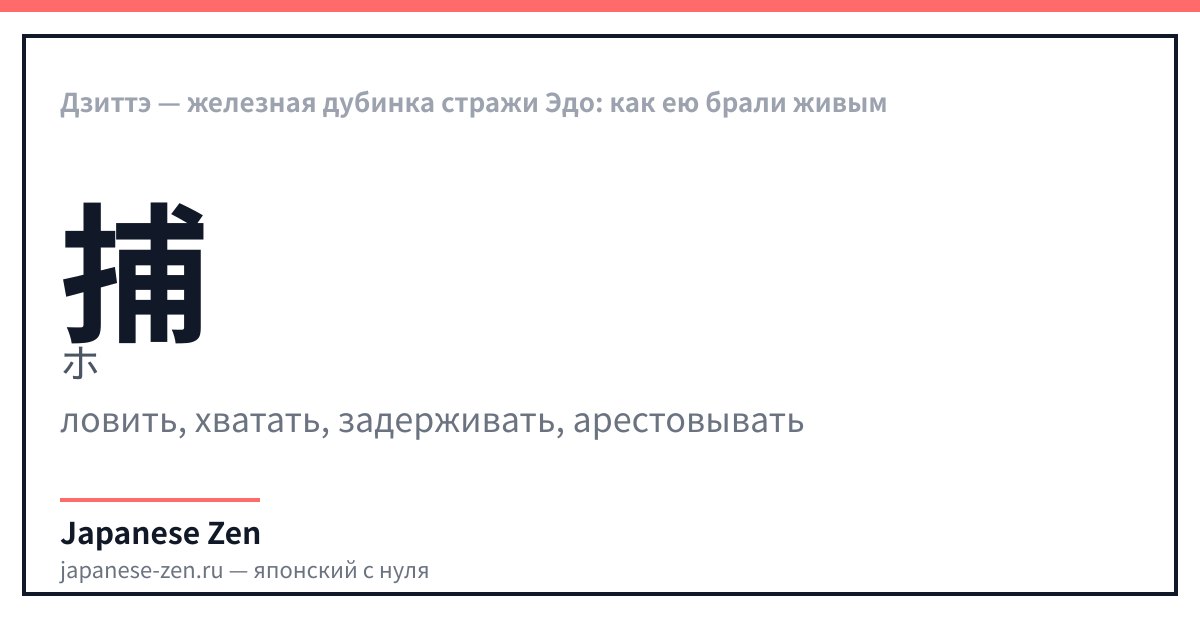
The essence of the jitte's work is conveyed by another sign — 捕, "to catch, to seize": read ホ in compound words like 逮捕 (taiho, "arrest") and つか(まえる) / と(る) in ordinary verbs about catching or seizing. This sign reflects the essence of the jitte's work more accurately than "ten hands": the weapon served for 捕物 (torimono), that is, capture, not for a fight to the death.
捕 — значение: to catch, to seize, to detain, to arrest — онъёми: ホ — кунъёми: と.らえる、と.らわれる、と.る、とら.える、とら.われる、つか.まえる、つか.まる — 10 штрих(ов). 捕 — "to catch, to seize": the same sign in 捕物 (torimono, "capture") and 逮捕 (taiho, "arrest").
Why detective stories are called "torimono"
From the same 捕物 (torimono) comes the genre of Japanese detective prose about the detectives of old Edo — they are often called by the word 捕物帳 (torimono-chō), "records of captures." The full Japanese title of the novels about the detective from the previous section — "銭形平次捕物控" — uses a close variant of the same word, 捕物控 (torimono-hikae), "notes of captures."
| Japanese | Reading | Translation |
|---|---|---|
| 十手 | jitte · jitte | iron truncheon of the guard |
| 捕まえる | tsukamaeru · tsukamaeru | to catch, to seize |
| 捕物 | torimono · torimono | capture of a criminal, detective case |
| 同心 | dōshin · dōshin | low-ranking investigator official of Edo |
| 岡っ引き | okappiki · okappiki | unofficial assistant to an investigator |
| 逮捕 | taiho · taiho | arrest |
Write 捕 along the guides — the sign "to catch," which describes the jitte more accurately than "ten hands."
FAQ
- What is a jitte?
- It was the name for a short weapon of the Edo-period city guard — a metal rod with a hook near the handle, used not to cut but to block and catch an opponent's blade. Strikes with the rod and joint locks were also used: the goal was to capture a criminal alive, not to kill him on the spot.
- How was the jitte used?
- With the hook at the base of the handle, one caught the attacker's blade and, using the jitte as a lever, wrenched the sword from the hand or broke the grip. Besides that, the jitte was used to strike, and paired with jujutsu techniques to lock joints and throw the opponent: the goal of jittejutsu was to capture a person, not to kill him on the spot.
- Who in Japan carried a jitte?
- Officially the jitte was allotted to dōshin — low-ranking investigator officials in the service of the Edo city administration — and it replaced a modern police ID for them. Dōshin hired unofficial assistants, okappiki or meakashi in different regions of the country, who were also entrusted with a jitte, though formally they were not on government service.
- Why was the weapon called "ten hands"?
- 十手 literally consists of the signs "ten" and "hand." According to the most common version, the name means that a fighter with this weapon in battle was worth the work of ten hands at once — was as effective as several opponents. Dictionaries do not give more detailed and equally reliable explanations of the origin of the name.
- How does the jitte differ from the sai?
- The jitte is a weapon of mainland Japan from the Edo period with a single narrow hook near the handle, while the sai is an Okinawan truncheon with two wide side guards. Both ideas solve the same task — to catch an opponent's blade without letting themselves be cut, though they are built differently.
- How is "jitte" written in kanji?
- Jitte is written 十手, read じって: 十 means "ten," 手 means "hand." The weapon's actual work — capturing a criminal — is conveyed more accurately by the sign 捕 "to catch": from it come 捕物 "capture" and 逮捕 "arrest," words familiar from any Japanese detective story.
Sources
Updated: 2026-09-15