Suiton, Katon and the Rest: The Ninja's Five "Elements of Escape"
Suiton, katon, doton, mokuton and kinton — the five "elements of escape" (五遁の術). In old ninjutsu treatises these are not magic but concealment techniques: hide in the foliage, raise smoke, burrow into the ground, use gear or water to throw pursuers off the trail. The tidy set of five by element doesn't line up perfectly, and the ninja "elemental techniques" in the anime "Naruto" inherited only three of the five names.
"Five elements" sounds like a spell from an anime, but in fact it's a working list of concealment techniques from ninjutsu treatises. Let's look at what katon, doton and suiton actually described, and what the early 20th-century "Tachikawa bunko" books with the legendary Sarutobi Sasuke have to do with it. Separately — why the set of five elements in "Naruto" is different: instead of wood and metal, there are wind and lightning.
Five Ways to Slip Away — Not Magic, but Concealment
The techniques a scout used to escape pursuit or hide from prying eyes are called 遁術 (tonjutsu) — "art of slipping away" — or 隠形術 (onkeijutsu) — "art of concealment" — in ninjutsu treatises. In the "Bansenshukai" (1676), a section called "Innin" is devoted to this: it lists "four articles of the concealment technique" — not five, as in later retellings.
The set of five — mokuton, katon, doton, kinton and suiton — is matched to the five elements of the Chinese wuxing system: wood, fire, earth, metal and water. This system is hard to call tidy: interpretations diverge, for example with kinton — sometimes the ringing of a bell to distract pursuers, sometimes bribery. So the neat "five by element" looks more like a later systematization than a single doctrine of one school.
| Technique | In Japanese | What it meant |
|---|---|---|
| mokuton | 木遁 | hide among trees, in bushes, in grass or in crops |
| katon | 火遁 | raise smoke or fire — often gunpowder — to cover a retreat |
| doton | 土遁 | use a pit, a moat or the features of the terrain |
| suiton | 水遁 | escape pursuit with the help of water: swim across, dive, or throw a stone into the water so pursuers think the fugitive jumped in |
| kinton | 金遁 | metal and money: the ringing of a bell, bribery, scattered coins that pursuers will stop to pick up |
Slipping Away Is a Scout's Work, Not a Battle Spell
None of the five techniques was an attack: they were used to stay unnoticed or to buy time for retreat, not to strike an enemy. The difference from what anime and games show is fundamental here: the treatises teach hiding, not attacking with an element.
Suiton in More Detail: Water as Cover, Not a Weapon
Suiton (水遁) — techniques connected with water: cross a river or moat unnoticed, use the current to throw pursuers off the trail, or hide right at the water's edge where the pursuer doesn't expect it. The "Ninki" section of the same "Bansenshukai" also describes gear for such cases — for example, mizugumo, a float for crossing.
Why Water Is Not a Weapon but a Way to Vanish
Suiton is not about fighting on water or striking with a wave: the goal of the technique is to end up where a pursuer on foot or on horseback cannot go, and to buy time. In this it is no different from mokuton or doton: the same concealment and retreat, only with the help of a different element.
From "Tachikawa bunko" to "Naruto": How Slipping Away Became Magic
"Tachikawa bunko" was a series of cheap books in the "written storytelling" (書き講談) genre, published from 1911 to 1924, 196 issues in total. The fortieth issue, in 1914, was a book about Sarutobi Sasuke — the legendary ninjutsu master of the Koga school, invented even earlier in the oral storytelling of Tamada Gyokusai, but known to the mass reader precisely thanks to this series. Sarutobi Sasuke himself is a figure of legend, not a historically confirmed person.
In the manga and anime "Naruto" (Kishimoto Masashi, 1999–2014), techniques are divided by "nature of chakra": the five main ones are fire, wind, lightning, earth and water, that is, katon, fūton (風遁), raiton, doton and suiton. Three names — katon, doton and suiton — match the old ones, while instead of wood and metal the set of five has wind and lightning. Mokuton remained in the story, but as a rare technique available to few characters, not one of the five main ones.
Why Ninja in Popular Culture Became Mages
Cheap early 20th-century books like "Tachikawa bunko" were already turning a scout's stealth into a flashy trick for the reader, and manga and anime a century later brought this device to full-fledged battle magic. The device itself stayed the same — to astonish with a spectacle — it's just that over time "to slip away" became "to attack with an element."
逃 — the Ordinary "to Run Away" Instead of the Rare 遁
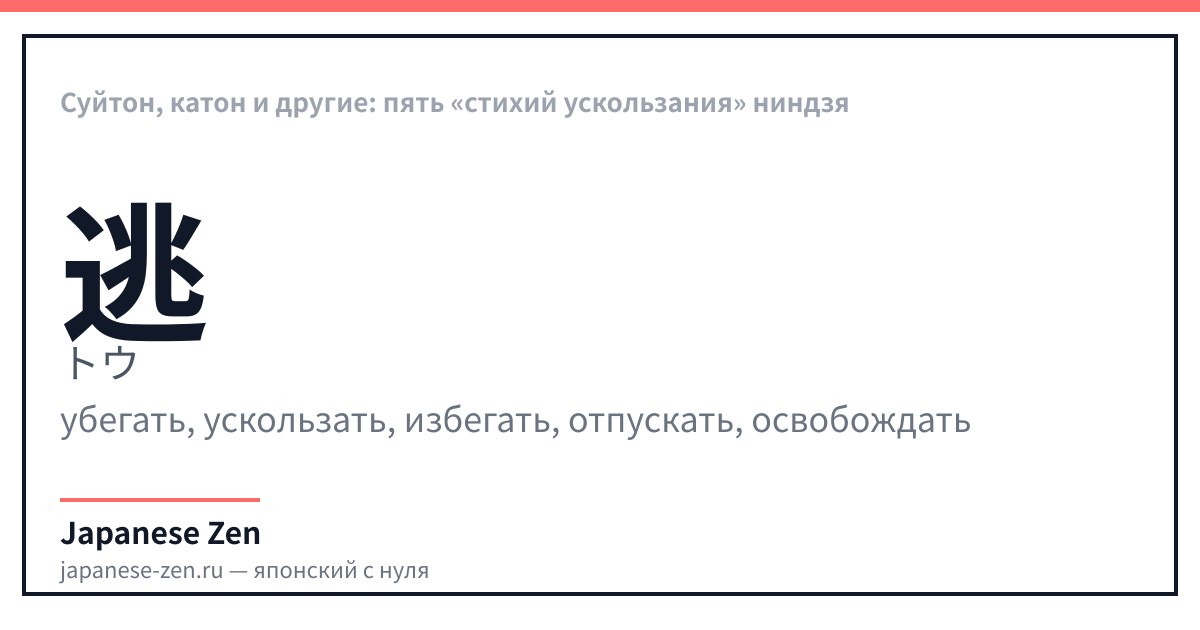
逃 — значение: to run away, to slip away, to avoid, to let go, to set free — онъёми: トウ — кунъёми: に.げる、に.がす、のが.す、のが.れる — 9 штрих(ов). 逃 — "to run away, to slip away": in everyday use it is far more familiar than the rare 遁 from the name of the "five elements," though in meaning they are almost twins. The same character is in 逃げる "to run away" and 見逃す "to overlook, to forgive."
Why the Character 逃 Here, and Not the Rare 遁
遁 (kun reading のがれる) is a rare character: outside combinations like 遁走 "flight" or 隠遁 "to withdraw from the world," it is almost never seen. 逃 is its everyday twin in meaning: the same root "to slip away," but in words heard every day, like 逃げる "to run away." The name 五遁の術 is made up of 五 "five," 遁 and 術 "art, technique" — "the art of five escapes."
逃 is read トウ in literary words like 逃走 "escape," and in Japanese as に(げる) in 逃げる "to run away" and のが(す) in 見逃す.
| Japanese | Reading | Translation |
|---|---|---|
| 五遁の術 | goton no jutsu · goton no jutsu | "The art of five escapes" — the very name of the techniques |
| 水遁 | suiton · suiton | Escaping pursuit with the help of water |
| 逃げる | nigeru · nigeru | To run away |
| 遁走 | tonsō · tonsō | Flight, escape |
| 火遁 | katon · katon | Smoke or fire to cover a retreat |
| 見逃す | minogasu · minogasu | To overlook, to forgive a slip |
Write 逃 along the guides — the ordinary character for "to run away," a close relative of the rare 遁 from the "five elements of escape."
"To Retreat Is to Win": the Proverb 逃げるが勝ち
逃げるが勝ち, "the one who runs away wins," is a Japanese saying that yielding in the moment and walking away from a pointless scuffle is sometimes better than standing your ground. The meaning is close to what a scout learned suiton and katon for: not victory by force, but the ability to vanish in time.
FAQ
- What is suiton?
- Suiton (水遁) is one of the five "techniques of escape" in ninjutsu treatises: escaping pursuit with the help of water — crossing, using the current, or hiding right at the water's edge. It is a stealth technique, not a battle spell, contrary to the image from anime.
- What were the five elements of escape for ninja?
- Mokuton (hiding in foliage and thickets), katon (smoke or fire to cover a retreat), doton (a pit, a moat, features of the terrain), kinton (metal and money — the ringing of a bell or scattered coins) and suiton (escaping with the help of water). The treatises apply this set of five by element not quite evenly: descriptions of kinton, for example, diverge between schools.
- Is it true that ninja commanded elemental magic?
- No: in ninjutsu treatises the "five escapes" are techniques of concealment and retreat, not an elemental attack. The image of the ninja as an elemental mage took shape in the 20th century thanks to cheap books like "Tachikawa bunko," and later was cemented by anime and games.
- Where do the elemental techniques in "Naruto" come from?
- In the manga and anime "Naruto" (Kishimoto Masashi, 1999–2014), techniques are divided by nature of chakra: fire, wind, lightning, earth and water. Three names — katon, doton and suiton — match the old ones, while instead of wood and metal there are wind and lightning.
- What does "katon" mean?
- Katon (火遁) is one of the "five escapes": raise smoke or fire, often gunpowder, to cover a retreat and throw pursuers off the trail. In "Naruto" the same word means a battle fire technique, but in ninjutsu treatises it is a way to hide, not to attack.
- How is "suiton" written in kanji?
- 水遁, read すいとん. 水 means "water," 遁 — "to slip away, to hide": the same character as in the name of the whole group of techniques, 五遁の術, "the art of five escapes." The ordinary everyday Japanese relative of the character 遁 is 逃, "to run away."
Sources
Updated: 2026-09-15