Naha — the capital of Okinawa: the port of the Ryukyu Kingdom and Kokusai Street
Naha is a port city on the island of Okinawa and the administrative center of the prefecture of the same name. The name 那覇 probably goes back to the word naba — 'fishing grounds' — though the characters themselves were chosen simply for their sound. For centuries Naha was the port of the Ryukyu Kingdom next to the royal capital Shuri, and the official reading 'Naha' was only fixed in 1934.
Let's look at where the name 'Naha' came from and why the characters for it were most likely chosen for their sound rather than their meaning. Along the way we'll learn how in 1954 the royal capital Shuri became part of the port town of Naha, where the city's main street got its name, and what a pottery quarter where Okinawan shisa lions are still made has to do with it.
The name Naha was assembled by sound — over more than one century
那覇 is read なは (Naha), but the characters themselves — 那 and 覇 — were chosen for the sound of the word, not its meaning: neither is related in meaning to a port or the sea. The most widespread explanation traces the name to the word naba — 'fishing place' or 'fish market'; this version was argued in the early 20th century by the Okinawan historian Iha Fuyu, and today it is considered the main one.
From the legend of the mushroom-shaped stone to the official reading of 1934
Old chronicles of the kingdom record another story: that in the house of the Gana Afa family a stone of unusual shape, resembling a mushroom (also naba locally), was found. From there a village with that name grew, and the characters were eventually replaced with 那覇. The pronunciation itself was long not unified: the city was called Nafa, Nawa, and Naba. 'Naha' was made the standard only in 1934, when a committee of Japanese radio broadcasting decided so.
From the port of the Ryukyu Kingdom to the merger with Shuri
Naha grew as a port city at the mouth of the Kokuba River — from the 14th–15th centuries ships with tribute and goods for the Ryukyu Kingdom came here, and nearby, on a hill, stood the royal residence — Shuri Castle. For a long time these were two different cities: the fortress capital Shuri and the trading port Naha.
How two cities became one
In the spring and summer of 1945 the island of Okinawa became the arena of one of the heaviest battles of the Pacific War — the Battle of Okinawa — and the prewar buildings of Naha were almost completely destroyed. After the war, on September 1, 1954, the city of Shuri together with the village of Oroku officially became part of Naha — so the royal capital and the port city finally united into one.
Kokusai Street and the pottery of the Tsuboya quarter
The main shopping street of modern Naha is Kokusai-dōri, 'International': it got its name in 1948 from a cinema that opened on it, and since then the lively one-and-a-half-kilometer street has been called the 'Miracle Mile' — a symbol of the city's postwar recovery.
The Tsuboya potters and their shisa on the roofs
In 1682 King Shō Tei united three separate pottery workshops of the kingdom in one quarter of Naha, Tsuboya — so Tsuboya-yaki was born, the main ceramic craft of Okinawa. Here they still fire the famous shisa — ceramic guardian lions, which in Okinawa are placed on roofs and gates.
覇 — supremacy, which Naha got by sound
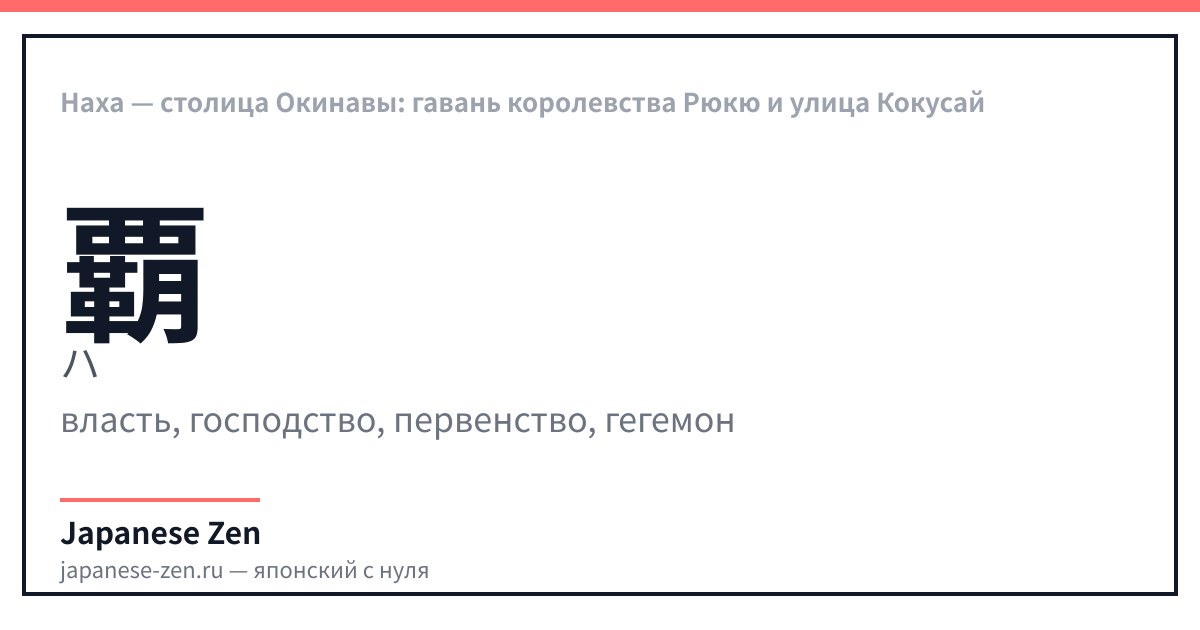
覇 — значение: power, dominion, supremacy, hegemon — онъёми: ハ、ハク — кунъёми: はたがしら — 19 штрих(ов). 覇 — 'power, supremacy': the second character in the name Naha, and also in the words 覇者 (hasha) 'winner, hegemon' and 制覇 (seiha) 'conquest, victory'.
A character that has nothing to do with the history of the port
覇 entered the name Naha by sound, not by meaning: the compilers put no hint of the royal capital nearby into 'power and supremacy' — it is a simple coincidence of writing. But today the same character is easily recognized in the colloquial 制覇 (seiha) — 'to complete a game' or 'to seize supremacy', a frequent word in conversations about games and sports.
| Japanese | Reading | Translation |
|---|---|---|
| 那覇 | Naha · Naha | Naha — the name of the city itself |
| 那覇市 | Naha-shi · Naha-shi | Naha City — the official name |
| 首里 | Shuri · Shuri | Shuri — the former royal capital that became part of Naha |
| 国際通り | Kokusai-dōri · Kokusai-dōri | Kokusai-dōri — the city's main shopping street |
| 壺屋焼 | Tsuboya-yaki · Tsuboya-yaki | Tsuboya-yaki — the pottery of the Tsuboya potters' quarter |
| 覇者 | hasha · hasha | Winner, hegemon — a word with the same character as in the city's name |
Write 覇 along the guides — the second character in the name Naha.
FAQ
- What kind of city is Naha and where is it located?
- Naha is a port city on the island of Okinawa, the administrative center of the prefecture of the same name in southern Japan. For centuries it was the trading port of the Ryukyu Kingdom next to the royal residence of Shuri, and today Naha is the largest city of the archipelago.
- Where did the name 'Naha' come from?
- 那覇 — characters chosen for their sound, not their meaning. The most widespread version links the name to the word naba — 'fishing place'; this version was argued in the early 20th century by the historian Iha Fuyu, and today it is considered the main one, though sources also give other legends.
- Are Shuri and Naha now one city or still two?
- Today one: Shuri was a separate city, the royal capital of Ryukyu, and became part of Naha only on September 1, 1954, together with the village of Oroku. Before that, for centuries there were two neighboring but different cities — the fortress on the hill and the port by the sea.
- Where did the main street of Naha get its name?
- Kokusai-dōri, 'International Street', got its name from a cinema that opened here in 1948. Since then the one-and-a-half-kilometer shopping street has been called the 'Miracle Mile' — a symbol of how quickly the city was rebuilt after the destruction of World War II.
- What is Tsuboya-yaki?
- Tsuboya-yaki is Okinawan pottery from the potters' quarter of Naha of the same name. In 1682 King Shō Tei brought together three scattered workshops of the Ryukyu Kingdom here; here they still make traditional tableware and the ceramic guardian lions shisa.
- What characters are used to write the name 'Naha'?
- 那覇, read なは. Both characters were chosen for the sound of the word, not its meaning: 那 in old texts simply meant 'that very', and 覇 — 'power, supremacy'. These meanings have no direct relation to the history of the port.
Sources
Updated: 2026-09-15