Nagasaki — the "long cape" and Japan's window to Europe under the shoguns
Nagasaki is a port city on the west coast of Kyushu and the administrative center of the prefecture of the same name. The name 長崎 means "long cape" — after the shape of the harbor or after the family that ruled these lands in the Kamakura era. From 1571 Portuguese ships called here, and from 1641 Dutch ones: for almost two centuries this was Japan's main port for direct trade with Europe.
We'll look at which of the two origin stories for the name is more accurate — the terrain or the family name. And why Nagasaki was in fact not Japan's only window to the world: with its borders closed, the country still had three other official channels of contact with its neighbors. Along the way we'll learn where the castella in the city comes from, what Dejima island is, and what the coal-mining Gunkanjima, inscribed on the UNESCO World Heritage list, has to do with it.
Nagasaki: the "long cape" — from the terrain or from a family name
長崎 is read ながさき (Nagasaki) and is written with 長 "long" and 崎 "cape." One version says the name describes the terrain itself: a narrow, long cape that once jutted into the bay near present-day Tateyama. Another traces it to the landowners of the Nagasaki family — stewards of these lands as early as the Kamakura era.
Which version the documents reflect
Documents link the area to the Nagasaki family as early as the Kamakura era, but whether the family name or the cape name came first cannot be said: Japanese clans often took their surname from the place they held. So the two versions complement each other rather than compete.
Dejima: a tiny harbor against all of Europe
In 1571 Portuguese ships entered Nagasaki bay for the first time, and the fishing harbor quickly became Japan's main port for European trade. In 1636 the authorities built the island of Dejima in the bay to keep Portuguese merchants apart from the city. After the Portuguese were expelled in 1639 the island stood empty, and in 1641 the Dutch trading post was moved there from Hirado. Dejima remained Japan's point of direct trade with Europeans until the country opened in 1859.
Was Nagasaki really the "only window" to the world?
In fact, with its borders closed Japan had not one but four official channels of contact with the outside world. Besides Nagasaki, relations with Korea were handled by the Tsushima clan, with the Ryukyu Kingdom by the Satsuma clan, and with the Ainu of Ezo by the Matsumae clan. But Nagasaki alone remained the one place where the country traded directly with Europeans and China — hence the widespread nickname "window to the world."
Castella, hidden Christians, and Gunkanjima: what remains of the old port
Castella is a soft sponge cake whose recipe came to Nagasaki with the Portuguese. The name is linked to the Portuguese pão de Castela, "Castilian bread": that is what the sweet was nicknamed in Japan, and the Japanese カステラ (kasutera) preserved that sound.
The coal island and the memory of August 9
It was from the area around Nagasaki that the story of the kakure kirishitan emerged — descendants of Japanese Christians who kept their faith in secret for almost two and a half centuries after it was banned by the state. In a nearby bay stands Gunkanjima ("battleship island") — the former coal island of Hashima, densely built up with concrete apartment blocks. Mining there stopped in 1974, and in 2015 the island was inscribed on the UNESCO World Heritage list as part of the Meiji industrial revolution sites. On August 9, 1945, the second atomic bomb was dropped on Nagasaki — the second and so far last combat use of nuclear weapons in history; today the Peace Park and the Atomic Bomb Museum commemorate it.
崎 — the cape that appears all over Japan
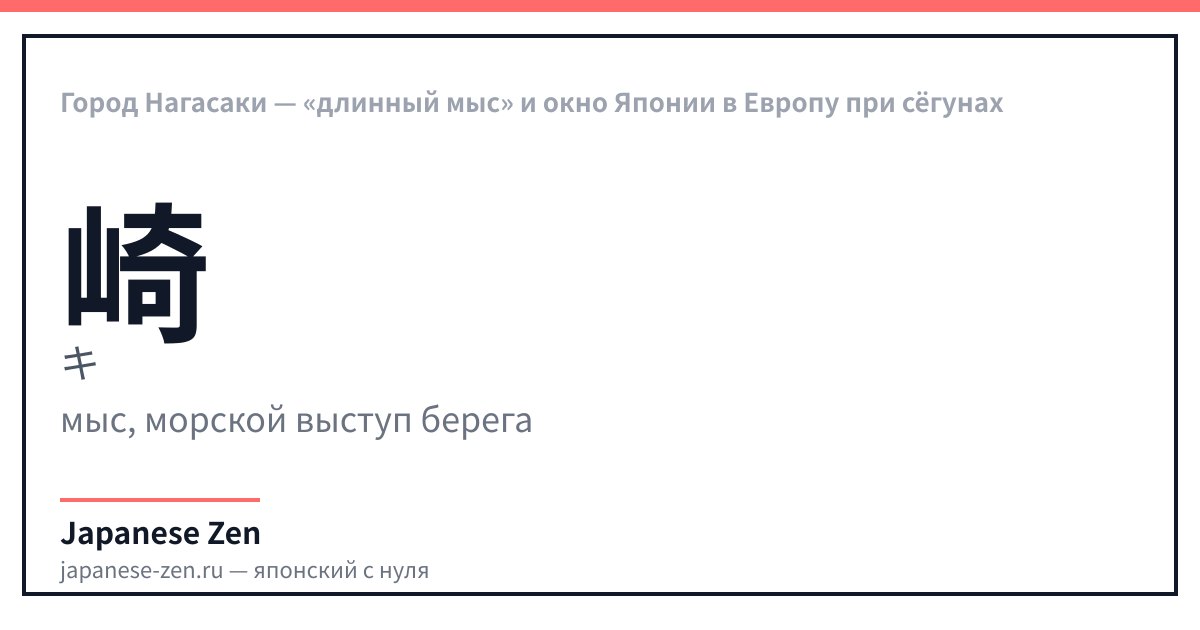
崎 — значение: cape, a jutting stretch of shore — онъёми: キ — кунъёми: さき、さい、みさき — 11 штрих(ов). 崎 — "cape": the second character in the name Nagasaki. The same character appears in the city name Miyazaki on Kyushu (宮崎) and in many surnames such as 山崎 (Yamazaki).
Why a mountain hides inside the character for "cape"
崎 is made up of the radical 山 "mountain" on the left and the phonetic 奇 on the right, which indicates the reading. The mountain in the character is no accident: capes are often the spurs of hills running out into the sea.
| Japanese | Reading | Translation |
|---|---|---|
| 長崎 | Nagasaki · Nagasaki | Nagasaki — the city's name itself |
| 長崎市 | Nagasaki-shi · Nagasaki-shi | Nagasaki City — the official name |
| 出島 | Dejima · Dejima | Dejima — the artificial island of the Dutch trading post |
| 宮崎 | Miyazaki · Miyazaki | Miyazaki — another city with the same character 崎 |
| カステラ | kasutera · kasutera | Castella — the sponge cake that came with the Portuguese |
| 軍艦島 | Gunkanjima · Gunkanjima | Gunkanjima — "battleship island," a UNESCO site |
Trace 崎 along the guides — the "cape" character from the name Nagasaki.
FAQ
- Where does the city of Nagasaki stand, and what was it famous for under the shoguns?
- The city lies on the west coast of Kyushu, on a natural deep bay. With Japan's borders closed in the 17th–19th centuries, European ships called here: first Portuguese, then Dutch — through the trading post on the artificial island of Dejima.
- What does the name Nagasaki mean in Japanese?
- 長崎 literally means "long cape": 長 is "long," 崎 is "cape." One version says the name describes the terrain of the old harbor; another traces it to the surname of the Nagasaki family, who ruled these lands in the Kamakura era. The two versions do not contradict each other.
- Is it true that Nagasaki was Japan's only window to the world?
- Not quite: with its borders closed the country had four official channels of contact with its neighbors — besides Nagasaki, there was Tsushima for relations with Korea, Satsuma for Ryukyu, and Matsumae for the Ainu of Ezo. But Nagasaki alone remained the one place of direct trade with Europeans and China.
- What is Dejima island?
- Dejima is an artificial island in Nagasaki bay, built in 1636 for the Portuguese and serving from 1641 to 1859 as the trading post of Dutch merchants. It was the single point of direct contact between Japan and Europeans for almost two and a half centuries.
- What is Gunkanjima?
- Gunkanjima, "battleship island," is the popular name of Hashima island in Nagasaki bay: a former coal mine densely built up with concrete apartment blocks, deserted after the mine closed. Today the island's abandoned silhouette is part of the UNESCO World Heritage list, where it was inscribed as a monument of the Meiji industrial revolution.
- Which kanji are used to write "Nagasaki"?
- 長崎, read ながさき. 長 means "long," 崎 means "cape." This reading became fixed to the place as early as the Kamakura period, when a family of the same surname became stewards of these lands, and the character 崎 later entered other Japanese place names as well, such as Miyazaki.
Sources
Updated: 2026-09-15