Sakamoto Ryōma — the ronin from Tosa who reconciled Satsuma and Chōshū
Sakamoto Ryōma (坂本龍馬, 1836–1867) was a low-ranking samurai (gōshi) from Tosa Domain who left the domain without permission in 1862, became a student of the reformer Katsu Kaishū, and founded a trading company later called Kaientai. Sakamoto Ryōma brought the feuding Satsuma and Chōshū together in the 1866 alliance, and on December 10, 1867, he was killed in Kyoto — a month before the Meiji Restoration.
Pop culture remembers Ryōma as a cheerful fellow in boots with a pistol and the "chief architect" of the Meiji Restoration — that image was created by Shiba Ryōtarō's novel, not by the documents of the era. Let's look at how a penniless ronin became a mediator between warring domains, what in the legendary "Eight-Point Plan on Board Ship" is confirmed by sources and what is not, and why people still argue about who exactly killed him.
A low-ranking samurai who tore up his oath to the domain himself
Sakamoto Ryōma was born in 1836 in Kōchi, the capital of Tosa Domain, into a family of gōshi — low-ranking samurai who stood below the domain's hereditary nobility. In 1862 he committed dappan (脱藩) — leaving the domain without permission, which was punishable as a serious crime — and went to Edo. There he became a student of Katsu Kaishū, a supporter of opening the country, and became fascinated by the idea of a modern navy. Later Ryōma founded in Nagasaki the trading company Kameyama-shachū, which in 1867 became known as Kaientai (海援隊) — Tosa's armed trading corps.
| Year | Event |
|---|---|
| 1836 | born in Kōchi, Tosa Domain, into a gōshi family |
| 1862 | dappan — leaves the domain, goes to Edo, and becomes a student of Katsu Kaishū |
| 1863 | senior student (juku-tō) at Katsu Kaishū's naval school in Kobe |
| 1865 | after the closure of Katsu Kaishū's school, founds the trading company Kameyama-shachū in Nagasaki |
| March 7, 1866 | through his mediation, the Satsuma-Chōshū alliance is concluded |
| December 10, 1867 | killed at the Ōmi-ya inn in Kyoto together with Nakaoka Shintarō |
The company that traded weapons and reconciled domains
Kameyama-shachū and its successor Kaientai were not only one of Japan's first private shipping companies, but also a channel through which Tosa, Satsuma, and Chōshū circumvented the shogunate's bans on purchasing weapons. It was precisely the connections built up in trade that Ryōma used as a mediator when, in 1866, he brought together two domains that had recently been fighting each other.
Why the name has two different dragons: 龍 and 竜
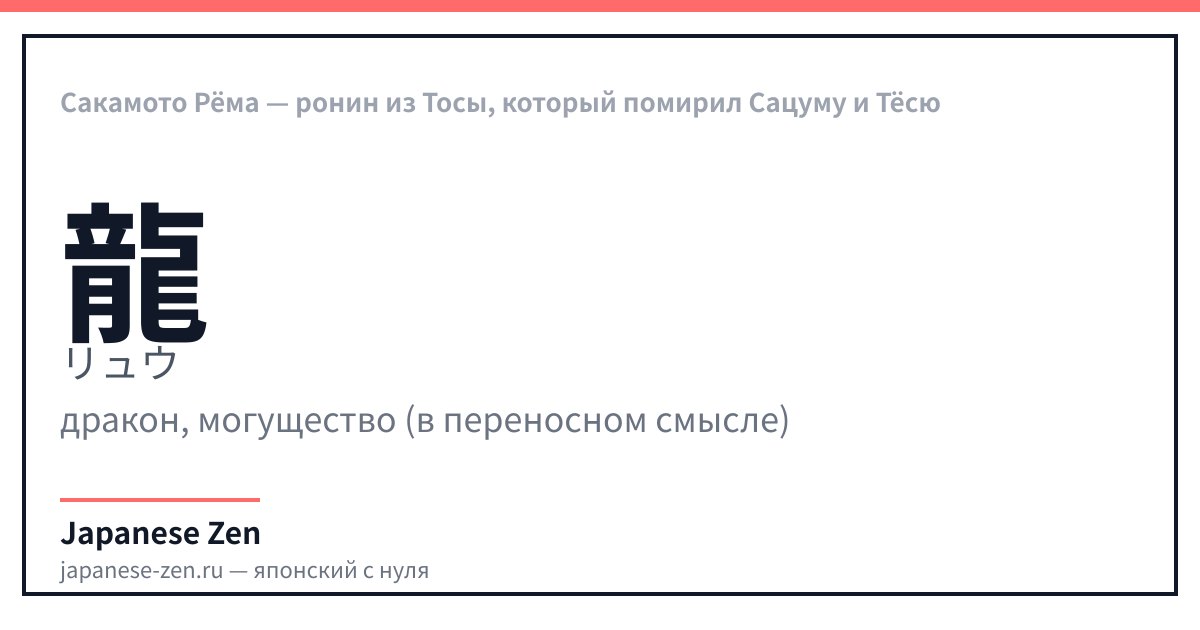
龍 — значение: dragon, power (figuratively) — онъёми: リュウ、リョウ、ロウ — кунъёми: たつ — 16 штрих(ов). 龍 — "dragon": the main kanji of Ryōma's name (龍馬, "dragon-horse"). This is the old, full form of the character; in modern kanji usage and in the title of Shiba Ryōtarō's novel, the simplified variant 竜 is used.
Why Shiba's novel is called "竜馬" and not "龍馬"
The characters 龍 and 竜 are read the same — "ryū" — and denote the same word "dragon": 竜 is the simplified form that became standard in postwar Japan, while 龍 is the old, "full" form. Ryōma himself and documents of his era wrote the name with 龍. Shiba Ryōtarō's novel "Ryōma Goes" (竜馬がゆく), serialized in the newspaper Sankei from 1962 to 1966, already uses the simplified 竜 — and that is how this variant became established in the titles of books and films about Ryōma.
| Japanese | Reading | Translation |
|---|---|---|
| 坂本龍馬 | Sakamoto Ryōma · Sakamoto Ryōma | Full name — surname and given name "dragon-horse" |
| 脱藩 | dappan · dappan | A samurai's unauthorized departure from his domain |
| 海援隊 | Kaientai · Kaientai | Tosa's armed trading corps, founded by Ryōma |
| 薩長同盟 | Satchō dōmei · Satchō dōmei | The Satsuma-Chōshū alliance of 1866 |
| 竜 | ryū · ryū | "Dragon" — the simplified form of the same character as in Ryōma's name |
| 馬 | uma · uma | "Horse" — the second kanji of the name |
Listen to how 竜 and 馬 sound — the app will evaluate your pronunciation.
A cheerful fellow in boots: Ryōma in anime, games, and TV dramas
- NHK taiga drama "Ryōma-den" (龍馬伝, 2010) — 48 episodes with Fukuyama Masaharu in the lead role; the first taiga about him, "Ryōma Goes," aired back in 1968.
- Sakamoto Tatsuma (坂本辰馬) in "Gintama" (2006, Sunrise studio) — a parodic cheerful fellow, head of a trading company and a former comrade-in-arms of the protagonist Gintoki.
- Fate/Grand Order (since 2015) — Ryōma is a playable Servant obtained in the GUDAGUDA event; he exists in two class versions, Rider and Lancer.
What in these images is true and what is not
Closest to the documents is the restrained tone of the taiga drama "Ryōma-den," although it too invents dialogue where the sources are silent. "Gintama" and Fate/Grand Order take only the name, the recognizable silhouette — boots, revolver, open smile — and the reputation of a cheerful fellow, spinning a comedy or fantasy around them; these images say nothing about the actual course of the 1866 negotiations.
Legends larger than the man: what Shiba's novel added
The very phrase "chief architect of the Meiji Restoration" is largely the achievement not of the era's sources but of Shiba Ryōtarō's novel "Ryōma Goes," which turned a modest mediator into a symbol of the entire movement. Ryōma's real contribution was great, but he was one of many figures from Tosa, Satsuma, and Chōshū, not the sole author of the victory.
- Legend: Ryōma personally dictated the "Eight-Point Plan on Board Ship" (船中八策) in 1867. Truth: no original with that title survives, and the expression itself spread only at readings marking the 50th anniversary of his death; it is probably based on the genuine document "Shinseifu kōryō hassaku" (新政府綱領八策), which Ryōma did indeed draft.
- Legend: Ryōma and his wife Oryō's trip to Kagoshima in 1866 was Japan's first honeymoon. That is what tourist materials of Kagoshima and Kirishima call it — but this is a later popular characterization, not a fact strictly proven by historians.
- Legend: the culprits in Ryōma's murder are beyond dispute. For decades the Shinsengumi were suspected, but today most historians consider the perpetrators to have been the shogunate's Mima-wari-gumi unit — based on the confession of one of its fighters, made already after the Restoration.
FAQ
- Who was Sakamoto Ryōma?
- A low-ranking samurai (gōshi) from Tosa Domain who left the domain without permission in 1862, became a student of the reformer Katsu Kaishū, and founded a trading company later called Kaientai. In 1866 he brought the feuding Satsuma and Chōshū together, hastening the fall of the shogunate, and in December 1867 he was killed in Kyoto.
- What is dappan and why did Ryōma risk it?
- Dappan (脱藩) is a samurai's unauthorized departure from his domain, punishable as a serious crime up to execution. Ryōma did it in 1862, disillusioned with Tosa's conservative policies, and went to Edo, where he became a student of Katsu Kaishū — that is how his career began outside the class framework of his native domain.
- Why is Ryōma's name written both 龍馬 and 竜馬?
- 坂本龍馬, where 龍 is the old form of the character for "dragon," and 馬 is "horse." In search results you may see the spelling "Sakamoto Rema" without the "yō" — but the correct reading is still Ryōma. Shiba Ryōtarō's novel "Ryōma Goes" (竜馬がゆく) uses the simplified variant of the character — 竜 instead of 龍, although the name sounds the same.
- Was Sakamoto Ryōma a real person or a legend created by a novel?
- A real person who died on December 10, 1867, in Kyoto. But the scale of his role in the Meiji Restoration is largely exaggerated by Shiba Ryōtarō's novel "Ryōma Goes" (1962–1966): Ryōma was an influential mediator, not the sole architect of events driven by dozens of politicians from Tosa, Satsuma, and Chōshū.
- Who killed Sakamoto Ryōma?
- He was cut down on December 10, 1867, at the Ōmi-ya inn in Kyoto together with his comrade Nakaoka Shintarō. For decades the Shinsengumi were suspected, but today most historians consider the perpetrators to have been the shogunate's Mima-wari-gumi unit — based on the confession of one of its fighters, made already in the Meiji era.
- In which anime and games does Sakamoto Ryōma appear?
- In "Gintama," Ryōma is portrayed under the name of the parodic cheerful fellow Sakamoto Tatsuma (坂本辰馬). In the NHK drama "Ryōma-den" (2010) he was played by Fukuyama Masaharu, and in Fate/Grand Order he is a playable Servant of the Rider and Lancer classes, obtained in the GUDAGUDA event.
Sources
Updated: 2026-09-13