Edo Castle — the shoguns' fortress that became an imperial palace
Edo Castle is the fortress built in 1457 by Ota Dokan, and from 1590 made his residence by Tokugawa Ieyasu and his shogunal heirs. The tenshu burned in the 1657 Meireki fire and was never rebuilt, and in May 1868 the castle was surrendered without a fight. Today the Imperial Palace stands on its site, and part of the former grounds is open for walks as the East Gardens.
The fortress on the site of present-day Tokyo stood for more than four centuries, changed hands several times, and survived a great fire after which the main keep was left unrestored. Let's look at how Ota Dokan's castle became the residence of the Tokugawa shoguns, what the kanji 江戸城 mean, and what has survived from the fortress to this day.
Edo Castle: from fortress to shogunate capital
Edo Castle (江戸城) was built in 1457 by Ota Dokan, a vassal of the Uesugi house — a small fortification at the mouth of the Hirakawa River. The fortress changed hands several times: to the Uesugi house, then to the Go-Hojo, until Tokugawa Ieyasu, the future founder of the shogunate, moved here in 1590. Under the Tokugawa the castle grew into the largest in Japan, and after the Meireki fire of 1657, which destroyed almost the entire city, its tenshu was left unrestored: the townspeople's quarters were rebuilt first. The corner Fujimi-yagura tower took on the role of watchtower from then on.
- The first fortification on this site was built in 1457 by Ota Dokan, a vassal of the Uesugi house
- From 1590, the residence of Tokugawa Ieyasu and all subsequent shoguns of the Tokugawa house
- The tenshu burned in the 1657 Meireki fire and was never rebuilt — its role was taken over by the corner Fujimi-yagura tower
- In May 1868 the castle was surrendered without a fight — one of the decisive episodes of the end of shogunal power
- Today the Imperial Palace stands on the castle grounds, and the former honmaru and ninomaru are open as the East Gardens since 1968
江戸城: "entrance to the bay" and the second name Chiyoda
江戸城 is read えどじょう (Edo-jō): 江 means "bay, inlet", 戸 means "door, entrance", 城 means "castle". The most common explanation is "entrance to the bay" or "door by the inlet": the fortress stood at the river mouth, where it flowed into Tokyo Bay. The castle's second name is 千代田城 (Chiyoda-jō), after which the central district of Tokyo is named today.
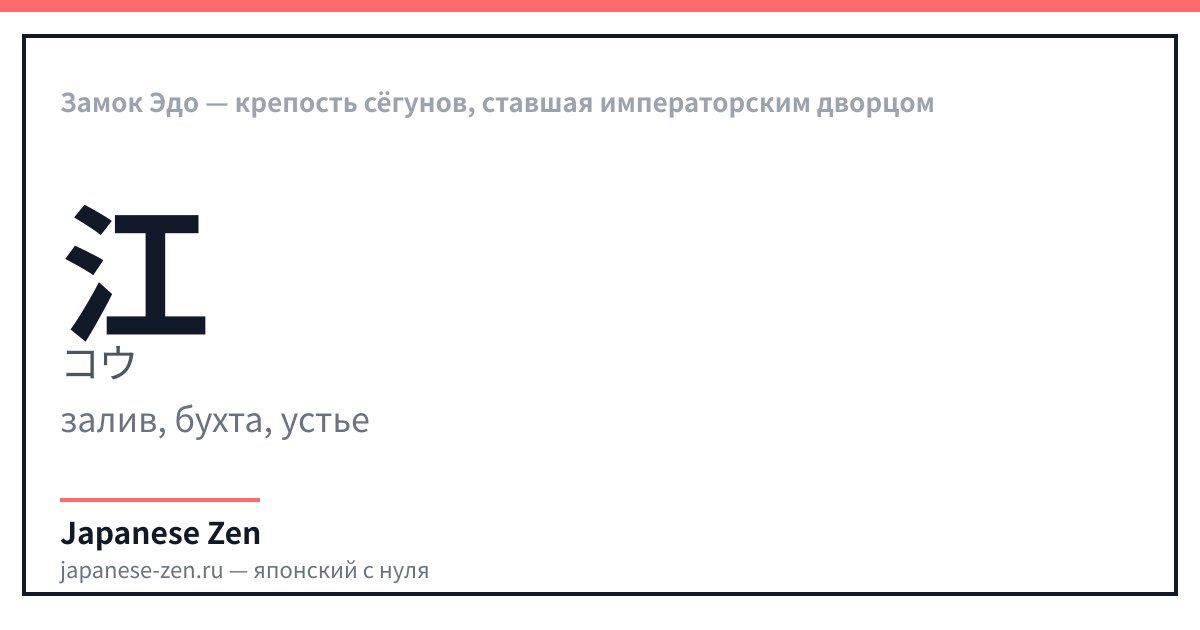
江 — значение: bay, inlet, river mouth — онъёми: コウ — кунъёми: え — 6 штрих(ов). 江 — "bay, inlet, river mouth": the first character in the name Edo (江戸), the old name of Tokyo and of the castle itself.
| Japanese | Reading | Translation |
|---|---|---|
| 江戸城 | Edo-jō · Edo-jō | The name of the castle |
| 千代田城 | Chiyoda-jō · Chiyoda-jō | The castle's second name — Tokyo's central district is named after it |
| 天守 | tenshu · tenshu | The castle's main keep — burned in 1657 and was never rebuilt |
| 富士見櫓 | Fujimi-yagura · Fujimi-yagura | The corner tower that replaced the tenshu |
| 皇居 | Kōkyo · Kōkyo | The Imperial Palace — what now stands on the castle site |
The name is older than the fortress
Edo was the name of the coastal area long before Ota Dokan. In the Kamakura period the Edo clan ruled here, taking its surname from the place name. When the city was renamed Tokyo in 1868, Emperor Meiji moved into the former shoguns' fortress, and it became his palace.
Write 江 along the guides — the first character in the name 江戸, the old name of Tokyo.
Edo Castle: the corridor of the 47 ronin and the East Gardens
You will hardly ever see the real Edo Castle on screen: few buildings survive, and the tenshu has been gone since 1657. But this is where an episode took place that the Japanese have been retelling for three centuries. On April 21, 1701, in the castle's Great Pine Corridor (松之大廊下), the daimyo Asano Naganori drew his sword and wounded the shogunate official Kira Yoshinaka. From this incident grew the story of the 47 ronin, staged dozens of times in kabuki, film, and on television.
Today the former castle grounds hold the emperor's residence, the Imperial Palace (皇居). Part of the former inner courtyards, the East Gardens, has been open to visitors since 1968: there you can still see the fortress walls, several gates, the Fujimi-yagura tower, and the stone base of the tenshu, on which a new keep was never placed.
FAQ
- What is Edo Castle?
- Edo Castle (江戸城) is the fortress built in 1457 by Ota Dokan, and from 1590 made his residence by Tokugawa Ieyasu. Today the Imperial Palace stands on its site, and part of the former castle grounds is open as the East Gardens.
- Who built Edo Castle?
- The first fortification was built in 1457 by Ota Dokan, a vassal of the Uesugi house. The fortress changed hands several times — Uesugi, Go-Hojo — and from 1590 became the residence of Tokugawa Ieyasu and grew into the largest castle in Japan.
- Why does Edo Castle have no main keep?
- The tenshu burned in the Meireki fire of 1657, when the flames destroyed almost the entire city. The keep was not rebuilt — the townspeople's quarters were rebuilt first, and the corner Fujimi-yagura tower took on its role as a watchtower.
- What is now on the site of Edo Castle?
- The Imperial Palace (皇居) — the residence of the Japanese emperor. Part of the former castle grounds, the East Gardens, has been open to visitors since 1968: the walls, several gates, and the stone base of the tenshu have survived there.
- What does the name 江戸城 mean?
- In Japanese it is 江戸城 (えどじょう, Edo-jō): 江 "bay, inlet", 戸 "door, entrance", 城 "castle". The most common explanation of the name is "entrance to the bay", after the fortress's location at the river mouth where it flowed into Tokyo Bay.
- How did Edo Castle pass to the new government in 1868?
- In early April 1868, Saigo Takamori and Katsu Kaishu agreed on the surrender of the castle, and on May 3 the fortress was handed over to the troops of the new government without a fight. This turned the tide of the Boshin War, and the Tokugawa house lost the residence where the shoguns had lived for almost three centuries.
Sources
Updated: 2026-09-13