Honmaru, Ninomaru, Sannomaru — the courtyards of a Japanese castle
Honmaru is the central, most heavily defended courtyard of a Japanese castle: it held the tenshu and the lord's palace. Around it, in a ring, lay ninomaru and sannomaru — courtyards for retainers, the garrison, and utility buildings. Each such walled enclosure is called a kuruwa (曲輪), and the whole layout of courtyards, moats, and walls is the nawabari. Figuratively, honmaru still means the main, most important part of any matter.
A castle was rarely a single tower — it was several courtyards nested one inside another, and the path to the tenshu ran through them in a ring, not straight. Let's look at how ninomaru differed from sannomaru, where the 'circle' character in their names came from, and why the word honmaru today turns up in talk of politics and business far removed from Japanese castles.
Kuruwa — the walled courtyard, the building block of a castle
Kuruwa (曲輪, also written 郭) is the general name for any walled, fortified area inside a castle: a flat plot with walls, a moat, and buildings. From several such courtyards, nested one inside another or arranged in a chain, the whole castle complex was assembled.
Nawabari — the plan according to which the courtyards were laid out
The arrangement of the kuruwa courtyards, moats, walls, and gates together is called nawabari (縄張り) — literally 'stretching the rope': before construction, the site was marked out on the ground with ropes, hence the name. Today the same word in everyday speech means 'sphere of influence, territory' — a far broader concept than the plan of one specific castle.
Honmaru, Ninomaru, and Sannomaru: what was where
Honmaru (本丸) is the central, most heavily defended courtyard: there stood the tenshu and the goten palace, where the lord lived. Next in importance is ninomaru (二の丸), often also containing living quarters for the master or his heir. Then came sannomaru (三の丸) — a courtyard of lower status, with retainers' houses and utility buildings; the following courtyards usually received their own names — for example, 'west courtyard' (西の丸).
Why the 'circle' character appears in the names of the courtyards
The character 丸 'circle' became fixed in the names of the courtyards later than the word kuruwa itself. When and why the courtyards came to be called 'maru' is not known for certain: there are several interpretations, and none is proven. What matters for the reader is something else — the number before 'maru' shows how far the courtyard is from the center.
Honmaru outside the castle: the main matter, not a courtyard with a tower
本丸 long ago outgrew military history: figuratively it means the very essence, the main issue, or the central figure of some matter — for example, 'the honmaru of political reform' means its key, most difficult part. The wordplay is simple: the thing for which the whole castle was built was hidden precisely in the central courtyard.
A similar shift in meaning in a neighboring word
Nawabari took the same path: from marking out the boundaries of a construction site with a rope — to any established sphere of influence, whether a city district or a government agency's area of responsibility. In both cases the military term has remained in the language with no military undertone at all.
The ring hidden in the word kuruwa
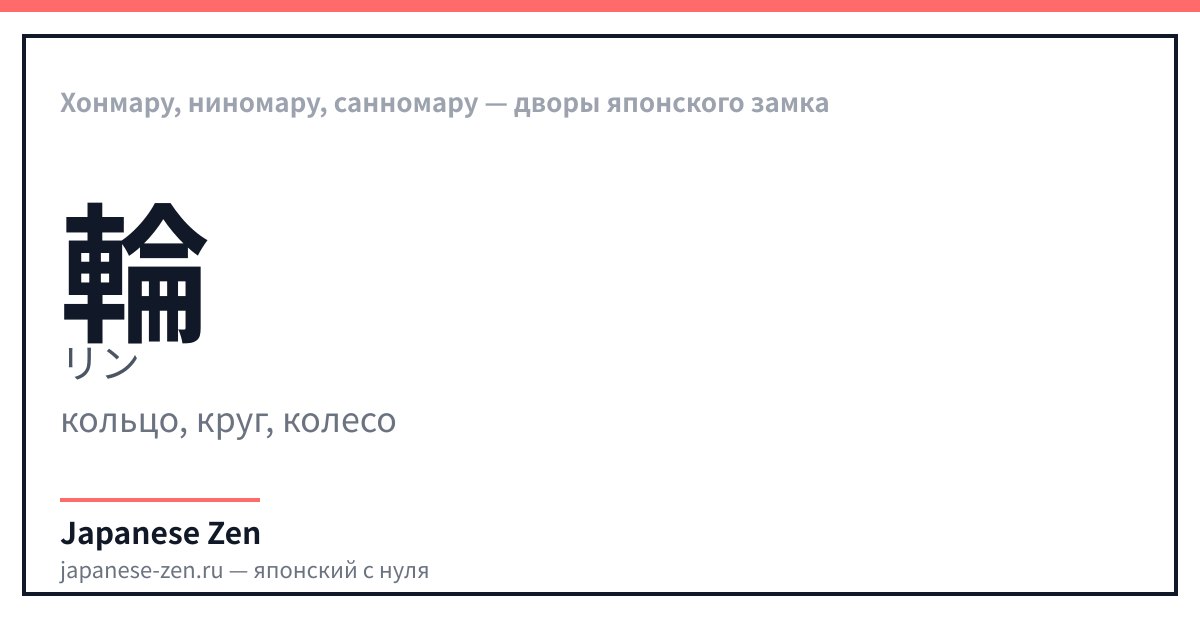
輪 — значение: ring, circle, wheel — онъёми: リン — кунъёми: わ — 15 штрих(ов). 輪 — the second character in 曲輪, 'ring, circle': the same character appears in 年輪 (nenrin), the annual rings of a tree.
Why 曲輪 is not read the way you expect
曲輪 is made up of 曲 'bend, turn' and 輪 'ring', yet together it is unexpectedly read くるわ (kuruwa) — not according to the usual readings of each character separately. This is a fused reading of a whole word, like the English 'breakfast', where you cannot guess the pronunciation from the letters. On its own, 輪 in everyday words is read wa or rin: for example, in 年輪 — the 'annual ring' of a tree.
| Japanese | Reading | Translation |
|---|---|---|
| 曲輪 | kuruwa · kuruwa | A walled courtyard of a castle |
| 本丸 | honmaru · honmaru | The main, central courtyard of a castle |
| 二の丸 | ninomaru · ninomaru | The second most important courtyard of a castle |
| 縄張り | nawabari · nawabari | The layout plan of a castle's courtyards, moats, and walls |
| 年輪 | nenrin · nenrin | An annual ring of a tree — the same character 輪 as in kuruwa |
Write 輪 along the guides — the ring character from the word kuruwa, the walled courtyard of a castle.
FAQ
- Which courtyard of a Japanese castle is called honmaru?
- Honmaru is the central, most heavily defended courtyard of a castle: there stood the tenshu and the goten palace, where the lord lived with his retinue. Around it, in a ring or a chain, lay ninomaru, sannomaru, and other courtyards of lower status.
- How did ninomaru differ from sannomaru?
- Ninomaru came right after honmaru and often also contained living quarters — for the master or his heir. Sannomaru was the next courtyard, of lower status: retainers usually lived there and utility buildings stood there. The following courtyards usually received their own names — for example, 'west courtyard' (西の丸).
- What does the word nawabari mean?
- Nawabari is the overall plan of a castle: the arrangement of courtyards, moats, walls, and gates. The word literally means 'stretching the rope' — that is how the boundaries of a construction site were marked out on the ground before work began. In modern language the same word is used figuratively — 'sphere of influence, territory'.
- Why do the names of castle courtyards contain the 'circle' character?
- It is not known for certain. The character 丸 became fixed in the words honmaru and ninomaru later than the concept of kuruwa itself, and there are several interpretations of its origin — none is proven. The number before 'maru' shows how far the courtyard is from the center of the castle.
- What does the word honmaru mean figuratively?
- Today the 'honmaru' of some matter means its main, most important part or central issue — for example, 'the honmaru of reform'. The meaning has outgrown military history: the central courtyard of a castle was the place for which the whole castle was built.
- How is kuruwa written in kanji?
- 曲輪, read くるわ (kuruwa): 曲 means 'bend', 輪 means 'ring', but the whole word is read as a single unit, not according to the usual readings of the characters separately. Sometimes the same word is written with another character — 郭, with the same meaning and reading.
Sources
Updated: 2026-09-15