Goryōkaku — the star-shaped fortress of Hakodate and the last battle of the Boshin War
Goryōkaku is a star-shaped fortress in Hakodate, built on the model of Western bastion fortifications. Construction began in 1857, the administrative office building opened in 1864, and all work was completed in 1866. The design was made by Takeda Ayasaburō, and in 1868–1869 the fortress became the last stronghold of the self-proclaimed Republic of Ezo in the Boshin War.
The five-pointed fortress in the middle of Hakodate looks like no other Japanese castle — and that is no coincidence: it was built with an eye to Western fortifications against naval artillery. Let's look at who designed the star-shaped walls, how Goryōkaku became the last refuge of the shogun's supporters, and why the story of a French textbook on fortresses from which it was supposedly copied is not supported by sources.
A Western-style fortress instead of a familiar castle
Goryōkaku was built not as a residence or administrative center in the familiar Japanese style, but as a fortification to move the Hakodate magistrate's office inland, away from bombardment by foreign ships in the roadstead. Instead of stone walls and a wooden tower, there is an earthen rampart in the shape of a five-pointed star, surrounded by a moat: this shape allowed defenders to cover the entire space in front of the walls without dead zones.
The legend of the French textbook
The design was made by Takeda Ayasaburō, who studied Western sciences. The widespread story that he copied the plans from a French treatise on fortresses obtained from officers of a warship that entered the port is not confirmed by historians. The French handed over to the Japanese only manuals on artillery, not on fortification. More likely, Takeda relied on his own knowledge of Western military science.
The last stronghold of the shogun's supporters
In December 1868, the remnants of the shogunate's troops led by Enomoto Takeaki occupied Goryōkaku, and soon proclaimed the Republic of Ezo on Hokkaido. The details of the Boshin War that brought them here are a separate long story; here the fortress became the last point on the map of the conflict.
How the fortress surrendered without a fight inside the walls
In the spring of 1869, imperial troops began a general assault on Hakodate, shelling Goryōkaku from ships and surrounding heights. On June 20, 1869, Hijikata Toshizō died in the battle defending the city, and on June 27, after negotiations, Enomoto surrendered the fortress — fighting directly inside the star-shaped walls never happened.
A park on the site of the shogunate's last battle
After the war, almost all buildings inside the fortress were dismantled, and the land was given to the army as a parade ground; the only building that survived to this day without reconstruction is a wooden provisions warehouse. Since 1914, the territory has been open as a city park, and since 1952 it has been protected as a special historic site — a category higher than an ordinary historic site.
The restored magistrate's office building
In 2010, part of the Hakodate magistrate's office building was restored in the fortress — based on old photographs, drawings, and using the same materials and techniques as 19th-century builders. Due to fire safety requirements, not the entire building was recreated, but about a third of its historic area.
The edge of the star that gave the fortress its name
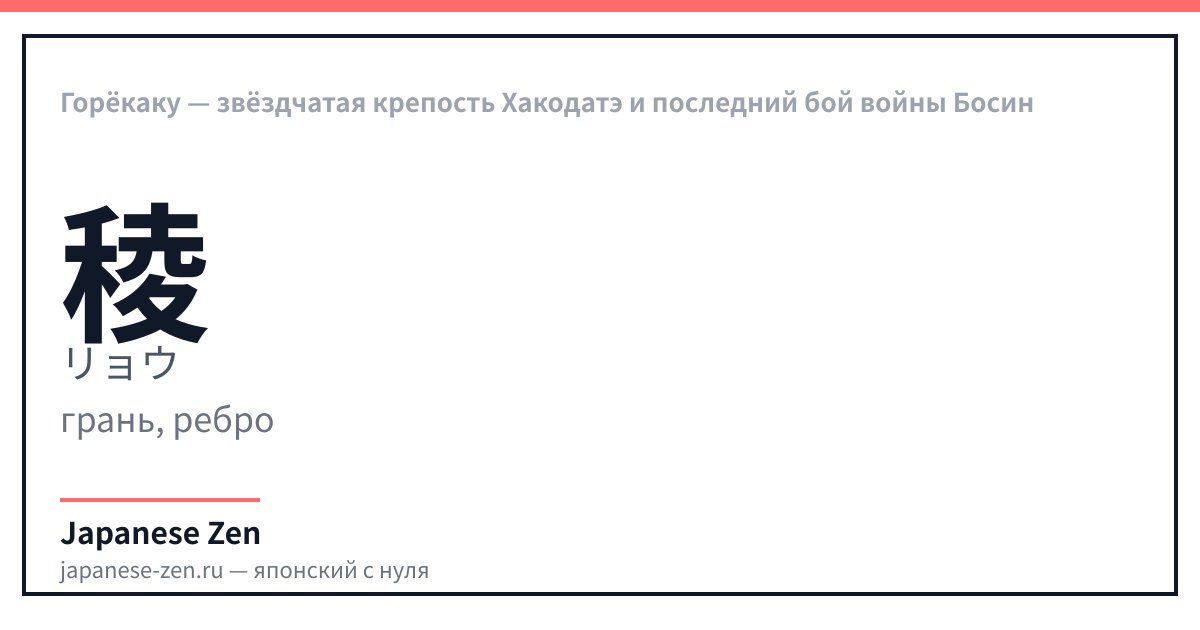
稜 — значение: edge, ridge — онъёми: リョウ、ロウ — кунъёми: いつ、かど — 13 штрих(ов). 稜 — 'edge, ridge': this character turns Goryōkaku into the 'fortress of five edges', for without it the name would simply mean 'five fortifications'. For this topic, it is more important than the two neighboring kanji in the name.
What 'Goryōkaku' means part by part
五稜郭 is read ごりょうかく (Goryōkaku) and is made up of three characters: 五 'five', 稜 'edge, ridge', and 郭 'outer wall, fortification' — together it means 'fortress with five edges', that is, with five protruding star bastions.
| Japanese | Reading | Translation |
|---|---|---|
| 五稜郭 | Goryōkaku · Goryōkaku | Goryōkaku — the full Japanese name of the fortress |
| 稜堡 | ryōho · ryōho | Bastion — a protruding corner of a fortress |
| 稜線 | ryōsen · ryōsen | Mountain ridge line — another word with the same character |
| 箱館奉行所 | Hakodate bugyōsho · Hakodate bugyōsho | Hakodate magistrate's office — the building inside the fortress |
| 蝦夷共和国 | Ezo kyōwakoku · Ezo kyōwakoku | Republic of Ezo, which defended the fortress in 1868–1869 |
| 五 | go · go | Five — as a separate numeral |
Write 稜 along the guides — the character for 'edge', which is why the fortress is called Goryōkaku.
FAQ
- What is Goryōkaku?
- Goryōkaku is a star-shaped fortress in Hakodate on Hokkaido, built in the mid-19th century on the model of Western bastion fortifications instead of a traditional Japanese castle. Inside it was the office of the Hakodate magistrate, and in 1868–1869 the fortress became the last stronghold of the shogunate's supporters in the Boshin War.
- When was Goryōkaku built?
- Construction began in 1857, the magistrate's office building moved inside the walls and opened in 1864, and all work, including planting protective trees, was completed in 1866. So the exact 'year of construction' can be given differently depending on what is considered completion.
- Who designed Goryōkaku and is it true that the plans were taken from the French?
- The design was made by the Japanese scholar Takeda Ayasaburō. The story that the fortress plan was copied from a French treatise on fortification is not confirmed: according to documents, French sailors handed over to the Japanese only manuals on artillery, without information on building fortresses.
- What role did Goryōkaku play in the Boshin War?
- From December 1868, the fortress was occupied by the remnants of the shogunate's troops led by Enomoto Takeaki, who proclaimed the Republic of Ezo on Hokkaido. After the spring assault of 1869 and the death of Hijikata Toshizō on June 20, Enomoto surrendered Goryōkaku on June 27 — with this capitulation the Boshin War ended.
- What is in Goryōkaku today?
- Since 1914, the territory has been open as a city park with thousands of cherry trees, and in 2010 part of the Hakodate magistrate's office building was recreated here based on old drawings and photographs. Of the 19th-century buildings, only one wooden provisions warehouse has survived without reconstruction.
- What does the name 'Goryōkaku' mean?
- The fortress's name is 五稜郭, read ごりょうかく (Goryōkaku): 五 means 'five', 稜 means 'edge, ridge', 郭 means 'fortification, outer wall'. Together it means 'fortress with five edges' — after the number of star bastions.
Sources
Updated: 2026-09-15