Tenshu — the main keep of a Japanese castle: why only twelve remain
Tenshu (天守) is the main, tallest tower of a Japanese castle: a lookout point and a storehouse for weapons in case of siege, not the lord's residence. Of the keeps built before the end of the Edo period, only twelve tenshu survive — the rest were demolished by decree, burned, or bombed. Two types are distinguished by silhouette: bōrō-gata with a separate lookout tower on top, and sōtō-gata with evenly tapering tiers.
The word "tenshu" conjures up a huge battle tower, but most of the time it stood almost empty: the castle lord and his retinue lived in a separate palace. Let's look at how the earlier bōrō-gata type differs from the later sōtō-gata, why only twelve of the thousands of castle keeps survived, and what the characters 天守 — "heaven" and "guard" — mean.
Tenshu: not a residence, but a watchtower and storehouse
Tenshu is the tallest and most conspicuous structure of a castle, but not a living space: weapons, gunpowder, and provisions were kept there in case of a long siege, and the surrounding area was watched from the top tier. The ruler and his family usually lived in a separate palace, the goten, in one of the inner courtyards, and entered the tower only on special occasions. The tenshu also served as a pure status symbol: the larger and more ornate the tower, the more important its owner.
Tenshu and tenshukaku are not quite the same thing
In scholarly literature the structure is called 天守 (tenshu), while in colloquial speech and guidebooks 天守閣 (tenshukaku) is more common — the same word with the added 閣, "pavilion, tall building." The second word is generally thought to have appeared at the end of the Edo period and became established in the Meiji era; and "tenshu" itself was formerly written with other characters as well — 天主, 殿主.
Bōrō-gata and sōtō-gata: two ways to compose a tower's silhouette
Early tenshu were built like this: the base was a one- or two-story building under a large irimoya roof, and a smaller lookout tower was placed on top. This silhouette is called bōrō-gata (望楼型), "with a lookout tower." The later type, sōtō-gata (層塔型), is assembled from tiers, each simply a little smaller than the previous one, without a large roof in the middle — from a distance it resembles a pagoda.
| Type | How it is built | Example |
|---|---|---|
| Bōrō-gata (望楼型) | A large lower building with a break in the roof, topped by a separate smaller tower | Inuyama, Matsue, Hikone, Himeji |
| Sōtō-gata (層塔型) | Floors diminish one after another according to a single plan, the silhouette is even, without a break | Uwajima, Matsuyama (Iyo) |
Why construction changed after Sekigahara
Bōrō-gata took shape under Oda Nobunaga and Toyotomi Hideyoshi. The sōtō-gata type was spread in the peaceful years after the Battle of Sekigahara in 1600 by the military commander Tōdō Takatora: identical floors according to a plan were easier to calculate in advance and faster to build. Researchers classify Matsumoto's tenshu sometimes as one type, sometimes as the other: the scheme does not always map onto a living structure one-to-one.
How only twelve of thousands of castle keeps survived
The 1615 decree ordering the demolition of surplus castles, another decree in the Meiji era, and the fires and bombardments of the 20th century removed battle keeps from the map one after another. By our time, a tenshu built before the end of the Edo period and never rebuilt survives at only twelve castles — these structures are called "surviving tenshu" (現存天守).
- Himeji, Matsumoto, Inuyama, Hikone, Matsue — National Treasures of Japan
- Hirosaki, Maruoka, Matsuyama, Uwajima, Kōchi, Bitchū-Matsuyama, Marugame — Important Cultural Properties
Why the list does not grow
The list is fixed: a new authentic tenshu cannot appear from nowhere, and the status depends on the structure never having burned down or been dismantled even once. That is why even the famous keeps of Osaka, Nagoya, and Kumamoto, which tourists see more often than others, are not on this list — all of them were rebuilt in the 20th century.
The character for "tier" hidden in the names of tenshu types
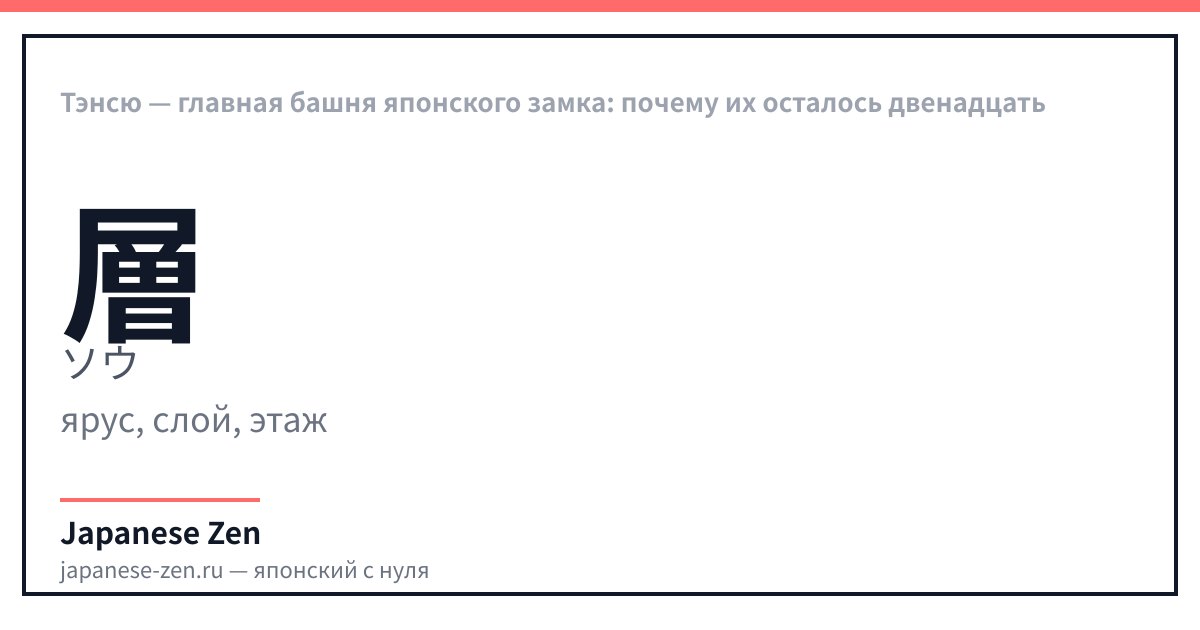
層 — значение: tier, layer, floor, story — онъёми: ソウ — 14 штрих(ов). 層 is not part of the word 天守 itself, but it defines both of its types: 層塔型 — "tiered," and in 高層 "multi-story" — the same character. For the topic of tenshu this character is more important than either of the two that make up the word itself.
What 天守 means part by part
天守 is read てんしゅ (tenshu) and is composed of 天 "heaven" and 守 "guard, protect" — together it comes out as something like "heavenly guardian." This is the meaning of the characters, not a confirmed history of the word itself: in different eras it was written with other characters as well, for example 天主 at Azuchi Castle.
| Japanese | Reading | Translation |
|---|---|---|
| 天守 | tenshu · tenshu | The main keep of a castle |
| 天守閣 | tenshukaku · tenshukaku | The same word in its colloquial variant |
| 望楼型 | bōrō-gata · bōrō-gata | Early type of keep with a separate lookout tower on top |
| 層塔型 | sōtō-gata · sōtō-gata | Later type of keep with an even silhouette |
| 現存天守 | genson tenshu · genson tenshu | "Surviving tenshu" — the name for all twelve authentic keeps |
| 高層 | kōsō · kōsō | Multi-story, high-rise — the same character 層 as in 層塔型 |
Write 層 along the guides — the character for tier that divides tenshu into two architectural types.
FAQ
- Why does a Japanese castle need a tenshu if no one lived in it?
- The tenshu served as a storehouse for weapons and provisions in case of siege and as a lookout point, and at the same time as a sign of the owner's status: the larger and more ornate the tower, the more important the owner. The ruler and his family lived separately, in the goten palace in one of the castle courtyards, and ascended the tower only on special occasions.
- How does bōrō-gata differ from sōtō-gata?
- In bōrō-gata the lower building is topped by a break in the roof, and above it stands a separate smaller tower — this is how they were built under Oda Nobunaga and Toyotomi Hideyoshi. Sōtō-gata is assembled from evenly diminishing floors without a break: this type was spread after 1600 by the military commander Tōdō Takatora, because it was simpler and faster to build.
- How many authentic tenshu survive in Japan?
- Twelve — only at these castles was the main keep built before the end of the Edo period and never rebuilt. Five of the twelve — Himeji, Matsumoto, Inuyama, Hikone, and Matsue — are designated National Treasures, and the other seven are Important Cultural Properties.
- Why did so few castle keeps survive?
- The 1615 decree forced the demolition of most castles in each domain, the 1873 decree of the Meiji era sent almost everything remaining to demolition, and fires, earthquakes, and the bombings of 1945 destroyed yet more structures. The famous keeps of Osaka, Nagoya, and Kumamoto are 20th-century reconstructions, not originals.
- Is it spelled "tenshu" or "tensyu"?
- In Hepburn romanization, the standard system for writing Japanese in Latin script, てんしゅ is rendered as "tenshu" — with "sh." The spelling "tensyu" comes from a different romanization system and is less common; it does not match the actual pronunciation as well.
- How is "tenshu" written in kanji?
- 天守, read てんしゅ (tenshu): 天 means "heaven," 守 means "guard, protect." In colloquial speech and guidebooks the same word is more often heard as 天守閣 (tenshukaku) — with the added character for "pavilion, tall building"; this is a later, colloquial name for the very same keep, not a separate structure.
Sources
Updated: 2026-09-15