Inuyama Castle — a tenshu above the Kiso River and a castle once privately owned
Inuyama Castle is one of the twelve Japanese castles with an original tenshu keep: dendrochronology dates its beams to the late 1580s. Until 2004 it was the last castle in Japan to be privately owned — managed by the Naruse family, whose descendants commanded the fortress for nine generations in a row. The tenshu stands on a hill above the Kiso River and bears the second name "Castle of the White Emperor" after a Chinese poem.
Among the twelve surviving tenshu of Japan, Inuyama Castle has a special fate of ownership: while others long ago became museums or city property, this fortress was literally run by a single family until 2004. Let's look at how the Naruse clan transferred the castle to a public foundation, where the poetic nickname "Castle of the White Emperor" came from, and what modern dating of the tenshu's beams actually showed.
How old Inuyama's tenshu really is
The first fortification on this site was built in 1469 by Oda Hirochika, and in 1537 Oda Nobunaga's uncle, Oda Nobuyasu, rebuilt it and moved his residence here. The castle changed hands many times and played an important role in the Battle of Komaki and Nagakute in 1584, and the current appearance of the tenshu is associated with a rebuild by Naruse Masanari around 1617.
What the beam dating showed
For a long time the construction dates of the tenshu itself remained disputed: some researchers attributed the lower two tiers to 1537, others to the early 17th century, and considered the upper floors a later addition. Dendrochronological analysis by the Nagoya Institute of Technology in 2019 gave a different answer: the main beams of the tower were felled in a three-year period starting in 1585. This suggests that all four tiers were built almost simultaneously, in the late 1580s. Inuyama is often called the oldest surviving tenshu. Maruoka Castle long contested this title, but in 2019 dating showed that its tower was built in the Edo period, in the 1620s. And yet the title remains unofficial: for some tenshu, exact dates have still not been established.
A castle managed by one family for nine generations
From 1617 until the Meiji era, the castle was owned by the Naruse clan — senior vassals of the Owari domain, who filled this post for nine generations of family heads. After the Meiji Restoration, the castle briefly passed into the ownership of Aichi Prefecture, but in 1895 the authorities returned it free of charge, under certain conditions, to the last lord of the clan, Naruse Masamitsu: he undertook to keep the building in order.
How the castle became public
From then until March 31, 2004, Inuyama Castle remained the only one among Japan's original tenshu that belonged not to the state or city but to a private individual — the head of the Naruse family. In 2004 the property was transferred to the Inuyama Castle Hakutei Bunko foundation: its chairwoman became Naruse Junko, sister of the thirteenth head of the clan.
"Castle of the White Emperor" on the Kiso River
The castle's second name, 白帝城 ("Hakuteijō"), compares Inuyama to the Chinese fortress Baidicheng on the Yangtze River — also standing on a hill above the water. According to legend, the nickname was given by the Confucian scholar Ogyū Sorai.
Which poem stands behind the name
The name refers to Li Bai's poem "Early Morning Departure from Baidicheng" — the poet describes a boat speeding downriver from a fortress on a cliff. From the viewing platform of Inuyama's tenshu a similar view opens up: the castle stands on a hill about 88 meters high right above the Kiso River, and on the other bank begins Mino Province.
The character for "white" hidden in the castle's nickname
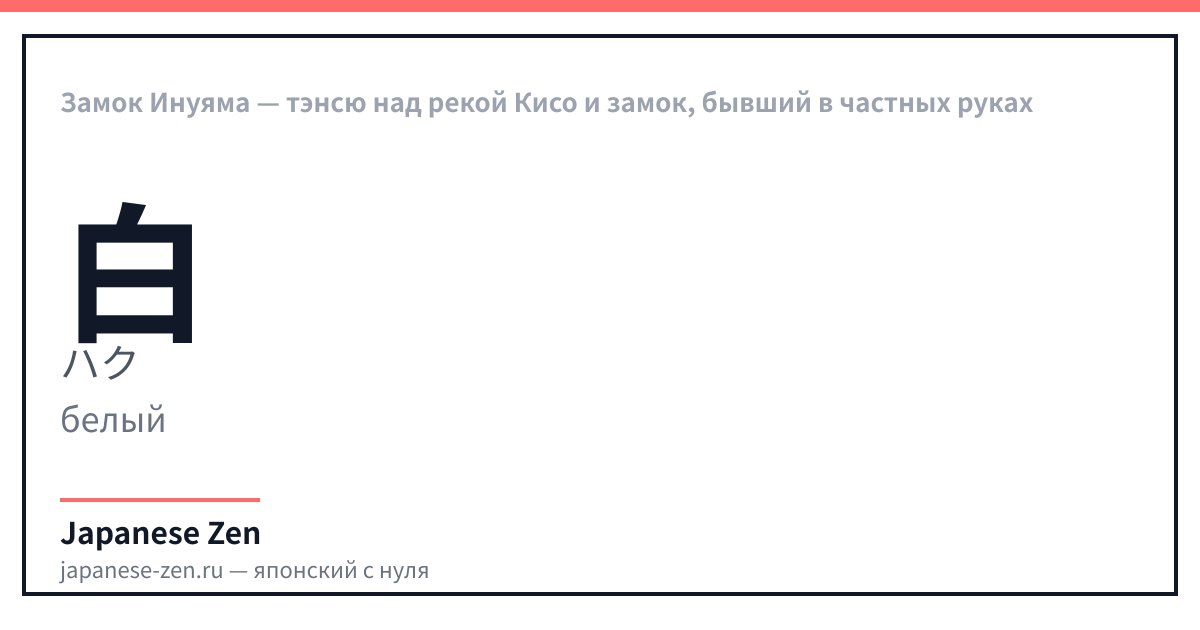
白 — значение: white — онъёми: ハク、ビャク — кунъёми: しろ、しら-、しろ.い — 5 штрих(ов). 白 is not part of the name 犬山城, but it defines the castle's nickname — 白帝城, "Castle of the White Emperor." For this topic, the character for "white" matters more than any kanji in the main name.
What "Inuyama" means part by part
犬山城 is read いぬやまじょう (Inuyama-jō) and is made up of 犬 "dog," 山 "mountain," and 城 "castle" — literally "castle of the dog mountain." The sources do not explain the origin of the place name itself: it is an established name of the area, not an image invented specifically for the castle.
| Japanese | Reading | Translation |
|---|---|---|
| 犬山城 | Inuyama-jō · Inuyama-jō | Inuyama Castle — the full Japanese name |
| 白帝城 | Hakutei-jō · Hakutei-jō | "Castle of the White Emperor" — the poetic nickname |
| 木曽川 | Kiso-gawa · Kiso-gawa | The Kiso River, above which the castle stands |
| 成瀬家 | Naruse-ke · Naruse-ke | The Naruse clan — the castle's former private owners |
| 財団 | zaidan · zaidan | Foundation — the castle's current owner |
| 白い | shiroi · shiroi | White — as a separate adjective |
Write 白 along the guides — the character that gave Inuyama Castle its poetic nickname.
FAQ
- What is unusual about the fate of Inuyama Castle?
- Inuyama Castle is one of the twelve Japanese castles with an original tenshu keep, standing on a hill above the Kiso River. Until 2004 it was the only original tenshu in the country owned by a private family — the Naruse clan, who managed the castle for nine generations in a row.
- When was the tenshu of Inuyama Castle built?
- The exact date is disputed. Dendrochronological analysis in 2019 showed that the main beams of the tower were felled around 1585–1588, meaning all four tiers were probably built almost simultaneously in the late 1580s, rather than being expanded in stages as previously thought.
- Is it true that Inuyama Castle is the oldest tenshu in Japan?
- It is often called that. The main rival, Maruoka Castle in Fukui Prefecture, dropped out of the contest in 2019: its tower was dated to the 1620s. But there is no official title of "oldest," and architectural historians speak of it cautiously.
- Is it true that Inuyama Castle was private property until 2004?
- Yes. From 1895 until March 31, 2004, the tenshu officially belonged to the head of the Naruse family — the only such case among Japan's original castles. In 2004 the property was transferred to the public foundation Inuyama Castle Hakutei Bunko, which manages the castle today.
- Where does Inuyama Castle's nickname "Castle of the White Emperor" come from?
- The nickname 白帝城 compares Inuyama to the Chinese fortress Baidicheng on the Yangtze River, celebrated in Li Bai's poem "Early Morning Departure from Baidicheng." According to legend, the name was given by the Confucian scholar Ogyū Sorai, who saw a resemblance in the castle's appearance above the Kiso River.
- How is "Inuyama" written in kanji?
- The castle's name is 犬山城, read いぬやまじょう (Inuyama-jō): 犬 means "dog," 山 means "mountain," and 城 means "castle." The castle's second, poetic name is written differently — 白帝城, "Castle of the White Emperor."
Sources
Updated: 2026-09-15