Hikone Castle — the stronghold of the Ii clan and the birthplace of the mascot cat Hikonyan
Hikone Castle is the residence of the Ii clan on the shore of Lake Biwa and one of the five Japanese castles with an original tenshu keep, recognized as a National Treasure. The fortress was built between 1603 and 1622, and some materials were taken from the dismantled castles of Otsu and Odani. Today, the Genkyu-en garden is laid out next to the keep, and the city's symbol is the mascot cat Hikonyan, created in 2006 for the castle's 400th anniversary.
Hikone Castle had an unusual construction: some of its towers are not new builds but structures from neighboring fortresses, dismantled after the 'one province, one castle' decree and reassembled on Lake Biwa. Let's explore how the Ii clan settled in Hikone, what connection the reformer Ii Naosuke has to the castle, and where the plush cat Hikonyan, which became a symbol of Japanese tourism, came from.
A castle assembled from other castles' towers
After the victory at Sekigahara in 1600, Ii Naomasa was granted lands in northeastern Omi and took over Sawayama Castle — the former residence of the defeated Ishida Mitsunari. Naomasa disliked the cramped medieval fortress and planned to move his residence closer to Lake Biwa, but he did not live to see it: he died in 1602 from wounds received in battle. Construction of Hikone Castle on the mountain of the same name began in 1603: the work was overseen by senior retainer Kimata Morikatsu, in consultation with Tokugawa Ieyasu.
Where the walls and towers came from
By 1606 the tenshu was ready, but all work was finally completed only in 1622. Some structures were not built anew but transported from dismantled castles. The tenshu of Otsu Castle was moved to the new site and deliberately reduced from four stories to three — so that Hikone's keep would be lower than Edo Castle's. According to legend, a gate with a tower was brought from Sawayama Castle, and a corner tower of the western compound came from Odani Castle. Among the castle's owners was Ii Naosuke: from age 17 to 32, until he unexpectedly became heir to the domain, he lived in a modest residence in the town below the castle, which survives to this day.
A garden by the water and the cat that saved the city
North of the tenshu lies the landscaped Genkyu-en garden with a pond and a tea pavilion: it once offered a view of the lake inlet, which was filled in during the 20th century. Together with the neighboring Rakuraku-en garden, it is protected as a monument of garden art.
How the mascot cat was born
The mascot cat Hikonyan was created in 2006 for the '400 Years of Hikone Castle' festival: the name was chosen by public vote from 1,167 suggestions. The image combines two legends at once — the beckoning cat that, according to legend, saved Lord Ii Naotaka from a lightning strike, and the red armor of the Ii troops. The festival ended, but the cat was kept and became a permanent symbol of the city.
A National Treasure, but not yet UNESCO
The tenshu, along with the adjoining multi-tiered gallery, received National Treasure status in 1952 — a year earlier, six castle buildings were designated Important Cultural Properties. The castle ruins themselves have been protected as a Special Historic Site since 1956 — a category above an ordinary historic monument.
Why the castle is not on the World Heritage list
Since October 1992, Hikone has been on the UNESCO tentative list, but the city is still preparing a formal nomination. Several times the draft was rejected with requests to clarify how Hikone's value differs from Himeji Castle, which is already inscribed. Work on the justification continues, so it is too early to speak of inclusion on the main list.
A country in one character — and in the title 'treasure'
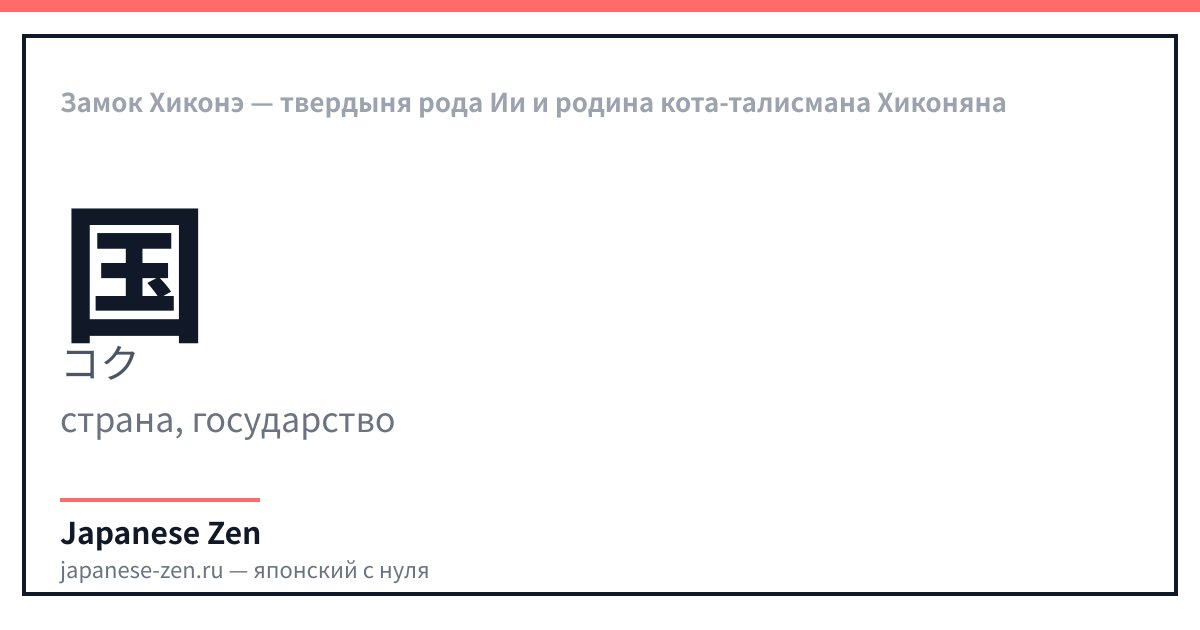
国 — значение: country, state — онъёми: コク — кунъёми: くに — 8 штрих(ов). 国 is not part of the name 彦根城, but it appears in the castle's title — 国宝, 'National Treasure'. For this topic, this character is more important than any kanji in the fortress's name.
What 'Hikone' means part by part
彦根城 is read ひこねじょう (Hikone-jō) and is composed of 彦 'young man, worthy man', 根 'root, foundation', and 城 'castle'. The mountain on which the castle stands has a second name, Konkiyama — 'golden turtle mountain', hence another, less known name of the fortress — Konki-jō.
| Japanese | Reading | Translation |
|---|---|---|
| 彦根城 | Hikone-jō · Hikone-jō | Hikone Castle — the full Japanese name |
| 国宝 | kokuhō · kokuhō | National Treasure — the tenshu's status since 1952 |
| 玄宮園 | Genkyū-en · Genkyū-en | Genkyū-en garden next to the castle |
| ひこにゃん | Hikonyan · Hikonyan | Mascot cat of Hikone city |
| 国 | kuni · kuni | Country — as a standalone word |
| 登り石垣 | nobori-ishigaki · nobori-ishigaki | Stone wall climbing up a hillside |
Write 国 along the guides — the character from the title 'National Treasure' that Hikone Castle holds.
FAQ
- What is Hikone Castle known for?
- Hikone Castle on Lake Biwa is the ancestral residence of the Ii clan and one of the five Japanese castles with an original tenshu keep, recognized as a National Treasure. Some of its structures were transported from neighboring dismantled castles, and today the city's symbol is the mascot cat Hikonyan.
- When was Hikone Castle built and why did it take so long?
- Construction began in 1603, the tenshu was ready by 1606, but all work was finally completed only in 1622 — after the fall of the Toyotomi house in 1615, palace buildings were still being erected at the castle. In total, the construction stretched over nearly two decades.
- Is it true that Hikone Castle was built from materials of other fortresses?
- Yes. The tenshu was moved from Otsu Castle and deliberately reduced from four stories to three, and the gate with a tower from Sawayama Castle and the corner tower from Odani Castle were, according to legend, taken from nearby. This was also done with other Japanese castles: transporting ready-made structures saved time and money.
- When and why did the cat Hikonyan appear?
- Hikonyan was created in 2006 for the '400 Years of Hikone Castle' festival, and the name was chosen by a vote from 1,167 options. The image combines the legend of the beckoning cat that saved Lord Ii Naotaka from lightning and the red armor of the Ii troops. After the festival, the cat was kept permanently and made the official symbol of the city.
- Is Hikone Castle a UNESCO World Heritage Site?
- No, not yet. Since 1992 it has been on the tentative list, but the city is still preparing and refining the official nomination, so it is too early to speak of inclusion on the main list.
- What characters are used to write the name Hikone?
- The castle's name is 彦根城, read ひこねじょう (Hikone-jō): 彦 means 'young man, worthy man', 根 means 'root, foundation', and 城 means 'castle'. The mountain under the castle also has a second name — Konkiyama, 'golden turtle mountain'.
Sources
Updated: 2026-09-15