Kanazawa — the "golden marsh": the city of the Maeda clan and gold leaf
Kanazawa is the capital of Ishikawa Prefecture and the former capital of the Kaga Domain. The name 金沢 means "golden marsh": according to legend, a poor man was washing a wild sweet potato he had dug up in a stream and found grains of gold in the water. The first written mention of the name appears as early as 1546 — as the name of a Buddhist temple, not a city. Today Kanazawa produces almost all of Japan's gold leaf.
Let's sort out what in the legend of the golden stream is folklore and what documents confirm, what the Maeda clan and its nearly million-koku Kaga holding have to do with it, and why the character for "marsh" turned out to be more important than the gold itself for this topic. And at the end — Kenroku-en garden, the samurai district, and an old temple nicknamed "ninja-dera" for reasons that have nothing to do with real ninja.
The golden stream of the poor man Togoro and the first record of 1546
金沢 is read かなざわ (Kanazawa) and is made up of 金 "gold" and 沢 "marsh, stream." According to legend, a poor man named Imohori Togoro was washing a wild sweet potato he had dug up in a forest stream and noticed grains of gold sand in the water — ever since, the stream was called "the stream where gold is washed." The name of the city is thought to come from this name; the place where it is said to have happened survives in Kenroku-en garden as the Kinjo Reitaku spring.
What the documents say, not the legends
The earliest written mention of the name "Kanazawa" dates to 1546: in the diary "Temmon Nikki," it refers to a Buddhist temple that stood on this spot, not a city or a castle. Only after the temple was destroyed and a fortress was built in its place did the name pass to the town that grew up around it.
The Maeda clan and a domain that only later became "million-koku"
The Maeda clan gathered the lands of Kaga, Noto, and Etchu under its rule: the founder of the house, the commander Maeda Toshiie, served Oda Nobunaga and Toyotomi Hideyoshi and moved his headquarters to Kanazawa in 1583. The nickname "Kaga hyakuman-koku" — "a million koku of Kaga" — came later: the three provinces reached an assessment of over a million koku of rice only after 1600, under his son.
The castle and the city under Toshiie's descendants
After the Battle of Sekigahara, Toshiie's son Maeda Toshinaga received new lands, and the domain's assessment passed a million koku. Kaga became the largest domain in the country, not counting the Tokugawa themselves. The clan's wealth showed in Kanazawa — in its estates, temples, and the garden that the Maeda lords laid out over more than one generation.
The garden of six virtues and the gold that covered all of Japan
Kenroku-en, laid out in the park next to Maeda Castle, is counted among the "three great gardens of Japan" alongside Kairaku-en in Mito and Koraku-en in Okayama. It was begun in 1676, received its current name in 1822, and was opened to the general public in 1874. The name "Kenroku," "combining six virtues," is taken from a Song-era Chinese treatise on the gardens of Luoyang: spaciousness and seclusion, artifice and antiquity, abundant water and wide views. These pairs of qualities were thought to conflict and rarely coexist in a single garden.
Almost all of Japan's gold leaf comes from here
According to the Japan National Tourism Organization, more than 99% of the country's gold leaf is made in Kanazawa. The craft is said to have begun with a decree by Maeda Toshiie in the 1590s. In 2020, the traditional method of making engitsuke-kinpaku sheets was added to a UNESCO intangible heritage listing dedicated to the crafts of Japanese wooden architecture.
Here too, in the Nagamachi district, the earthen walls of former samurai residences still stand. And nearby is Myoryu-ji temple, popularly called "ninja-dera": not because ninja lived there, but because of its cunning layout with hidden staircases, traps, and false doors. A common explanation is that the temple was also designed as a secret defensive point on the approaches to the castle.
沢 — that very "marsh" without which there would be no gold
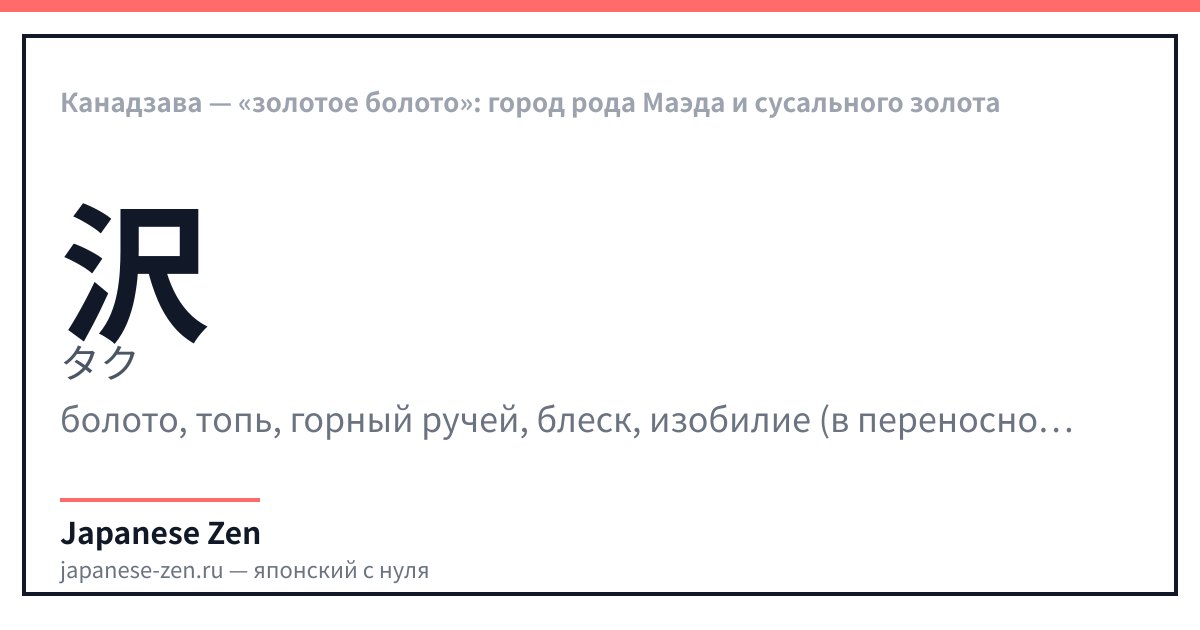
沢 means "marsh, bog, mountain stream," and figuratively "luster, grace." The radical on the left, 氵, is the same as in other characters related to water and points to the original meaning "a damp, wet place."
沢 — значение: marsh, bog, mountain stream, luster, abundance (figuratively) — онъёми: タク — кунъёми: さわ、うるお.い、うるお.す、つや — 7 штрих(ов). 沢 — "marsh, stream": the second character in the name Kanazawa, the very body of water where gold was found according to legend. The same character appears in the everyday word 贅沢, "luxury."
沢山 — "a lot": the marsh you can't see
沢山 is read たくさん (takusan) and means "a lot, plenty." The word is read with the on readings of the characters — タク and サン — and the image of "marshes and mountains," if it ever stood behind it, has long been worn away: a Japanese speaker just hears "a lot." With the name Kanazawa it's the opposite — the character 沢 in it is read the Japanese way, さわ, and keeps its literal meaning.
| Japanese | Reading | Translation |
|---|---|---|
| 金沢 | Kanazawa · Kanazawa | Kanazawa — the city's name itself |
| 沢山 | takusan · takusan | A lot — an everyday word with the character for "marsh" |
| 金 | kin · kin | Gold — the first character in the city's name |
| 兼六園 | Kenroku-en · Kenroku-en | The garden of "six virtues" next to Maeda Castle |
| 忍者寺 | ninja-dera · ninja-dera | The popular nickname of Myoryu-ji temple |
Trace 沢 along the guides — the character for "marsh," the second in the name Kanazawa.
FAQ
- What does the name "Kanazawa" mean?
- 金沢 literally means "golden marsh": 金 is "gold," 沢 is "marsh, stream." According to legend, a poor man here was washing a wild sweet potato in a forest stream and found gold sand in the water — that's how the stream got its name, and then passed it on to the city.
- Is it true that the city's name is just a legend?
- Not only: the first written mention of the word "Kanazawa" dates to 1546 and refers to a Buddhist temple, not a city. The legend of gold washing is prettier than the documents, but the 1546 record is the most reliable evidence that the name existed even before the castle.
- What is "Kaga hyakuman-koku"?
- That's what the Maeda clan's domain was nicknamed when its rice yield assessment in the provinces of Kaga, Noto, and Etchu passed a million koku. This happened after 1600, under the son of the house's founder Maeda Toshiie, and Kaga became the largest domain after the Tokugawa themselves.
- How much gold leaf is produced in Kanazawa?
- According to the Japan National Tourism Organization, more than 99% of the country's gold leaf. The craft is said to date back to the 1590s, and in 2020 the traditional method of making the sheets was added to a UNESCO intangible heritage listing on the crafts of wooden architecture.
- Why is Myoryu-ji temple called "ninja-dera"?
- Not because of real ninja, but because of its layout: the temple has many hidden staircases, traps, and false doors. The nickname is popular — no ninja lived here, and the unusual design is usually explained by the temple possibly serving as a hidden defensive point.
- Which characters is "Kanazawa" written with?
- 金沢, read かなざわ. 金 means "gold," 沢 means "marsh, stream." Together the name describes the legendary stream where gold sand is said to have been found — today that place survives in Kenroku-en garden as the Kinjo Reitaku spring.
Sources
Updated: 2026-09-15