Kyoto: a thousand years of capital, a grid of streets and the word "miyabi"
Kyoto is a city in western Japan with a tautological name: 京都 literally means "capital", and both characters, 京 and 都, mean the same thing on their own. Japan was governed from here from 794 until the court moved to Tokyo in 1868–1869 — more than a thousand years in a row. The court culture of the Heian period is still described here with the word "miyabi" — refined, exquisite taste.
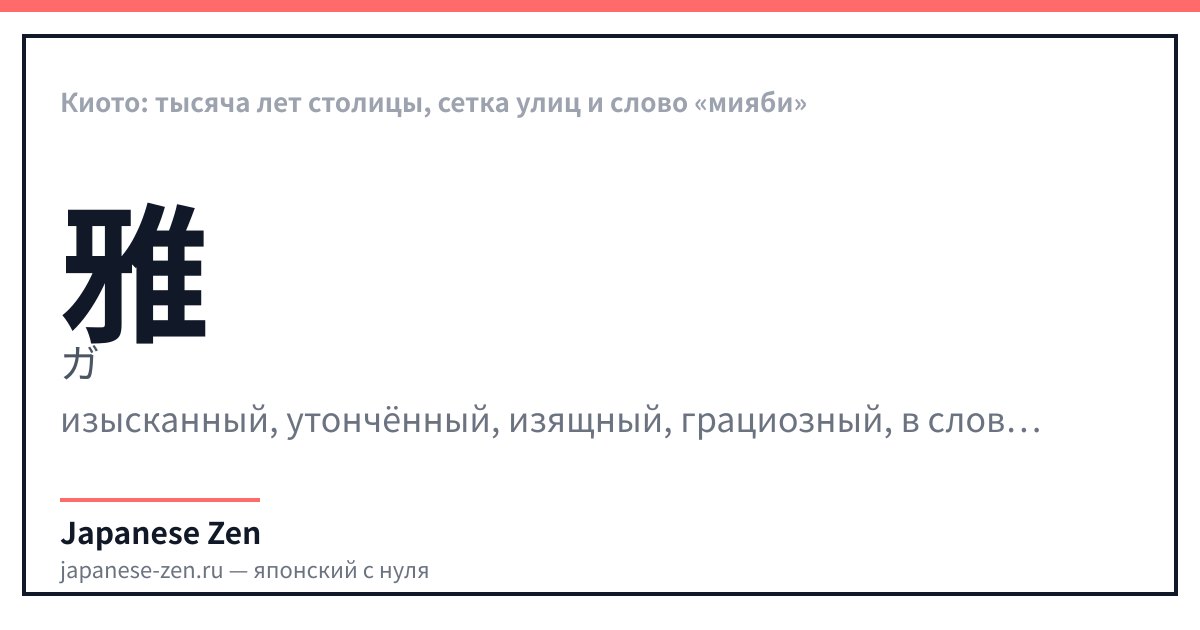
Let's look at why the name 京都 is essentially "capital of capitals", and how the word "miyabi" grew out of this name in the language, which in Kyoto still describes taste and style. We'll find out where the famous street grid came from, what the geiko of the Gion district and the Kyoto dialect have to do with it, and why the court's move to Tokyo in 1868–1869 was never formalized by an official decree. And at the end — the character 雅, which will tell you more about this city than the characters of its name.
Heian-kyō, which over time became simply "the capital"
In 794, Emperor Kanmu moved the capital to the new city of Heian-kyō, "the capital of peace and tranquility". For more than a thousand years it was the only true capital city of the country, and over time it came to be called simply "Kyō", "the capital", and then — 京都, the same word repeated twice with different characters. The same character 京, "capital", also stands in the second syllable of the name Tokyo, 東京 — so both main cities of the country at least partly call themselves by the same word.
A street grid on the Chinese model
Heian-kyō was built according to the jōbō system — the city was divided by straight streets into a regular grid of blocks, and the model was the Chinese Chang'an of the Tang era. The city was symmetrical: Suzaku Avenue divided it into the left and right capitals, and those, in turn, into blocks. Many addresses in the center of present-day Kyoto are still named after the nearest intersection — a habit that goes back to the same rectangular layout of the city.
Geiko, crafts and the dialect that sets Kyotoites apart
Dozens of temples and shrines stand in the city and its surroundings; some of them are part of the UNESCO World Heritage list "Historic Monuments of Ancient Kyoto".
- Kinkaku-ji — a temple with a golden pavilion over a pond.
- Kiyomizu-dera — a temple above a waterfall with a famous wooden stage.
- Fushimi Inari — a shrine with tunnels of thousands of scarlet torii.
- Arashiyama — a district in the west of the city, known for its bamboo grove and the Togetsukyō bridge.
Gion and the dialect you can hear right away
Gion is a district by the Yasaka Shrine, one of the five Kyoto hanamachi where geiko and maiko still work: that is what artists are called here, who in other regions are more often called geisha. Kyoto has also preserved its own dialect, the Kyoto dialect: it is softer than the standard Tokyo literary language, with its own forms of politeness and intonation. The city also lives by crafts — from yūzen textile dyeing to Kiyomizu-yaki porcelain.
794 with a decree, 1868–1869 — without one
Heian-kyō became the capital by the direct decree of Emperor Kanmu in 794, after a short stop in Nagaoka-kyō. After that the city remained the residence of the imperial court for almost a thousand years, although real power repeatedly passed to shoguns. The hardest blow to the city was the Ōnin War of 1467–1477: the capital turned into the main battlefield for ten years, and its blocks burned later as well — in the fire of 1788 and during the unrest of 1864. In 1994, some of the city's temples, shrines and Nijō Castle were added to the UNESCO World Heritage list as "Historic Monuments of Ancient Kyoto".
Why the move to Tokyo has no decree of its own
In 1868, Edo was renamed Tokyo, in the same year the emperor traveled there for the first time, and in 1869 he moved again — together with the government bodies. But historians find no formal decree that would have stripped Kyoto of its capital status: that is why in Japanese this event is more often called not a "transfer of the capital" but the "establishment of another capital" — and in Kyoto this subtlety is recalled with pleasure.
雅 — a word about refinement that explains the tone of the city better than its name
京 and 都 separately mean the same thing, "capital": 京 has the kun reading みやこ, and 都 has the same みやこ. Neither of these characters tells anything about the city except its status, so for the language card another character was chosen — 雅, which stands in the word 雅び, "miyabi".
雅 — значение: exquisite, refined, elegant, graceful, in the word miyabi — the courtly taste of the Heian era — онъёми: ガ — кунъёми: みや.び — 13 штрих(ов). 雅 is not part of the name Kyoto itself, but the word 雅び (miyabi) — "refinement, exquisite taste" — still describes the court culture of Heian-kyō and the special sense of style for which the city is famous.
The on reading ガ and the kun reading みやび
The on reading of 雅 is ガ (ga), it appears in ordinary words like 優雅, "grace, elegance", and 風雅, "refined artistic taste". The kun reading is みやび (miyabi): since the Heian era this word has been used to describe everything capital, courtly, exquisite — as opposed to "rustic", coarse.
| Japanese | Reading | Translation |
|---|---|---|
| 京都 | Kyōto · Kyōto | Kyoto — the name of the city itself |
| 雅び | miyabi · miyabi | Miyabi — the courtly refinement of the Heian era |
| 優雅 | yūga · yūga | Grace, elegance — an ordinary word with the same character 雅 |
| 風雅 | fūga · fūga | Refined artistic taste |
| 平安京 | Heian-kyō · Heian-kyō | Heian-kyō — the ancient name of the city, "the capital of peace and tranquility" |
| 祇園 | Gion · Gion | Gion — the district of geiko and maiko |
Write 雅 along the guides — the character of "refinement" that stands in the word miyabi and explains the taste of courtly Kyoto better than the characters of its name.
FAQ
- What kind of city is Kyoto and what is it famous for?
- Kyoto is a city in the Kansai region that remained the capital of Japan for more than a thousand years. Today it is a center of traditional culture: dozens of temples and shrines, the Gion district of geiko and maiko, crafts like yūzen textiles and its own recognizable Kyoto dialect.
- What does the name "Kyoto" mean?
- 京都 literally means "capital": both characters, 京 and 都, are read separately as みやこ and mean the same thing. This happened because for almost a thousand years the city had no other name besides a description of its status — over time that description became its proper name.
- How many years was Kyoto the capital of Japan?
- More than a thousand years: from 794, when Emperor Kanmu moved the court here, until 1868–1869, when the court and government moved to Tokyo. At the same time, historians find no formal decree that would have stripped Kyoto of its capital status — the move was made without one.
- Why are the streets in central Kyoto laid out in a grid?
- The city was originally planned according to the jōbō system — straight streets divided it into regular rectangular blocks on the model of the Chinese Chang'an of the Tang era. Many addresses in central Kyoto are still named after the nearest intersection — an echo of the same layout logic.
- What does the word "miyabi", used to describe Kyoto, mean?
- 雅び, "miyabi", is the aesthetic ideal of the court culture of the Heian era: refinement, grace, a capital rather than rustic taste in everything — from clothing to poetry. Today this word describes the special atmosphere of Kyoto inherited from that era.
- How do geiko in Kyoto differ from geisha in other cities?
- Essentially nothing but the name: "geiko" is the Kyoto word for artists who in Tokyo and other regions are more often called geisha. They work mainly in the Gion district and other hanamachi of the city, where their own tradition of training in this craft is preserved.
Sources
Updated: 2026-09-15