Kannon — Bodhisattva of Compassion: Goddess or God, and Where the Thousand Arms Come From
Kannon (観音) is the Japanese name of the bodhisattva Avalokiteshvara, the embodiment of boundless compassion in Mahayana Buddhism: she is believed to hear the pleas of those who suffer and respond to them at once. Most statues of Thousand-Armed Kannon actually have 42 arms, not a thousand. In 1934 the same name was given to the first prototype of the Canon camera — Kwanon, an older romanization of the same name.
It is easy to hear three mutually exclusive things about Kannon: that she is a goddess, that she is a Buddha, and that the statues really do have a thousand arms. Let us sort out who Kannon actually is, how she differs from goddesses and from the Buddha, where in Japan her most famous statues are found, and what cameras have to do with it.
Who Kannon Is and Why She Has So Many Forms
Kannon (観音) is the Japanese name of the bodhisattva Avalokiteshvara, one of the most revered figures in Mahayana Buddhism. The full name is Kanzeon (観世音), "the one who contemplates the sounds of the world": the bodhisattva is believed to hear the pleas of those who suffer and to respond with compassion, without waiting for her own final entry into nirvana.
Five Forms of a Single Kannon
- 千手観音 — Thousand-Armed, the embodiment of boundless compassion.
- 十一面観音 — Eleven-Faced: the faces on her head look in all directions.
- 馬頭観音 — Horse-Headed, patron of animals and travelers.
- 如意輪観音 — with the wish-fulfilling jewel and the wheel of the teaching.
- 聖観音 — "simple" Kannon without extra heads or arms, the earliest form.
Is Kannon Male or Female?
Kannon's gender is a question not of biography but of iconographic tradition: in India Avalokiteshvara was more often depicted as a male deity, while in East Asia, including Japan, the statues gradually acquired soft, feminine features. Calling Kannon simply a "goddess" is imprecise: in Buddhist texts the bodhisattva takes whatever form is needed by the one being saved — male or female.
During the persecution of Christianity, secret believers — the Kakure Kirishitan — hid their veneration of the Virgin Mary behind statuettes of Kannon holding a child; such "Maria-Kannon" figures gave no outward sign of their true object of worship.
Where in Japan the Most Kannon Statues Are Found
In the Kyoto temple Sanjusangen-do, 1001 life-size statues of Thousand-Armed Kannon stand along the walls of the hall, with a larger statue by the workshop of a 13th-century sculptor in the center. Despite the name "thousand-armed," the central statue and most of the statues in the rows have 42 arms: two are clasped in prayer, and the other forty symbolically stand in for a thousand. In Buddhist reckoning, each of the forty arms saves twenty-five worlds, and forty times twenty-five gives a thousand.
At Tokyo's Senso-ji, the city's oldest Buddhist temple, the main sacred image is also dedicated to Kannon: according to legend, two fisherman brothers caught the statue in a river in 628. The statue itself is "absolutely hidden": it is never shown at all, and once a year, on December 13, only its "substitute" is unveiled — a statue attributed to the monk Ennin.
Japan's oldest pilgrimage route, the Saigoku, also leads to Kannon: thirty-three temples in Kansai and Gifu. The number thirty-three comes from the Lotus Sutra: it says that Kannon appears to those who suffer in thirty-three forms.
Kannon and Canon Cameras
In 1934 the Japanese company Seiki Kōgaku released a prototype 35-millimeter camera under the name Kwanon — an older romanization of the name Kannon. A year later the firm registered the more internationally appealing name Canon, and in 1947 it became the official name of the whole company.
Why Sounds Are "Contemplated": 観 and 音 in the Name Kannon
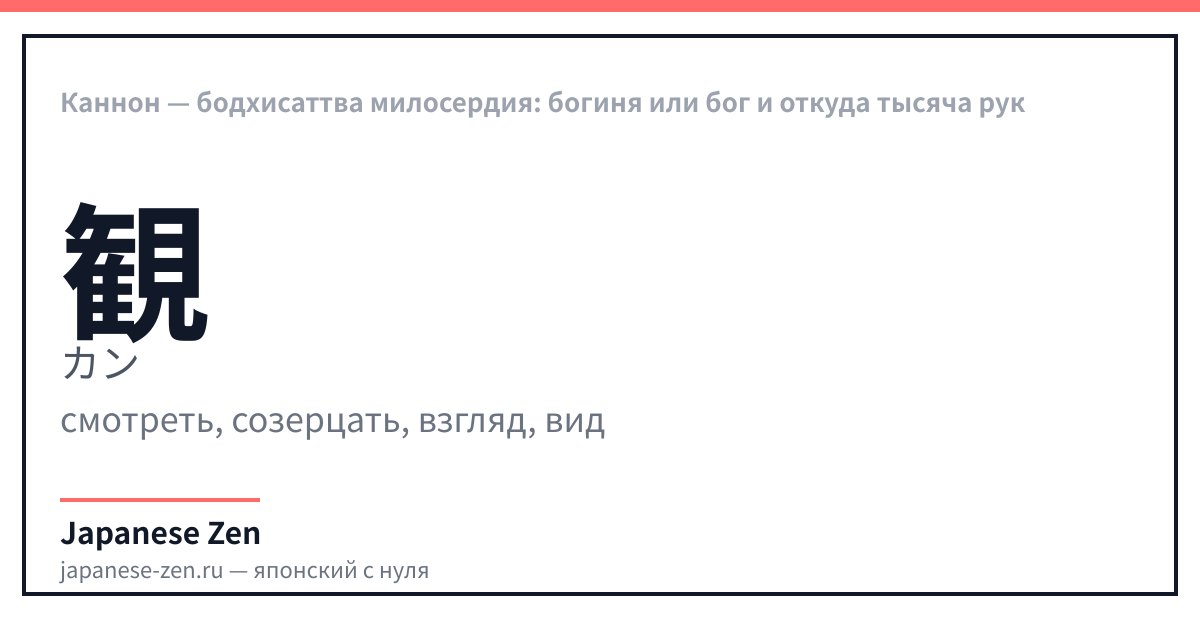
観 — значение: to look, to contemplate, view, appearance — онъёми: カン — кунъёми: み.る、しめ.す — 18 штрих(ов). 観 — "to look, to contemplate": the first character in the name Kannon. The same character appears in 観光 (tourism) and 観察 (observation).
観音 literally means "contemplating sounds": 観 "to look, to contemplate" plus 音 "sound." The traditional interpretation: the bodhisattva does not merely hear the pleas of those who suffer but sees through them, perceiving sound as an image. In the Heart Sutra there is a related name — 観自在, "freely contemplating": a translation of the same Sanskrit name made by a different translator, while the earlier 観世音 belongs to the translator Kumarajiva.
観光 — "Contemplating the Splendor of a Country," Not Just "Tourism"
The word kankō (観光, "tourism") goes back to the ancient Chinese Book of Changes: it contains the expression "to contemplate the splendor of a country" — to appreciate its culture and order. In Japanese this combination arrived as a ready-made word long before tourism in the modern sense, and only later narrowed to travel for impressions.
| Japanese | Reading | Translation |
|---|---|---|
| 観音 | Kannon · Kannon | Kannon |
| 観世音 | Kanzeon · Kanzeon | Full name of Kannon |
| 観自在 | Kanjizai · Kanjizai | "Freely contemplating" — the name of Kannon in the Heart Sutra |
| 観光 | kankō · kankō | Tourism |
| 千手観音 | Senju Kannon · Senju Kannon | Thousand-Armed Kannon |
| 聖観音 | Shō Kannon · Shō Kannon | Kannon in simple form, without extra arms and faces |
Write 観 along the guides — the first character in the name Kannon.
Not Shinto, Not a Buddha, and Not Literally a Thousand Arms
- "Kannon is a Shinto goddess." Kannon belongs to the Buddhist, not the Shinto, tradition: a bodhisattva, not a kami. The confusion arises because for centuries the Japanese venerated both side by side, sometimes in the same temple complex.
- "Kannon is a Buddha." Bodhisattva and Buddha are different statuses: a Buddha has attained full liberation, while a bodhisattva like Kannon deliberately remains among suffering beings to help them with compassion.
- "Thousand-Armed Kannon really has a thousand arms." Most statues, including the central one at Sanjusangen-do, have 42 arms: the two main ones are clasped in prayer, and the other forty symbolically represent a thousand.
FAQ
- Who is Kannon?
- Kannon is the name used in Japan for the bodhisattva Avalokiteshvara: the bodhisattva is believed to respond to the plea of anyone who calls this name. The full name, Kanzeon, translates as "the one who contemplates the sounds of the world."
- Is Kannon a goddess or a god?
- Neither, strictly speaking: Kannon is not a deity but a bodhisattva, and in Buddhist texts she takes both male and female form. In India Avalokiteshvara was more often depicted as male; in East Asia his appearance gradually became feminine.
- Why does Kannon have a thousand arms?
- In fact the vast majority of statues have 42 arms, not a thousand: the two main ones are clasped in prayer, and the other forty symbolically stand in for the missing arms — in Buddhist interpretation, each one helps in many worlds at once.
- Where in Japan are the most famous Kannon statues?
- Sanjusangen-do in Kyoto — 1001 statues of Thousand-Armed Kannon along the walls of the hall; Senso-ji in Tokyo, where Kannon is the main sacred image; and the Saigoku pilgrimage route of thirty-three temples dedicated to her in Kansai and Gifu.
- Is it true that Canon is named after Kannon?
- Yes: in 1934 the Japanese company released a prototype camera under the name Kwanon — a romanization of the name Kannon. A year later the similar-sounding brand Canon was registered for the world market.
- How is "Kannon" written in kanji?
- 観音, read かんのん. The first character 観 means "to look, to contemplate," the second 音 means "sound": together — "the one who contemplates the sounds of the world." In the Heart Sutra there is a rarer variant of the name — 観自在, "freely contemplating."
Sources
Updated: 2026-09-14