Jizō — who he is: stone statues in red bibs along Japan's roads
Jizō (地蔵) is the bodhisattva Kṣitigarbha, protector of travelers, children, and the dead: a small stone figure with a shaved head, found in Japan along roads, in cemeteries, and in temple courtyards. The red bibs on the statues are not part of canonical attire but offerings from parents asking to keep a child from harm. The name literally means "earth treasury."
Jizō statues are encountered in Japan more often than any other Buddhist image, but tourists rarely know who they are seeing. Let's look at the origin of the bodhisattva's name, the most famous folktale about him, the meaning of the six figures on city outskirts, and why stone statues are dressed at all.
The Bodhisattva by the Roadside: Whom Jizō Protects
Jizō (地蔵) is the bodhisattva Kṣitigarbha, protector of travelers, children, and the dead, one of the most recognizable figures of Japanese Buddhism: a small stone figure with a shaved head, often wearing a red bib or cap. The name comes from the Sanskrit Kṣitigarbha: "kṣiti" means "earth," "garbha" means "womb, receptacle" — literally "womb of the earth," "earth treasury."
Why the Statues Wear Red Bibs
The red bibs (yodarekake) and caps on Jizō statues are offerings from parents and relatives, not part of the bodhisattva's canonical attire: they are put on in gratitude or with a request to protect a child from harm. In Japanese tradition, the color red is associated with protection from evil forces.
A separate, more somber side of the Jizō cult is mizuko kuyō, the memorial service for children who never saw the light: miscarriages, stillbirths, abortions. Such services are requested at Buddhist temples, and small Jizō statues in the cemeteries of these temples in Japan are often placed specifically for this purpose.
Jizō in Legends and Folktales: From the Sai River to the Six Guardians
According to Buddhist belief, the souls of children who die before their parents go to the banks of the Sai River — Sai no Kawara — and pile up stones in memory of their parents, but demons destroy them again and again. In one version of the legend, it is Jizō who comes to comfort the children and shelters them under the folds of his robe from the demons.
The most famous folktale about Jizō is "Kasa Jizō," "Jizō in Straw Hats." A poor old man, having sold none of his hats on New Year's Eve, puts them on six roadside statues freezing under the snow, and for one that has no hat left, he ties his own towel around its head. At night the old couple hears a noise at their house — it is the Jizō bringing them food and gifts in gratitude for his kindness.
The Six Jizō and the Festival in His Honor
The number six in the tale is no accident: Jizō is believed to protect all six realms of rebirth in Buddhist cosmology, and by tradition his statues are placed in groups of six — roku Jizō. In Kyoto, the custom of visiting six such groups at the old entrances to the city survives; the tradition is traced back to the Hōgen period, the second half of the 12th century. Another festival, Jizō-bon, is celebrated around his memorial day, August 24, primarily in Kyoto and the Kansai region as a whole — with treats for children at roadside statues.
Jizō statues also appear frequently in film. In "My Neighbor Totoro" (1988, Studio Ghibli), Satsuki and Mei take shelter from the rain under the roof of a small roadside shrine with a Jizō.
Why Jizō Stands by the Roads
The roadside location is not just a matter of convenience for travelers: Jizō is believed to guard boundaries — between village and forest, between this world and the next. According to one interpretation, he partly inherited this role from local Shinto road deities, the dōsojin, with whom his image merged over time at many crossroads.
Storehouse, Granary, and Refrigerator: The Character 蔵 in Everyday Life
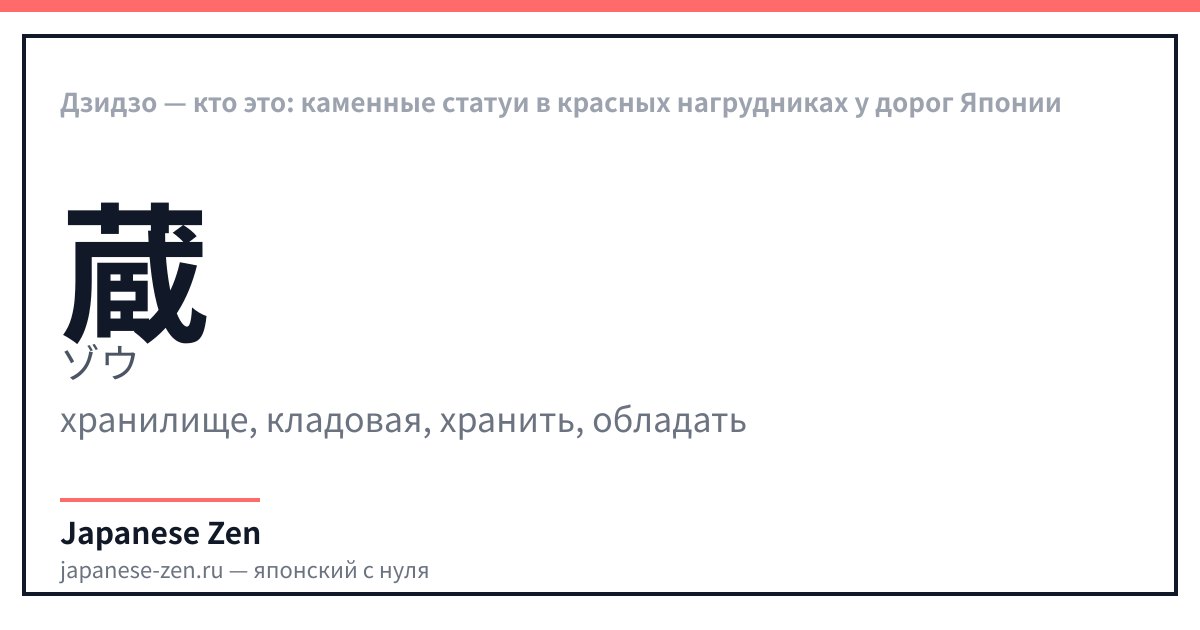
蔵 — значение: storehouse, granary, to store, to possess — онъёми: ゾウ、ソウ — кунъёми: くら、おさ.める、かく.れる — 15 штрих(ов). 蔵 — "storehouse, treasury": the second character in Jizō's name and a calque of the Sanskrit "garbha," "womb, receptacle."
地蔵 = 地 "earth" plus 蔵 "storehouse, treasury" — a literal translation of the Sanskrit name Kṣitigarbha, "earth treasury": the bodhisattva is believed to hold within himself the same boundless compassion with which the earth holds the seeds of future life. The same character 蔵 on its own means "granary, storehouse" and appears in 冷蔵庫, "refrigerator," literally "cold storehouse."
"O-Jizō-san" — an Affectionate Address, Not Just Politeness
The prefix お- and the suffix -さん are not only for people: they are used to affectionately name things that are close and familiar — お月さん (o-tsuki-san, the moon), お稲荷さん (o-Inari-san). A Jizō statue is almost always called o-Jizō-san — like a kind neighbor, not an abstract symbol.
| Japanese | Reading | Translation |
|---|---|---|
| 地蔵 | Jizō · Jizō | Jizō |
| 地蔵菩薩 | Jizō bosatsu · Jizō bosatsu | Bodhisattva Jizō, full name |
| お地蔵さん | o-Jizō-san · o-Jizō-san | Affectionate name for Jizō statues |
| 蔵 | kura · kura | Granary, storehouse, treasury |
| 冷蔵庫 | reizōko · reizōko | Refrigerator |
| 六地蔵 | roku Jizō · roku Jizō | Six Jizō at the entrance to a city |
Write 蔵 along the guides — the second character in Jizō's name, "storehouse."
Roadside Jizō Is Neither a Kami Nor a Gravestone
- "Jizō is a Shinto kami." Jizō is a figure of the Buddhist tradition, the bodhisattva Kṣitigarbha; the confusion arises from the roadside placement of the statues, which is also typical of Shinto deities like the dōsojin.
- "Jizō statues by the roads are gravestones." Most roadside statues do not mark a specific burial but serve as general protection for the journey and as a memorial to children who were never born or died young; actual gravestones in Japan look different.
- "Jizō is the patron of children only." Originally and primarily, Jizō is the protector of all who are in danger or suffering, including travelers; care for children is only one, though today the most visible, of his roles.
- "The red bib is an obligatory part of Jizō's appearance, prescribed by canon." The clothing on the statues is put on by laypeople of their own accord, in gratitude or as a request, not by religious prescription: statues with no bibs at all are also found.
FAQ
- Who is Jizō in Japan?
- Jizō is one of the most revered bodhisattvas of Japanese Buddhism, whose Sanskrit name is Kṣitigarbha. Stone figures with shaved heads and red bibs in his honor stand along roads, in cemeteries, and in temple courtyards throughout the country — he is believed to protect travelers, children, and the dead.
- Why do Jizō statues wear red bibs?
- The bibs (yodarekake) are put on by the believers themselves — in gratitude or with a request to protect a child from harm, not by religious prescription. In Japan, the color red has long been associated with protection from evil forces.
- Why are Jizō statues placed by the roads?
- Jizō is believed to guard boundaries — between village and forest, between this world and the next. One explanation links this role to local Shinto road deities, the dōsojin: at many crossroads their image merged with Jizō's over time.
- What is the most famous folktale about Jizō?
- "Kasa Jizō" — about a poor old man who on New Year's Eve covers six roadside statues from the snow with his unsold straw hats and his own towel. At night, the Jizō bring the old man and his wife food and gifts in gratitude.
- How is Jizō different from Kannon?
- Both are figures of the Buddhist tradition, but with different roles. Kannon is the bodhisattva of compassion in the broadest sense, with many forms and shrines, while Jizō is primarily the protector of travelers, children, and the dead, whose image is recognized by a simple stone figure by the road.
- How is "Jizō" written in kanji?
- 地蔵, read as じぞう. The first character 地 means "earth," the second 蔵 means "storehouse, treasury": together they are a calque of the Sanskrit name Kṣitigarbha, "earth treasury."
Sources
Updated: 2026-09-14