Tanuki — the shapeshifting yokai: why its statues stand outside every tavern
The tanuki is a Japanese shapeshifting yokai: an aged raccoon dog that can transform, bewilder travelers, and drum on its distended belly with its paws. Unlike the cunning and dangerous kitsune, the tanuki plays pranks without malice, so it is sculpted as a good-natured fat figure in a straw hat with a bottle of sake. Such statues from Shigaraki have been placed at the entrances of shops and taverns for good luck since the mid-20th century.
In Japan, the tanuki is often confused with an ordinary raccoon or a badger, though in nature it is a separate animal — the raccoon dog. In folklore, it long outgrew zoology: the hero of the grim tale "Kachi-kachi Yama" and the kind "Bumbuku Chagama," the prototype for thousands of clay statues at tavern doors. Let's explore where this image came from, what the character 化 "to transform" has to do with it, and how the tanuki differs from the kitsune.
Tanuki: the raccoon dog that bewitches people
The tanuki (狸) is a rural shapeshifting yokai based on a very real animal: the raccoon dog of the genus Nyctereutes, found in Japan and on the mainland. Folk beliefs endow it with the ability to transform into humans and objects, to place a tree leaf on its head to strengthen its illusion, and to drum on its distended belly with its paws — this trick, 腹鼓, is often depicted in old prints. It differs from its neighbor the kitsune in temperament: the kitsune is cunning and truly dangerous, while the tanuki plays pranks without malicious intent and often ends up in a foolish position itself.
Why the tanuki is not a raccoon
The raccoon dog is not related to raccoons or badgers, but is a separate species in the canid family, resembling both due to its thick winter fur. The confusion existed in Japan itself: the tanuki was often also called "mujina" (貉), a word that in some regions referred to the badger and in others to the tanuki itself. In 1925, the dispute reached court: the Supreme Court acquitted a hunter who had taken a "mujina" outside the permitted hunting season for tanuki — in his area, these two words had always meant different animals.
A separate layer of legends about tanuki warlords developed on the island of Shikoku. In Tokushima Prefecture, a Shinto shrine still stands in honor of a tanuki named Kintyō — the hero of a story about a war between tanuki clans, told differently in various villages.
Shigaraki statues: how the tanuki became a talisman of commerce
The most recognizable image is the "boy buying sake": a good-natured fat figure in a woven hat, with a bottle of sake in one paw and an account book in the other. Such figurines are made from the reddish Shigaraki ware (信楽焼) — one of Japan's six oldest pottery centers.
- The hat — protection from unexpected misfortune.
- Big eyes — attentiveness to what is happening around.
- The smile — warmth toward the customer.
- The account book — a reminder that trust is the main thing in commerce.
- The sake bottle — good name and character.
- The round belly — composure and courage in business.
- The purse — luck in money.
- The thick tail — a task seen through to the end.
Why the tanuki is a talisman of commerce
The most common explanation is a pun: the name "tanuki" is said to echo the phrase "to surpass others," so the figurine is kept at shop entrances for good luck in business. This is indeed a pun, not a scholarly etymology of the word, but it explains the custom well. However, the status of the Shigaraki tanuki as a national symbol is younger than it seems. Shigaraki tanuki truly became famous nationwide in 1951. That year, Emperor Hirohito, during a postwar tour, noticed them along the road with small flags in their paws and composed a poem about it — the story was picked up by newspapers.
Tanuki in fairy tales, "Pom Poko," and video games
"Bumbuku Chagama" (分福茶釜) ends much more kindly: a tanuki that transformed into a tea kettle, out of gratitude, walks a tightrope at the performances of a poor junk dealer, and afterward returns to Morin-ji temple as a precious relic. "Kachi-kachi Yama" is darker: the tanuki cruelly deceives a peasant and his wife, and is then punished by a rabbit — the plot is so harsh that children's books usually soften it.
Tanuki in 20th-century animation and games
In 1994, Studio Ghibli released the animated film "Pom Poko" (平成狸合戦ぽんぽこ) directed by Takahata Isao: tanuki master the ancient art of transformation to defend their native forest from development. And even earlier, in 1988, the tanuki made it into video games — the tanuki suit in Super Mario Bros. 3 allowed Mario to fly and temporarily transform into an invincible statue.
化 — the character of transformation used to describe the tanuki's tricks
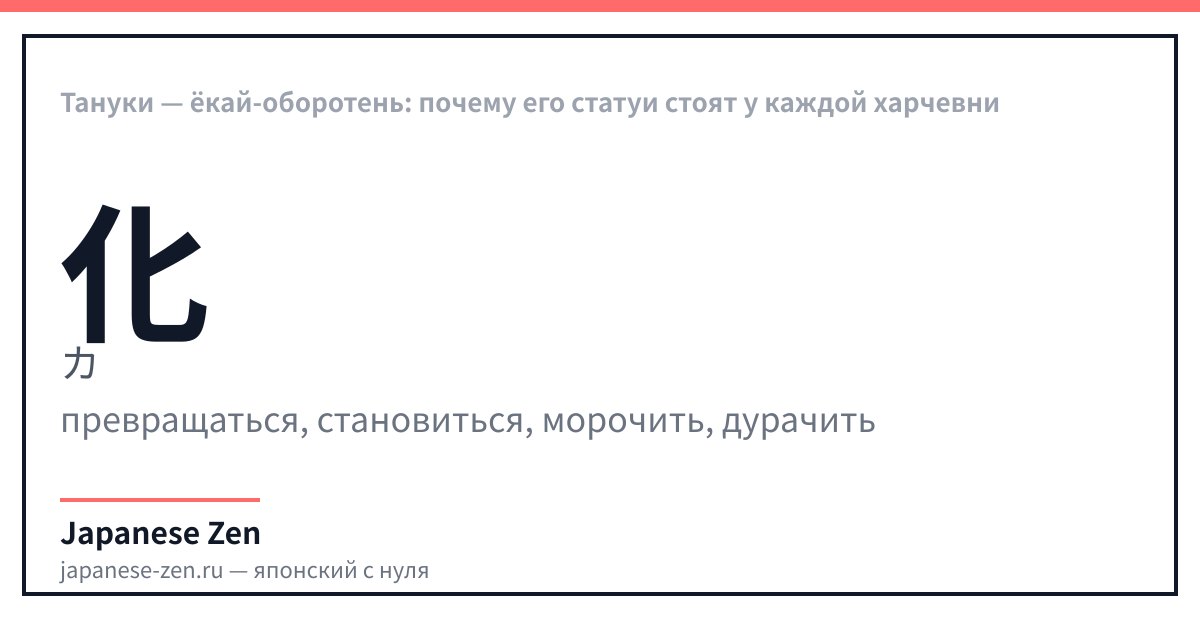
化 — значение: to transform, to become, to bewitch, to deceive — онъёми: カ、ケ — кунъёми: ば.ける、ば.かす、ふ.ける、け.する — 4 штрих(ов). 化 — "to transform, to bewitch": on the left is the person radical 亻, on the right an "inverted person," together "a changing person." This is the character in the verbs 化かす and 化ける, which describe all the tanuki's tricks.
The word "tanuki" itself is written with the rather rare kanji 狸 (たぬき), whose on-reading is リ, and it appears almost nowhere except in this word. The animal's main skill is described by another character — 化: 狸に化かされる "to be deceived by a tanuki" and 化ける "to turn into someone else."
| Japanese | Reading | Translation |
|---|---|---|
| 狸 | tanuki · tanuki | Tanuki, the shapeshifting raccoon dog |
| 化ける | bakeru · bakeru | To transform, to take on another's form |
| 狸寝入り | tanuki neiri · tanuki neiri | To pretend to be asleep or dead |
| 取らぬ狸の皮算用 | toranu tanuki no kawazan'yō · toranu tanuki no kawazan'yō | To count the skin of a tanuki not yet caught |
| 信楽焼 | Shigarakiyaki · Shigarakiyaki | Shigaraki ware with tanuki statues |
| 八相縁起 | hassō engi · hassō engi | The eight lucky signs on tanuki statues |
Proverbs about the tanuki: sleep and skin
The tanuki also left its mark in sayings: 狸寝入り — "to sleep like a tanuki," that is, to pretend to be asleep or dead, as the animal actually does when it hears a hunter's shot. And 取らぬ狸の皮算用 is a joke about someone counting the skins of tanuki not yet caught; the English equivalent is "to count one's chickens before they hatch."
Write 化 along the guides — the character with which the tanuki "bewitches" the whole world.
FAQ
- Who is the tanuki in Japanese mythology?
- The tanuki is a rural yokai embodied in the form of a raccoon dog: it is believed that with age it learns to transform into people and objects, and a leaf on its head helps it cast a stronger illusion. Its nature is not evil — unlike the cunning and dangerous kitsune, the tanuki more often ends up in a fix itself than seriously harms people.
- Is the tanuki a raccoon or a badger?
- Neither: the tanuki is a raccoon dog of the genus Nyctereutes, a separate species in the canid family. It resembles both a raccoon and a badger due to its thick winter fur, and in Japan itself it was confused for centuries with the "mujina" — in different regions that name referred either to the tanuki or to the true badger.
- Why are tanuki statues placed at the entrances of restaurants and shops?
- According to a popular pun, the name "tanuki" echoes the phrase "to surpass others," so the figurine is kept for good luck in commerce. Every detail of a Shigaraki ware statue also symbolizes something: the hat — protection from misfortune, the sake bottle — a good name, and the book in its paw — the trust of customers.
- What fairy tales are there about the tanuki?
- The kindest is "Bumbuku Chagama": a tanuki-kettle thanks a poor junk dealer with tightrope performances. The harshest is "Kachi-kachi Yama" with a cruel revenge. And in the 20th century, Studio Ghibli's animated film "Pom Poko" (1994) was added to them, about tanuki trying to protect their forest from development.
- How does the tanuki differ from the kitsune?
- In temperament: the kitsune is cunning and in legends can be truly dangerous, while the tanuki plays pranks without malice and often ends up in a foolish position itself. Both are shapeshifting animals, but the kitsune is considered clever and sly, while the tanuki is good-natured and a bit absurd.
- How is "tanuki" written in Japanese?
- 狸, read as たぬき. It is a rather rare kanji with the on-reading リ, which appears almost nowhere except in this word. The animal's main skill is described by another character — 化 "to transform": from it come 化かす "to bewitch" and 化ける "to turn into."
Sources
Updated: 2026-09-15