Himeji Castle — the "White Heron": history, layout, and the name in kanji
Himeji Castle (姫路城) is the largest of Japan's castles whose main keep has survived in its original form. In 1993, together with Hōryū-ji Temple, it opened Japan's UNESCO World Heritage list. Its white walls and silhouette, as if about to take flight, earned it the nickname "White Heron." The castle's current appearance was shaped by Ikeda Terumasa between 1601 and 1609, after Tokugawa's victory at Sekigahara.
The history of Himeji Castle spans more than two and a half centuries: from a small fortification of the Akamatsu clan to the white-stone giant known today from photographs around the world. Let's break down how the name 姫路城 is composed of the characters for "princess," "road," and "castle," what survived the 1945 bombings, and in which films and games its walls appear.
Himeji Castle: the largest of the original Japanese castles
Himeji Castle (姫路城) is the largest of the twelve Japanese castles whose main keeps have survived in their original form, and a UNESCO monument since 1993. Its white plastered walls and silhouette with spreading wings earned it the nickname "White Heron Castle" — 白鷺城. Its current appearance did not emerge all at once: a small 14th-century fortification on Himeyama hill was rebuilt several times until Ikeda Terumasa, between 1601 and 1609, constructed the complex that survives today, with its main tenshu and a labyrinth of inner courtyards.
| Year | Event |
|---|---|
| 1346 | Akamatsu Sadanori builds a fortification on Himeyama hill |
| 1580–1581 | The castle passes to Hashiba (the future Toyotomi) Hideyoshi, who builds a three-story tenshu |
| 1601–1609 | Ikeda Terumasa rebuilds the castle in its current form |
| 1931 | The castle is designated a National Treasure |
| 1945 | An air raid burns the city, but the castle remains intact |
| 1993 | Together with Hōryū-ji Temple, it opens Japan's UNESCO World Heritage list |
| 2009–2015 | The "Heisei Grand Renovation" renews the plaster and roofing of the main tenshu |
Why it survived when other castles burned
Himeji was spared by both its materials and luck. The white plaster covers not only the walls but also the wooden structures, so fire and weather affect the castle less. And in the summer of 1945, when air raids burned the city, the castle stood firm: according to accounts, a bomb that pierced the roof of the main keep failed to explode.
姫路城: "the princess's road" or a name from an 8th-century chronicle
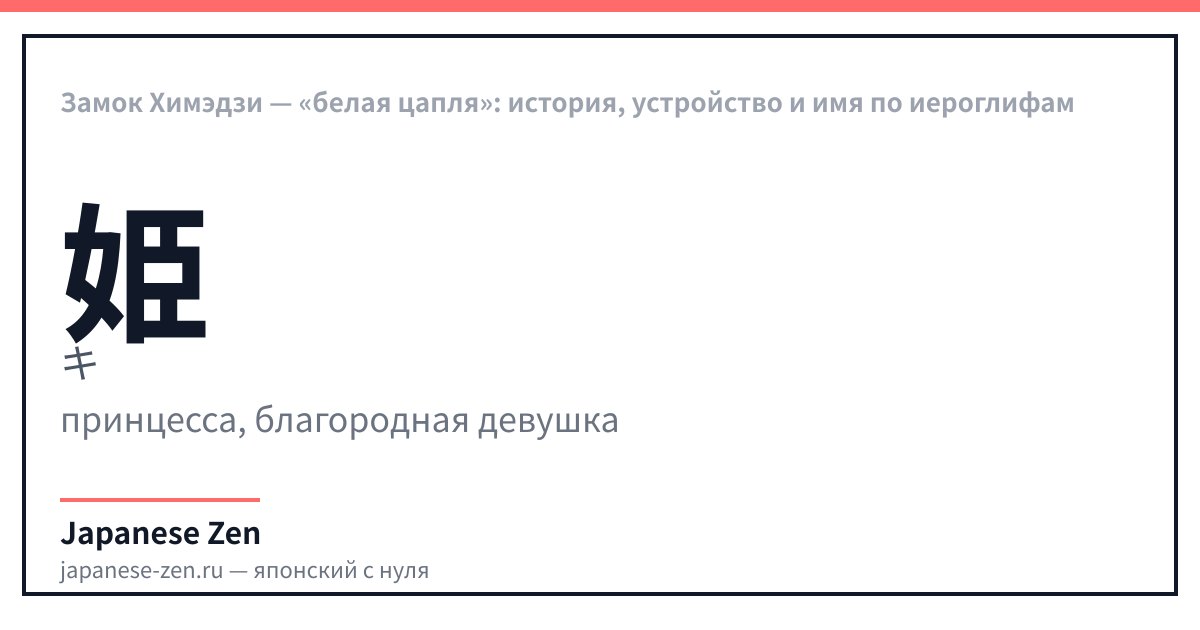
姫路城 is read ひめじじょう (Himeji-jō): 姫 means "princess, noble lady," 路 means "road, path," and 城 means "castle." The place name Himeji is older than the fortress itself: the 8th-century provincial chronicle Harima Fudoki calls the local hill 日女道丘 and links the name to a legend about silkworm cocoons washed ashore by a storm. Over time, 日女道 became the modern spelling 姫路 — this is folk etymology, not a strict linguistic reconstruction.
姫 — значение: princess, noble lady — онъёми: キ — кунъёми: ひめ、ひめ- — 10 штрих(ов). 姫 — "princess, noble lady": 10 strokes, the first character in the name of the castle and the city of Himeji.
| Japanese | Reading | Translation |
|---|---|---|
| 姫路城 | Himeji-jō · Himeji-jō | The castle's name |
| 白鷺城 | Shirasagi-jō · Shirasagi-jō | Nickname "White Heron Castle" |
| 天守 | tenshu · tenshu | The castle's main keep |
| 石垣 | ishigaki · ishigaki | Stone walls and foundations |
| 国宝 | kokuhō · kokuhō | National Treasure — the castle's status since 1931 |
The literal meaning of the name
Literally, 姫路城 means "castle of the princess's road": a beautiful combination, but most likely secondary to an older place name. Separately, 姫 as "princess" and 路 as "road" are the exact dictionary meanings of the characters, but historians do not confirm a connection between the place name and a real princess: it is more likely a later reading of an old name.
Write 姫 along the guides and study the stroke order.
The labyrinth of Himeji: gates, loopholes, and ishiotoshi
The path to Himeji's main keep is not a straight line but a labyrinth of narrow passages and inner courtyards: gates, dead ends, and nearly 180-degree turns were meant to confuse and delay attackers under the defenders' crossfire. The bases of the walls are ishigaki stone masonry, and the keep itself is a wooden frame coated with shikkui fire-resistant plaster, which is why the castle appears snow-white.
- 82 buildings under state protection: 8 of them are National Treasures, 74 are Important Cultural Properties
- A system of dozens of gates and winding passages between honmaru, ninomaru, and sannomaru
- Loopholes of various shapes — triangular, round, square — for different types of weapons
- Ishiotoshi — openings in the floor of wall projections through which defenders attacked assailants at the base
The legend of Okiku's well
In one of the inner courtyards, visitors are shown "Okiku's well." That was the name of a servant girl from the tale Banshū Sarayashiki: she was slandered, accused of losing a precious plate, killed, and thrown into the well. Since then, the legend says, the counting of plates can be heard from there at night. This is a legend, not a documented event.
Himeji Castle in film and games
- You Only Live Twice (007, 1967) — ninja training scenes were filmed around the castle, one of the film's main locations
- Kagemusha (1980) — Akira Kurosawa's historical epic
- Ran (1985) — another Kurosawa film shot with the castle's participation
- Assassin's Creed Shadows (Ubisoft, 2025) — Himeji Castle is one of the 1582 locations here
What the castle was like in 1582
Assassin's Creed Shadows is set in 1579–1582, during the lifetime of Oda Nobunaga. The white castle familiar from photographs did not yet exist: that appearance emerged in 1601–1609 under Ikeda Terumasa. In Nobunaga's time, a much more modest three-story tenshu built by Hideyoshi stood on the hill.
FAQ
- What is Himeji Castle?
- Himeji Castle (姫路城) is the largest surviving original Japanese castle, a UNESCO monument since 1993, and a National Treasure of Japan. The castle acquired the appearance that earned it the nickname "White Heron" in 1601–1609 under Ikeda Terumasa.
- Why is Himeji Castle called the "White Heron Castle"?
- The castle received the nickname 白鷺城 (Shirasagi-jō) for its white plastered walls and silhouette with spreading roofs, resembling a heron about to take flight. The shikkui plaster also protects the wooden frame from fire.
- Who built Himeji Castle in its current form?
- The first fortification on Himeyama hill was built in 1346 by Akamatsu Sadanori; in the early 1580s, Hideyoshi built a three-story tenshu. The white stone complex standing today was built in 1601–1609 by Ikeda Terumasa after the victory at Sekigahara.
- How is "Himeji Castle" written in Japanese?
- In Japanese it is 姫路城, read ひめじじょう (Himeji-jō): 姫 "princess," 路 "road," 城 "castle." The place name Himeji is older than the fortress itself and traces back to a legend from the 8th-century provincial chronicle Harima Fudoki about the hill 日女道丘. Today the characters are read literally, though a connection to a real princess is unconfirmed.
- When did Himeji Castle enter the UNESCO list?
- In December 1993. That was when Japanese sites first entered the World Heritage list — four at once: Himeji Castle and the Buddhist monuments of Hōryū-ji as cultural sites, and Yakushima Island and the Shirakami-Sanchi mountains as natural sites. Himeji was noted as the pinnacle of Japanese castle architecture with an almost untouched complex of buildings.
- In which films and games does Himeji Castle appear?
- The castle was filmed in the Bond movie You Only Live Twice (1967) and in Akira Kurosawa's films Kagemusha and Ran. It also appears in the game Assassin's Creed Shadows (2025), set in 1582 — two decades before its current white appearance.
Sources
Updated: 2026-09-13