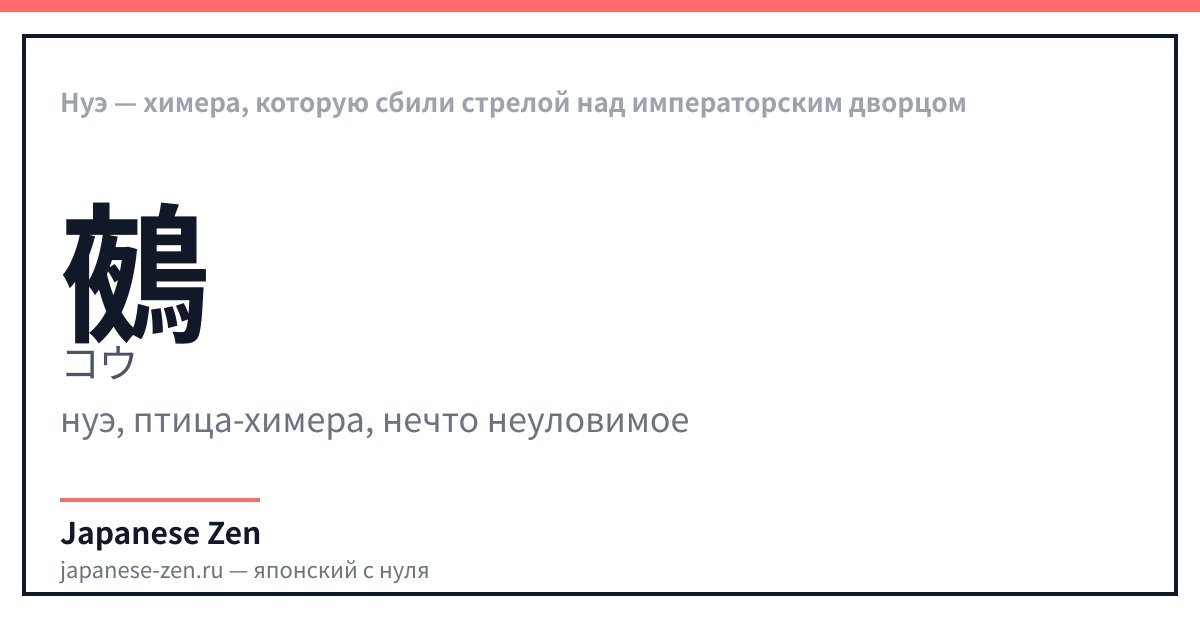
Nue — the chimera shot down with an arrow above the imperial palace
The nue is a chimera monster from Japanese legends: the head of a monkey, the legs of a tiger, the body of a tanuki, and the tail of a snake. In the 12th century, it was said to circle as a black cloud over the imperial palace in Kyoto until the warrior Minamoto no Yorimasa shot it down with an arrow. Since then, "nue" has also been a Japanese word for anything elusive and ambiguous.
For three nights in a row, a black cloud hung over the roof of the palace, and with it came a fever to the emperor — so begins one of the most bizarre hunts in Japanese mythology. Even by yokai standards, the nue is a creature made of odds and ends: a little from each of four different animals.
Who the nue is and what it looks like
The nue (鵺) is a composite monster from Japanese lore: the head of a monkey, the body of a tanuki, the legs of a tiger, the tail of a snake, and a voice like that of the toratsugumi thrush. This exact description, down to the bird that provides its voice, is given even in Japanese dictionaries. None of the four "donors" of the body is primary — the nue is not a tiger with someone else's head or a snake with someone else's legs, but precisely all of them at once.
- The head is a monkey's.
- The body is a tanuki's (raccoon dog's).
- The legs are a tiger's.
- The tail is a snake's, and the voice is like that of the toratsugumi thrush.
Is it dangerous
In the main legend, the nue does not attack directly — it appears as a black cloud over the roof at night, and with that cloud comes an inexplicable illness to the emperor. The danger here is not in its claws but in the very fact of its appearance: something that has no place in the usual order spoils health simply by its presence.
Night at the palace: how it was shot down with an arrow
The story is told in the Heike Monogatari. At the court of Emperor Konoe (the 76th), in the Ninpei years (1151–1154), black smoke began to rise at night over the Seiryō-den pavilion — the emperor's private chambers — and the sovereign fell ill. The task of killing the monster was assigned to the warrior Minamoto no Yorimasa: he shot into the darkness and hit, and his servant Ino Hayata finished off the wounded creature. As a reward, Yorimasa received the sword Shishiō.
What became of the archer
That same Yorimasa, almost three decades later, in 1180, raised a rebellion together with Prince Mochihito against the Taira clan — and with that rebellion began the Genpei War, which would end the entire Heian era. It is symbolic: the man who shot the nue is the same man who started the war destined to end an entire era.
鵺 — a character with the "bird" radical
The character 鵺 exists practically only for this word: it is assembled from the radical 鳥 "bird" and the phonetic 夜 "night" — literally "night bird." The name refers not to its appearance (the nue, as we already know, is far from entirely a bird) but to how it was heard in the darkness — by its cry.
鵺 — значение: nue, chimera bird, something elusive — онъёми: コウ、ヤ — кунъёми: ぬえ — 19 штрих(ов). 鵺 — "nue, chimera bird": 19 strokes, the radical 鳥 "bird" on the right, the phonetic 夜 "night" on the left. A rare character that appears almost nowhere except in this word.
| Japanese | Reading | Translation |
|---|---|---|
| 鵺 | nue · nue | Nue, the chimera monster |
| 鵺塚 | Nuezuka · Nuezuka | The Nuezuka mound in Osaka |
| 清涼殿 | Seiryō-den · Seiryō-den | The pavilion of the emperor's private chambers in Kyoto |
| 源頼政 | Minamoto no Yorimasa · Minamoto no Yorimasa | The warrior who shot the nue |
| 鵺的な | nue-teki na · nue-teki na | "Elusive, ambiguous" — about a person or a position |
Why this word today means "elusive"
In modern Japanese, 鵺的な describes not a monster but a person or a position: vague, without a clear shape, impossible to define unambiguously — for example, a politician who is neither fish nor fowl. The word inherited from the mythical nue its main property: assembled from recognizable parts, yet as a whole it fits no single category.
Write 鵺 along the guides and work through the stroke order.
Nue and Yamata no Orochi: how composite monsters differ
| Feature | Nue | Yamata no Orochi |
|---|---|---|
| Body | head of a monkey, legs of a tiger, body of a tanuki, tail of a snake | a serpent with eight heads and eight tails |
| Where it appears | as a black cloud over the imperial palace in Kyoto | at the Hi River in Izumo |
| How it was defeated | shot with a bow by Minamoto no Yorimasa | made drunk on sake and slain in its sleep by the god Susanoo |
| What remained after | the Nuezuka mound in Osaka, the word "nue-teki na" | the sword Kusanagi no Tsurugi — one of the three imperial regalia |
Why they are easily confused in retellings
In brief retellings, both are reduced to the common label "Japanese composite monster." But these are stories from different eras: Yamata no Orochi belongs to the age of the gods in the Kojiki and Nihon Shoki, while the nue belongs to a much later, almost historical episode of the Heian court in the Heike Monogatari. Different centuries, different genres of text — only the principle of "assembling a monster from parts of other animals" coincides.
FAQ
- Who is the nue?
- A composite chimera monster from Japanese lore: the head of a monkey, the body of a tanuki, the legs of a tiger, and the tail of a snake, with a voice like that of the toratsugumi thrush. According to the legend in the Heike Monogatari, it appeared at night as a black cloud over the imperial palace in Kyoto and brought illness upon the sovereign.
- What does the nue look like?
- The nue has the head of a monkey, the body of a tanuki (raccoon dog), the legs of a tiger, and the tail of a snake — this description is consistent in the Heike Monogatari and in modern Japanese dictionaries. A separate distinguishing feature is its voice, resembling the cry of the toratsugumi thrush, which is how it was noticed at night.
- When and where, according to legend, did the nue appear?
- According to the Heike Monogatari, at the court of Emperor Konoe, in the Ninpei years (1151–1154), black smoke rose for several nights in a row over the Seiryō-den pavilion — the emperor's private chambers in Kyoto — and with it the sovereign fell ill.
- Who killed the nue?
- The warrior Minamoto no Yorimasa shot at the monster with a bow in the darkness and hit it, and his servant Ino Hayata finished off the wounded creature. As a reward, Yorimasa received the sword Shishiō — a rare case where a yokai hunter is known by name and honored with a reward.
- Is it true that the word "nue" is still used in Japanese?
- Yes. The expression 鵺的な (nue-teki na) describes something elusive and ambiguous — for example, a politician's position that cannot be reduced to a clear formula. The word inherited from the monster its main property: assembled from recognizable parts, yet as a whole it reduces to nothing.
- How does the nue differ from Yamata no Orochi?
- Both are composite monsters, but from different layers of mythology: Yamata no Orochi is the eight-headed serpent from the age of the gods in the Kojiki and Nihon Shoki, while the nue is a chimera of four beasts appearing in a much later, almost historical episode of the Heian court.
Sources
Updated: 2026-09-10